


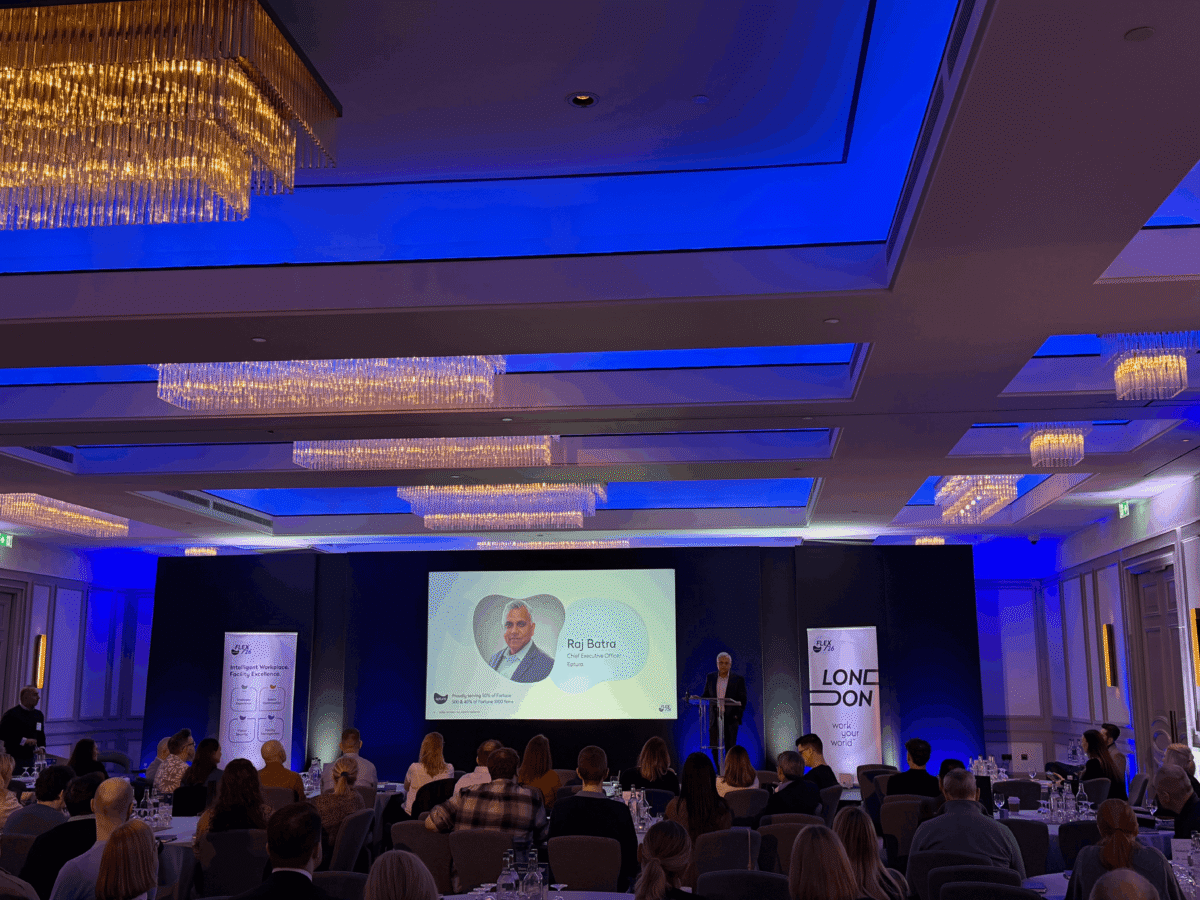
When workplace and facilities leaders gathered at our Flex/26 London event in early March, they came to connect with peers, learn about trending worktech innovations, and share best practices for navigating the changing work environment. What they discovered was that organizations have already crossed the “complexity threshold,” where traditional approaches to workplace management are no longer enough.
Although the group represented many different industries, including business services, insurance, legal, accounting, banking, finance, and technology, they grapple with the same fundamental challenges: managing hybrid work’s uneven demand, securing increasingly connected building systems, delivering seamless employee experiences, and making confident decisions without comprehensive data.
Key takeaways
- Workplace complexity has crossed a critical threshold where traditional management approaches no longer scale, as organizations face hybrid work patterns creating uneven demand, building systems becoming security vulnerabilities, and disconnected data preventing confident decisions. The solution rethinking how workplace operations connect and communicate.
- The most successful organizations are designing offices for experience and collaboration rather than simply providing desk inventory, dramatically reducing workstation counts while investing in social spaces that give employees compelling reasons to commute.
- Data has emerged as the essential foundation for modern workplace strategy, but only when it drives action rather than accumulating in dashboards. Organizations that excel are building integrated data threads that make operational seamless.
What emerged from the day’s presentations and customer conversations was a clearer picture of how leading organizations are rethinking workplace operations and establishing new ways to succeed.
The hybrid work equation: Balancing capacity and employee experience
Raj Batra, CEO of Eptura, opened the event with numbers that illustrated many of the main challenges facing facility and workplace leaders. In London, workers average 2.7 days per week in the office, with 60% of UK firms now requiring in-office attendance and two-thirds of employees settling into a three-day pattern.
But behavioral consistency often masks operational complexity.
Demand is uneven and unpredictable, with midweek concentration. Static policies don’t absorb the variability well, Batra explained.
Offices remain overcrowded Tuesday through Thursday and underutilized on Mondays and Fridays — a pattern confirmed through audience polling where attendees reported uneven desk booking across the week.
Many organizations are trying to find the right size for their footprints. Sixty-nine percent of large office portfolios have already been significantly reduced, but 45% of UK businesses are looking to expand or reconfigure existing space within the next 12-18 months. Organizations aren’t simply shrinking — they’re fundamentally rethinking what their real estate should enable.

That’s hard to do, though, when only 27% of operational leaders feel they have the right mix of collaboration to desk space, and globally, 64% of office space remains underutilized.
Batra is confident companies can find success.
Looking forward, he suggested that workplace composition will continue to evolve, and that “Fifty percent of workspaces will become spaces to socialize and collaborate,” creating a fundamental shift from thinking about offices primarily as individual workstation inventory to viewing them as collaborative infrastructure.
Rightsizing meets experience design
During a fireside chat, Phil Healey, head of facilities at accounting firm Moore Kingston Smith, shared how his firm tackled a unique hybrid work challenge. Moore Kingston Smith made multiple acquisitions, creating immediate integration and cultural challenges.
The firm’s response was counterintuitive. Rather than simply adding capacity, they cut desk counts from 380 to 150 while completely redesigning their headquarters around experience rather than capacity.
“To get people into that office is made up of so many different facets of what we need to implement. So, getting people into, firstly a lovely office, space to socialize and we have a good social committee, we’ve run some good events, social quizzes, etc. We’ve made the spaces so there are lots of collaboration areas.”
“We’ve now got the other problem where we’ve got too many people wanting to come into our head office.”
But success created new operational challenges. Now there are too many people who want to come into the office, and peak days still led to capacity shortages, requiring the firm to acquire a 50-desk overflow space near their headquarters. Managing this new dynamic required sophisticated booking systems with strict policies: two-week advance booking windows and structured team days to ensure predictable flow.
Data as the foundation for global strategy
Leonie Blakeley, a facilities manager with a long and varied career working at global law firms, echoed the critical role of data in navigating the modern workplace landscape during her session. Her insights come from managing facilities across multiple regions globally, where she runs bimonthly coordination calls that always include data topics.
“Data is my foundation. Everybody in the firm, globally, strategically. Data is my core thing that fires me up. It’s the bedrock of why we use the offices in the way that we do. We have meeting rooms, utilization of meeting rooms, utilization of spaces, whatever the type of space resource they might be, is incredibly important, but also the data around side of things.”
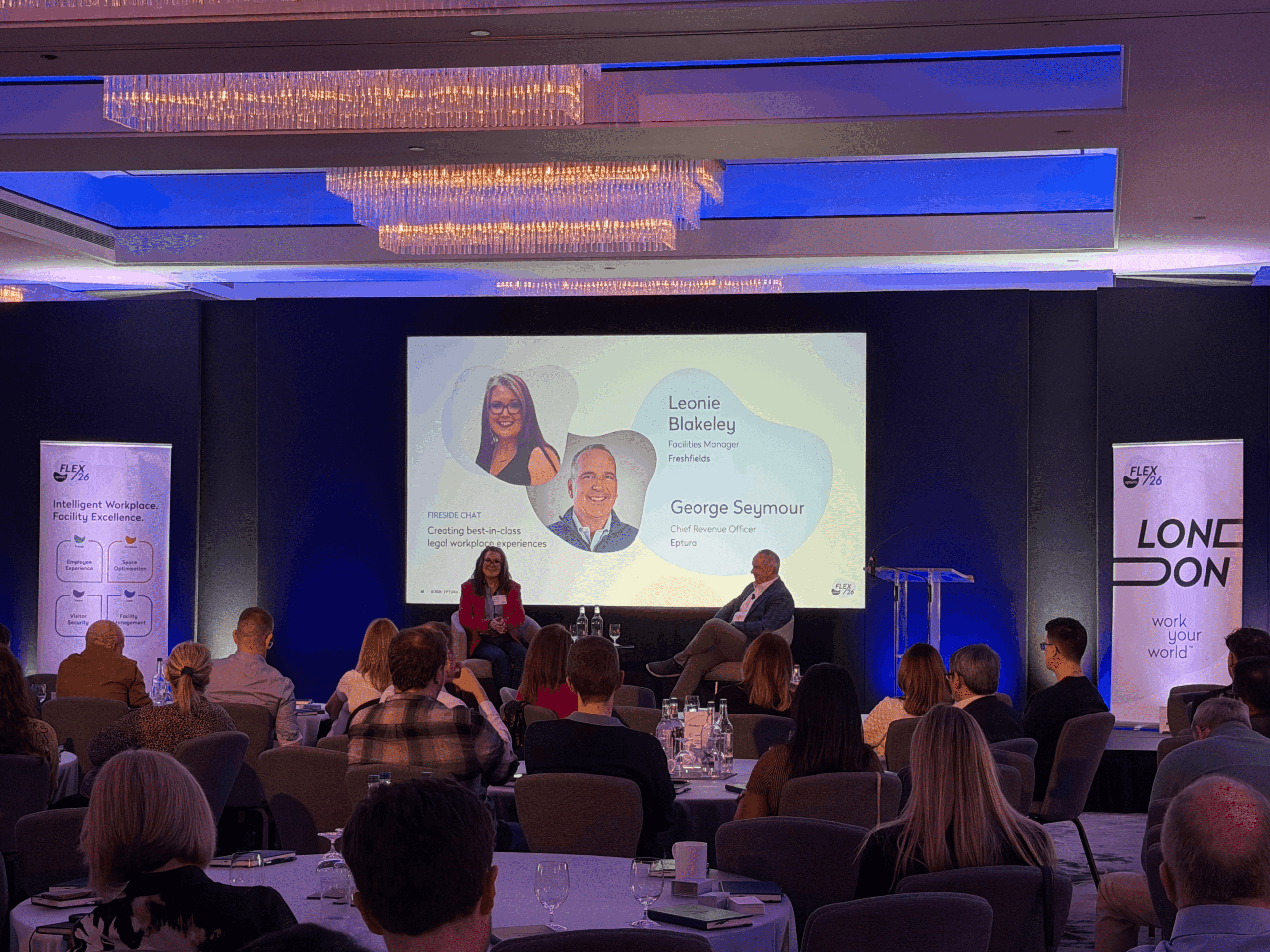
A data-driven approach enables strategic real estate decisions across Freshfields’ global portfolio. Blakeley spends substantial time analyzing utilization data from different regions to support “right sizing” — ensuring offices are specified correctly through architects and design plans. Standardization across regions creates the foundation for strategic decision-making at scale.
But data without purpose falls short.
“The office has to be a reason to come in, be it the people, be it the technology, be it the workstation set up, all the elements that can be an office. You need to make a place of choice to come to and that return on somebody’s investment of commuting in, and the cost-time of commuting in.”
The technology dilemma: Security and the seamless experience
The event included a closer look at a dual challenge facing modern workplaces: building systems that are simultaneously more secure and more seamless. These aren’t competing priorities, though. Instead, they’re interdependent requirements that organizations must address together.
The new attack surface: Buildings and the built environment
Twenty-seven percent of UK buildings have reported cyber incidents linked to building management systems — a sobering statistic that illustrates how the convergence of operational technology and IT creates new vulnerabilities. When building systems connect to enterprise networks — HVAC talking to corporate networks, access control syncing with HR systems, meeting room displays connecting to calendars — they stop being purely facilities infrastructure and become potential vectors for security breaches.
Batra emphasized the shift, explaining that building management systems are now interconnected with enterprise IT networks, making the physical building itself part of a company’s digital infrastructure. He cautioned that smart buildings represent a new category of operational and digital risk, requiring management standards as rigorous as those applied to all other mission-critical systems.
The frictionless imperative: Technology for high-stakes environments
At the same time, organizations must deliver seamless technology experiences. In high-pressure environments where time equals money, friction carries real cost.
In practice, then, the definition of frictionless extends far beyond just the meeting room to include catering, visitor management, wayfinding, and all the supporting services that help people navigate the space. While it can be as straightforward as booking a room, the real challenge comes when trying to ensure everyone on-site has the support they need to deliver exceptional service.
In his fireside chat, Graeme Roberts, workplace design manager at Royal London, explained how the organization is pursuing a “concierge experience” that eliminates friction at every touchpoint. The approach extends beyond simply automating bookings to creating an environment where technology anticipates needs and removes barriers to productivity.
Roberts is pursuing this integration through both sensor technology and AI capabilities. The organization uses sensors to capture real-time occupancy data, which Roberts is working to integrate directly into automated check-in workflows. Employees won’t need to manually confirm their presence — the system recognizes they’ve arrived and automatically updates availability across all connected platforms.
Beyond current automation, he’s exploring how AI can improve service delivery across booking and workplace functions to create intelligent systems that learn patterns, predict needs, and proactively resolve issues before employees even realize there’s a problem.
In high-pressure financial services environments like Royal London, where time directly translates to client value, these seemingly small friction points carry outsized operational cost.
“Making people’s experience seamless is what I want to get to using desk booking, meeting room booking, checking into your desks, all that kind of stuff should be seamless. People shouldn’t need to think about it,” he said.
The technology strategy reflects the broader shift discussed throughout the day: buildings are no longer just physical infrastructure but integrated digital experiences where every system — from access control to environmental controls to workplace services—must work together invisibly to support the people using them.
The data visibility challenge: Connecting disconnected systems
Batra’s keynote highlighted a structural issue underlying many operational challenges. “The built environment has crossed a complexity threshold,” he explained, “and the challenge is how components work together as a system.”
Meg Swanson, Eptura’s chief product officer, described the situation using current market data. Space utilization globally averages 49% — far below the 74% target — yet organizations face mounting operational complexity. Maintenance work orders have increased year over year, while despite all the workplace technology available, 50% of companies still rely on email for ticketing requests.
Their remarks matched what attendees are already feeling. In a live poll, 31 respondents identified lack of trusted data to prove what’s working as their primary challenge, far outpacing other concerns like time spent booking spaces at 18 votes, or coordination difficulties at 10 votes.
The solution starts with pulling everything together, and Swanson highlighted a focus on making sure that’s a digital thread, that everything integrates and works together.”
In his presentation, Michael Robbins, director of solutions engineering at Eptura, explained how a unified platform creates this thread by unifying data across real estate, occupancy, assets, and workplace activity.
“Every interaction, whether someone’s booking a desk, submitting a ticket, it now happens in a more connected way where we’re making the workplace more than something that’s just physical, it’s digital,” he said.
Hands-on workshops and insightful sessions
The event also helped attendees develop tools to address data visibility problem. A hands-on workshop focused on developing practical workplace scorecards, where tables collaborated to define focused metrics that leadership could leverage for stronger decision-making.
Attendees worked to build short scorecard aligned to a single outcome with clear ownership and review cadence, which facilitators called a “front page” view. Participants also identified one metric they could realistically act on, turning the abstract challenge of proving what’s working into concrete next steps.
The practical approach reflects the broader shift attendees must navigate, the move from data collection to data utilization, from intuition-based decisions to evidence-driven strategy.
Beyond the collaborative workshop, best practice sessions addressed the specific operational challenges surfaced throughout the day. Attendees learned how to use team booking workflows to manage structured hybrid patterns using Eptura, directly tackling the midweek bottleneck Healey described at Moore Kingston Smith. Sessions covered how reservation data from desk bookings feeds into space planning tools, enabling the kind of utilization analysis Blakeley emphasized at Freshfields.
Participants also explored how to flag maintenance conflicts with future bookings to minimize workspace disruption, which is the operational friction Roberts at Royal London works to eliminate through his concierge approach.
Join the conversation
Events like Flex/26 London create space for the kind of peer-to-peer learning and strategic conversations that shape how organizations approach workplace complexity. If the insights shared here resonated with your own challenges or if you’re looking to connect with others navigating similar transformations, explore our exciting upcoming events.
Frequently asked questions
By Mike Petrusky
As Director of Podcasts at Eptura, Mike Petrusky hosts both the Workplace Innovator Podcast and the Asset Champion Podcast, sharing thought leadership with CRE, FM, and IT leaders in the digital and hybrid workplace. Mike has produced more than 500 podcast episodes listened to in over 111 countries. As an in-demand public speaker, Mike engages audiences at numerous industry events each year, including International Facility Management Association and CoreNet conferences, focusing on the human element of workplace and facility management.