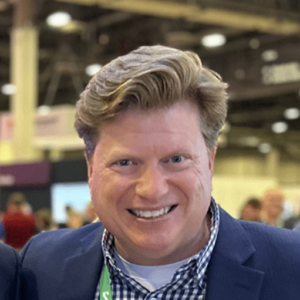
In the final episode of the Workplace Innovator podcast, host Mike Petrusky welcomes Kay Sargent, Senior Principal and Director of Thought Leadership, Interiors at HOK and author of “Designing Neuroinclusive Workplaces: Advancing Sensory Processing and Cognitive Well-Being in the Built Environment.” Reflecting on a decade of conversations about workplace innovation, they explore the forces shaping the future of work, including human well-being, climate change, geopolitical shifts, and artificial intelligence. Together, Mike and Kay discuss why workplace and real estate leaders need to look beyond the latest technology trend, ask better questions, and consider the long-term consequences of decisions they make today. They also explore cognitive sovereignty, the growing pressure on people’s attention, and why intentional choices about technology, workplaces, and human connection will matter even more as the pace of change accelerates.
Agenda
- Which major forces are shaping the future of work and workplace
- Why workplace leaders need to protect cognitive sovereignty in the age of AI
- How asking better questions can lead to more intentional workplace decisions
- Why workplace and real estate leaders need to design for people and future generations
What you need to know: Workplace takeaways
Takeaway 1: Workplace leaders need to look beyond the latest shiny object
Although AI dominates current workplace conversations, Kay cautions against allowing a single technology to overshadow the broader forces changing work and the built environment. She identifies four major areas workplace leaders need to consider together: human sustainability, climate change, geopolitical shifts, and artificial intelligence. Each can influence where organizations operate, how people work, and what employees need from the workplace.
That broader perspective matters because workplace and real estate decisions can have consequences that last for decades. A building may stand for 70 years or more, while decisions about leases, locations, and workplace strategies can shape organizations long after today’s technology trends have changed.
So, she cautions, rather than reacting to disruption one trend at a time, workplace leaders need to consider how these forces interact and what they could mean for the people and places they support.
Takeaway 2: AI makes protecting our ability to think more important
As AI becomes embedded in everyday work, Kay argues that people need to protect their ability to think independently, question information, and make their own judgments, describing the challenge as “cognitive sovereignty.”
AI can generate polished, convincing answers quickly, but that creates a risk when people begin accepting those answers without stopping to evaluate them. The ability to recognize when something does not make sense still depends on human knowledge, experience, and critical thinking.
At the same time, the sheer volume and speed of information make thoughtful processing more difficult. Kay describes people as experiencing “attention fracking,” where their attention is continually pulled in different directions until sustained focus becomes harder.
For workplace leaders, the question therefore goes beyond how quickly teams can adopt AI. They also need to consider whether people have the time, space, and habits necessary to think critically about the information and recommendations technology puts in front of them.
Takeaway 3: Channel your inner five-year-old and keep asking “Why?”
Organizations can easily inherit assumptions about offices, technology, and ways of working without stopping to ask whether they still serve a useful purpose. Why do we design spaces a certain way? Why are people being asked to work this way? What do employees actually value? What do we want them to be able to accomplish?
Those questions move workplace strategy away from simply repeating established practices and toward designing around desired outcomes. Instead of starting with a room type, technology, or existing process, leaders can start with people and what they need to do, then build the environment around those needs.
That mindset also provides a useful check on technology. Efficiency has value, especially when AI can remove administrative work people do not want to spend time on. But if greater efficiency simply creates more work, more information, and more pressure, leaders need to step back and ask whether it is actually improving the experience of work.
Takeaway 4: Be intentional about the future you are creating
Workplace leaders cannot future-proof buildings or organizations against every possible change. Kay argues for something more practical: pay attention to what is already emerging, consider where those changes could lead, and make deliberate choices about the future you want to help create.
That means looking beyond the immediate benefit of an individual decision. Technology choices, workplace strategies, building investments, and design decisions accumulate over time. Each one takes an organization a little farther down a particular road.
For facility management, corporate real estate, and workplace leaders, intentionality means understanding not only what a decision solves today but also its longer-term consequences for people. The goal is not to predict the future perfectly. It is to make today’s choices with a clearer idea of where you want them to lead.
“We need to just slow our roll, be intentional, remember who we’re designing for, and create a world that our children will be thankful for.”
Workplace management insights
- Real estate and workplace decisions made today can have consequences that last for decades.
- AI makes independent thinking, questioning, and critical judgment increasingly important.
- The speed and volume of information can make it harder for people to focus and process ideas deeply.
- Workplace leaders should question established assumptions instead of automatically repeating familiar approaches.
- Workplace decisions should begin with what people value and what organizations want them to be able to do.
- Leaders cannot future-proof the workplace, but they can make more intentional decisions about the future they are helping create.
Explore the full library of Workplace Innovator podcast episodes for an in-depth look at workplace insights and watch the full video here.