



For facility managers overseeing multi-site operations, vendor coordination takes too much time away from more strategic initiatives. Email chains, invoice reconciliation, chasing documentation, and managing vendor relationships through disconnected systems creates an administrative burden that slows down operations and increases costs.
By implementing structured vendor management best practices, your team can see improvements in operational efficiency, cost control, and service quality.
Key takeaways
- Centralization is foundational: Moving vendor information from scattered spreadsheets and email chains to a unified platform creates the foundation for all other improvements. Without a single source of truth for vendor contracts, certifications, and performance history, automation and accountability remain impossible
- Automation shifts maintenance from reactive to strategic: Automated preventive maintenance scheduling and work order generation transforms vendor management from constant firefighting to predictable, planned operations. Vendors receive clear expectations and schedules, while facility teams redirect time from administrative tasks to strategic planning
- Documentation creates accountability: Standardized work order documentation requirements, comprehensive audit trails, and three-way invoice matching eliminate disputes and compliance gaps. When evidence is comprehensive and searchable, vendor performance becomes measurable and contract decisions become data-driven rather than subjective
The difference between reactive vendor management and strategic partnership comes down to specific practices, frameworks, and workflows that centralize information, automate routine tasks, and create accountability.
Centralize vendor information
Step one is moving to a unified vendor management platform that creates a single source of truth for all vendor-related data. Now, instead of spreadsheets and email threads, facility teams can access vendor profiles, contracts, certifications, insurance documentation, and complete performance history in one location.
Ideally, all your vendor information should be accessible through one platform, including:
- Current certificates of insurance with coverage minimums and expiration tracking
- Required licenses, certifications, and training records with renewal alerts
- Contract terms, pricing schedules, and renewal dates
- Service level agreements and response time commitments
- Complete work order history and performance data
Centralized data makes it easier to audit past work, manage current projects, and plan. So, when evaluating vendors for new projects, you can quickly review past performance, verify current insurance coverage, and confirm regulatory compliance.
Enable real-time visibility through a vendor portal
Consider the more common methods of vendor management, where you’re constantly calling vendors to check work order status, leaving voicemails, waiting for callbacks, finally connecting to learn the work was completed yesterday but nobody notified you. Meanwhile, finance wants invoice timelines, other departments need equipment status updates. You’ve been reduced to a human messaging service.
Systems that depend on manual communication wastes time for both facility teams and vendors while creating information delays that impact decision-making.
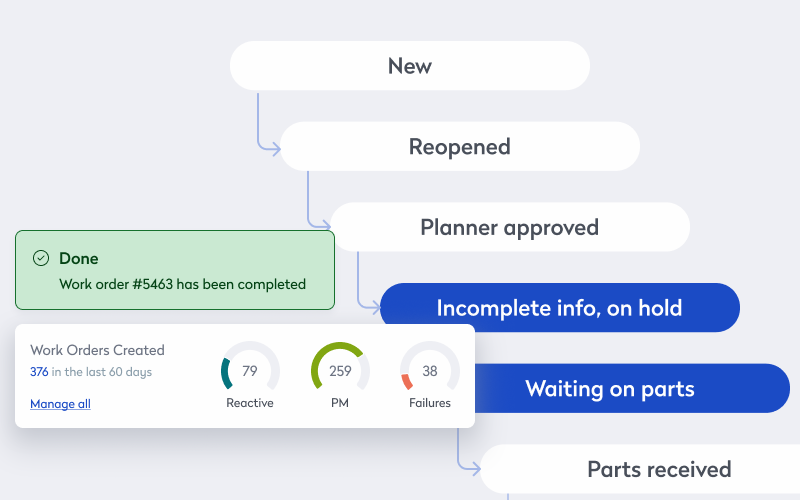
Secure vendor portals eliminate status chasing by providing vendors with a direct channel to update work progress and facility teams with instant visibility into all active work orders. No phone calls required — and no information delays.
Leverage the vendor portal to:
- Assign work orders directly to vendors with complete asset history, access instructions, and special requirements
- Receive real-time status updates as vendors mark work in progress, completed, or blocked
- Verify completed work through photos and documentation submitted directly by vendors
- Track actual time on site and labor hours for billing validation
- Communicate directly with vendors within the platform, creating searchable audit trails
By establishing two-way communication, you create transparency that benefits everyone.
Your team now knows exactly what’s happening with every work order without manual follow-up. Vendors can communicate delays, parts needs, or additional scope requirements immediately rather than waiting for the next phone call.
The impact on operational efficiency is immediate: you can redirect time from status chasing to strategic work, vendors appreciate clearer communication and expectations, and problems surface early when they’re still easy to address.
Maintain comprehensive audit trails
In regulated industries or public sector facilities, comprehensive documentation is often a legal requirement. Yet many facility teams operate with documentation gaps that create compliance risk: work orders without completion verification, vendor communications via unrecorded phone calls, and invoice approvals in unsearchable email chains.
Modern vendor management platforms automatically log every action, communication, and transaction, creating searchable audit trails that require zero manual effort while ensuring nothing is missed, including
- Work order creation, assignment, modification, and completion with timestamps and user attribution
- All vendor communications conducted through the portal
- Invoice submission, review, approval, and payment processing
During audits, your facility team can produce complete documentation instantly rather than spending weeks assembling records. When disputes arise over invoices or scope of work, the audit trail provides objective evidence resolving disagreements faster and more fairly.
If vendor work leads to safety incidents, comprehensive records demonstrate proper oversight and protect the facility team from liability.
Audit preparation time drops, compliance risk decreases, and disputes are resolved based on evidence rather than competing narratives.
Implement three-way invoice matching
Invoice processing can quickly become a challenge for facility teams managing dozens of vendors across multiple sites. Vendor A invoices for work you can’t remember authorizing. Vendor B charges parts that weren’t listed in the original quote. Vendor C’s labor hours don’t match observed time on site.
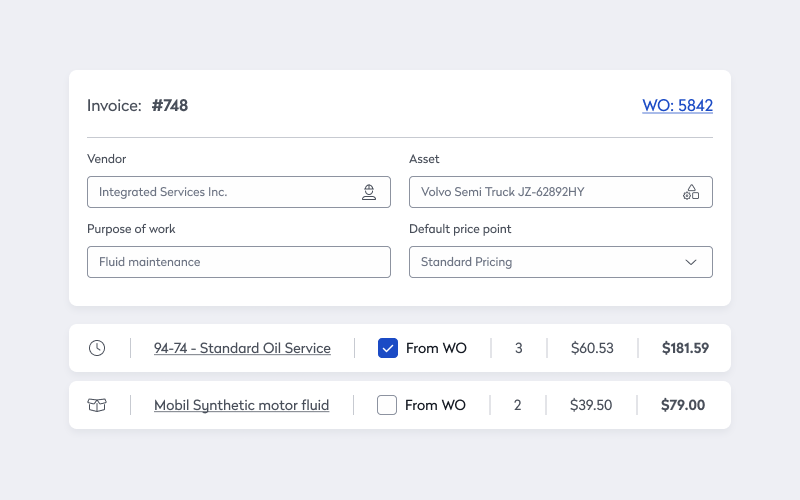
Now you’re spending hours cross-referencing work orders, calling vendors for clarification, and mediating disputes between operations and finance.
The three-way match helps you quickly validate work orders, completion documentation, and invoices. Invoices that match all three documents within tolerance can be fast-tracked for payment. Flagged invoices route through exception workflows for review and vendor communication before payment authorization.
By automating the process, you’re speeding everything up while better protecting against billing errors.
Beyond time savings, automated invoice matching creates behavioral incentives for vendors to submit accurate documentation and invoices. When vendors know that incomplete documentation will delay invoice processing and payment, documentation quality improves dramatically.
Vendor management maturity assessment
Understanding where your organization currently stands in vendor management maturity helps prioritize improvement initiatives and set realistic transformation timelines.
Most facility teams fall into one of three distinct maturity levels, each with characteristic challenges and logical next steps.
Reactive and fragmented
Vendors managed through email and phone calls with no centralized system. You generate work orders only when assets fail, with vendor documentation scattered across email, filing cabinets, and individual staff members’ files. Preventive maintenance tracked manually. Invoice processing entirely manual with frequent payment delays and vendor disputes.
You frequently deal with high emergency repair costs due to reactive maintenance, and there’s a lot of compliance risk from incomplete documentation. You have difficulty comparing vendors or making data-driven decisions.
At this stage, you should Start with a centralized vendor database and baseline documentation requirements. This foundation enables all other improvements.
Documented but manual
You have vendor contracts, but they’re neither centralized nor accessible. You’re struggling with work orders tracked in spreadsheets or basic systems that require significant manual effort, and your preventive maintenance schedules require manual work order creation and tracking.
Although you’re collecting some performance metrics, it’s hard to consistently analyze the data. The Invoice processing is partially systematized, but you still have to do a lot of manual reconciliation.

Manual processes don’t scale as portfolio grows, and staff turnover creates knowledge loss because documentation isn’t comprehensive. Preventive maintenance falls through cracks during busy periods, and it’s hard to reliably performance comparison across vendors because you lack standardized data.
You should Implement a vendor management platform and automate preventive maintenance workflows to reduces administrative burden while improving consistency.
Systematized and automated
You have a centralized vendor database with complete documentation and automated alerts, with automated preventive maintenance work order generation based on asset schedules.
You’ve also set up standardized workflows for vendor onboarding, documentation requirements, and invoice processing. Performance tracking in place with established KPIs. Vendor portal enabling direct communication and documentation submission.
The problem, though, is you have limited advanced analytics capabilities, and that means what should be strategic vendor relationships are still mostly transactional rather than deeply collaborative.
Next steps include looking for a platform that allows for more advanced reporting, and strategic vendor partnership development to maximize value from existing platform investment.
Ready to advance your vendor management maturity?
Discover how leading facility teams are centralizing vendor data, automating preventive maintenance, and achieving measurable improvements in uptime, cost control, and compliance. Schedule a conversation with our experts.
Frequently asked questions

By Jonathan Davis
As a content creator at Eptura, Jonathan Davis covers asset management, maintenance software, and SaaS solutions, delivering thought leadership with actionable insights across industries such as fleet, manufacturing, healthcare, and hospitality. Jonathan’s writing focuses on topics to help enterprises optimize their operations, including building lifecycle management, digital twins, BIM for facility management, and preventive and predictive maintenance strategies. With a master's degree in journalism and a diverse background that includes writing textbooks, editing video game dialogue, and teaching English as a foreign language, Jonathan brings a versatile perspective to his content creation.