

Occupancy sensors, reservation systems, desk bookings, badge data, and workplace analytics platforms all generate detailed information about how people use space. Yet many workplace leaders still struggle to answer a critical question: What should we do with the data?
Utilization data can help you identify mismatches between workplace supply and employee demand, evaluate potential changes, and make more confident portfolio decisions. The value comes from understanding what the measurements reveal about how employees work.
Key takeaways
- Utilization data reveals demand, not just activity: Occupancy tells you who is in the office, but utilization helps you understand whether employees can access the spaces they actually need to do their work effectively
- Strong space planning starts with evidence: Reliable occupancy, utilization, reservation, and attendance data help workplace teams identify mismatches, compare alternatives, and make more confident planning decisions
- The goal is the right mix of space, not maximum utilization: Successful organizations use utilization insights to redesign, redistribute, and optimize space around employee demand, collaboration patterns, and future business needs
When organizations move beyond measuring space and start acting on what the data reveals, workplace planning becomes more strategic. Utilization insights help teams understand demand, evaluate trade-offs, and make portfolio decisions with greater confidence.
Start with utilization data you can trust
You need a consistent baseline that combines occupancy, utilization, reservations, attendance patterns, and other workplace signals. Without that foundation, it becomes difficult to distinguish meaningful patterns from temporary fluctuations.
Effective space planning starts with reliable measurements. Occupancy, utilization, reservation activity, attendance patterns, and sensor data all contribute to a more complete understanding of workplace performance. Organizations that need deeper guidance on building that measurement foundation should begin with occupancy and utilization metrics before moving into planning decisions.
Once you establish a reliable baseline, the conversation changes. The question becomes what the data suggests you should do next.
Use utilization insights to understand workplace demand
Many organizations discover that utilization rates alone fail to tell the full story. A floor may appear partially occupied while employees continue struggling to find the spaces that support their work.
Our upcoming Workplace Index captures that contradiction.
According to employees, 30.1% are unable to find a space that supports their work, while 44.6% plan their day around workspace availability. That suggests workplace challenges often stem from mismatches between available space and desired space rather than simple capacity shortages.
Utilization analysis can help you identify where those mismatches exist. For example, focus rooms may operate near capacity while assigned desks remain partially occupied. Large conference rooms may sit empty for much of the week while smaller collaboration spaces stay fully booked. Employees may consistently search for quiet work environments even though square footage appears sufficient on paper.
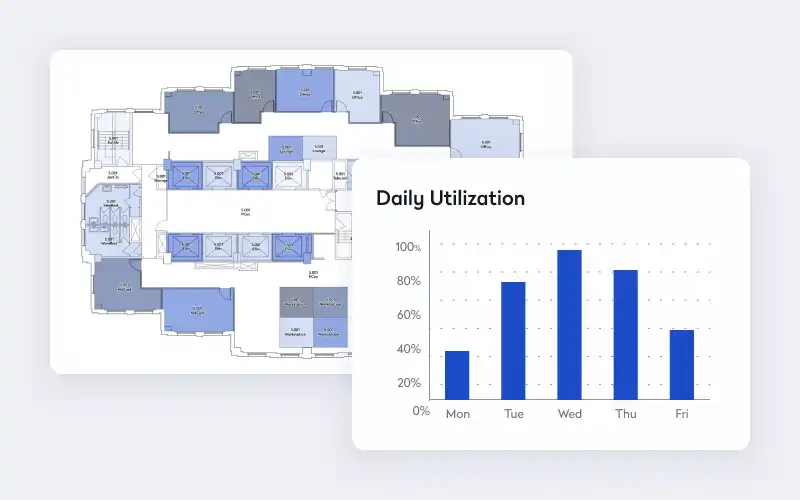
Demand patterns provide valuable context because they reveal which spaces employees actively seek out and which spaces they avoid when alternatives exist.
Just as important, utilization data helps distinguish recurring needs from temporary surges. An occasional booking peak rarely justifies a redesign project. Consistent patterns occurring across weeks or months often deserve closer attention.
Identify where space no longer matches how employees work
Utilization insights become most valuable when they help workplace teams recognize where the existing workplace no longer aligns with employee behavior.
Many offices were designed around assumptions that no longer hold true. Hybrid schedules, flexible work arrangements, and evolving collaboration habits all influence how people use physical space.
A traditional workplace may dedicate significant square footage to assigned desks even though employees use collaborative environments, focus rooms, and meeting spaces more frequently. Another workplace may maintain oversized conference rooms even though most meetings involve fewer than six participants.
Remember, underutilization does not automatically indicate excess space. In many cases, underutilization highlights opportunities to redistribute space, modify space types, or redesign portions of the portfolio around current workplace requirements, so strong space planning starts by understanding whether the issue involves quantity, quality, allocation, or a combination of all three.
Compare future space scenarios before making changes
Historically, many workplace decisions relied on experience, observation, and stakeholder feedback. Those sources remain valuable, but utilization data allows organizations to compare potential outcomes before committing resources.
Instead of asking whether employees want more collaboration space, you can evaluate how collaborative environments currently perform relative to other workspace types, and instead of assuming that reducing assigned desks will improve efficiency, you can assess whether existing utilization patterns support the change.
Scenario evaluation should focus on practical questions, including:
- Which spaces consistently experience demand pressure?
- Which spaces remain underutilized despite availability?
- How would the proposed changes affect employee experience?
- Would the new configuration improve flexibility?
- Can the existing space adapt to future workplace changes?
Defining success before comparing alternatives is equally important. As Rebecca Swanner, Associate Principal and Senior Workplace Design Leader at HED, explained in “‘What are the Outcomes?” – AI Strategies for Building the Responsive Workplace of the Future.”
“Have a very big picture, high level conversation about what are the outcomes… you have to know what you want the outcome to be.”
Organizations often focus first on floor plans, seating ratios, or square footage targets. Utilization data becomes far more valuable when planning teams first define the business outcomes they want to achieve, then use the data to evaluate which workspace configuration is most likely to support those goals.
When you’re looking at converting focus rooms, rebalancing neighborhoods, reducing assigned seating, or redesigning collaboration environments, utilization insights provide a stronger basis for comparing trade-offs and expected outcomes.
Scenario planning also helps teams move beyond reacting to trends and begin evaluating alternatives before committing resources.
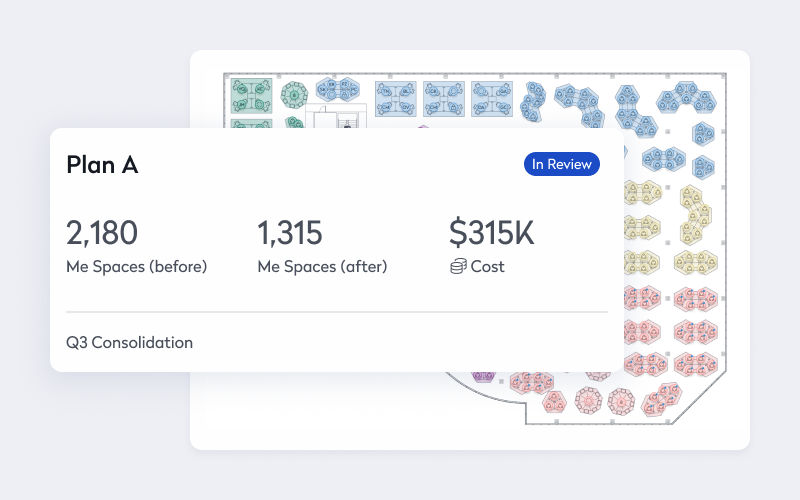
A floor with underused desks may support several possible responses. You might convert portions of the area into focus rooms. You might expand your collaboration space. You might create more flexible neighborhoods that accommodate different work styles. In some cases, the best decision may be leaving the environment unchanged while additional data accumulates.
The goal here is to compare multiple options using the same utilization baseline.
Strong planning teams evaluate trade-offs before making changes. They compare demand patterns, employee experience, operational requirements, flexibility, future growth expectations, and space costs to identify the option that creates the most value.
Measure the impact of space changes over time
The strongest space-planning programs treat implementation as the midpoint of the process, not the endpoint. Many organizations redesign a floor, redistribute seating, convert workspace types, or introduce new workplace policies without establishing how they will evaluate success. As a result, they often struggle to determine whether the change improved workplace performance or simply altered utilization patterns.
Start by documenting a baseline before making modifications. Record occupancy trends, utilization rates, reservation activity, employee feedback, and any other metrics that support the original business case.
The comparison often reveals insights that support future portfolio decisions. A successful redesign may provide a model for additional sites. Less successful outcomes may reveal assumptions that need refinement before expanding the approach elsewhere. In the end, you can create the most value from utilization data when you use it to support continuous improvement rather than one-time projects.
Use AI to evaluate planning decisions faster
AI-backed workflows can help workplace teams identify patterns, evaluate alternatives, and surface planning insights more quickly. Here, the role of AI is not to make planning decisions independently. The role of AI is to help planners assess more information in less time.
AI-powered analytics can combine utilization, occupancy, reservation, and operational data to identify recurring demand patterns, highlight underperforming spaces, and compare potential workplace configurations. Instead of spending more time assembling reports, planning teams can focus on evaluating trade-offs and making decisions.
You can leverage AI-assisted scenario planning to compare future workplace configurations before committing budget or portfolio resources. Evaluating alternatives becomes easier when planners can assess likely outcomes using connected workplace data.
The strongest use of AI follows a simple principle: turn operational data into options that people can review, evaluate, and implement. Technology should strengthen planning, not replace it.
Turn utilization findings into portfolio decisions
Utilization insights also help workplace leaders communicate decisions more effectively. Portfolio changes often affect workplace teams, facilities, finance, HR, business-unit leaders, and employees. When planning teams can demonstrate demand trends, utilization patterns, scenario comparisons, and projected outcomes, conversations become less dependent on opinion and more focused on evidence.
Individual space decisions rarely exist in isolation.
A change to one floor can influence collaboration patterns, space demand, employee experience, operational costs, and future workplace requirements.
You can use utilization insights to support:
- Workplace redesign initiatives
- Hybrid workplace planning
- Portfolio optimization efforts
- Workplace expansion decisions
- Space redistribution projects
These decisions shape far more than real estate costs. They influence how effectively the workplace supports collaboration, flexibility, growth, and employee experience.
Avoid common mistakes when interpreting utilization data
Even organizations with mature workplace analytics programs can misinterpret utilization findings. Watch for these common mistakes:
- Treating all underutilized space as surplus space: Some spaces support important but infrequent activities and may still provide significant organizational value
- Relying exclusively on overall averages: Building-level utilization percentages often conceal meaningful differences between individual space types
- Making decisions based on short-term activity patterns: Seasonal fluctuations, events, and temporary attendance changes can distort utilization findings
- Changing space before understanding employee demand: A redesign may increase utilization while making the workplace less effective for employees
Utilization analytics create the greatest value when they challenge assumptions, provide context, and validate planning decisions.
Make portfolio decisions with confidence
Empty space and unmet demand often exist at the same time. The organizations making the strongest portfolio decisions are the ones that understand why. When planning teams connect utilization patterns to employee demand, they can redesign, expand, consolidate, and invest with greater confidence.
To bring occupancy, utilization, and planning insights together, explore space planning software and workplace management analytics solutions.
Frequently asked questions

By Erin Sevitz
As Vice President of Content and Customer Marketing at Eptura, Erin Sevitz oversees teams responsible for providing worktech insights and engaging 25 million Eptura users worldwide. With over 10 years in thought leadership on workplace management and the built environment, Erin brings deep industry knowledge to her role. Previously, she led communications for the International Facility Management Association, a global nonprofit dedicated to professional development for workplace strategists and building managers, and served as editor in chief for IFMA’s FMJ magazine.