


The Workplace Innovator podcast recently reached a major milestone: our 400th conversation with workplace leaders on how organizations design, track, and manage the modern workplace. Those conversations didn’t produce an all-encompassing answer, but they do reveal patterns. Leaders consistently describe the challenge of making workplace decisions while balancing competing priorities around strategy, data, technology, and employee experience.
Key takeaways
- Workplace leaders are navigating ongoing tensions between strategy and execution, but teams that succeed find ways to connect day‑to‑day operations with long‑term business direction.
- Data has become central to decision‑making, yet organizations see the most impact when they combine measurement with context, experience, and judgment.
- Technology continues to expand what workplaces can do, but performance ultimately depends on how well organizations align tools, people, and how they define success.
Together, these are the tensions that define modern workplace decision-making, and the organizations moving forward are the ones that learn to operate inside them.
Strategy vs. execution: Who really drives workplace decisions?
At a strategic level, workplace leaders increasingly agree that real estate and workplace decisions should follow business strategy, not the other way around. Portfolio planning, space allocation, and workplace investments are all more effective when they reflect how the business operates and what it’s trying to achieve.
That shift matters because workplace decisions are long-term commitments. Once leases are signed or capital investments are made, flexibility disappears quickly. The organizations that get this right are the ones that build alignment early, using workplace strategy to support growth, productivity, and transformation over time.
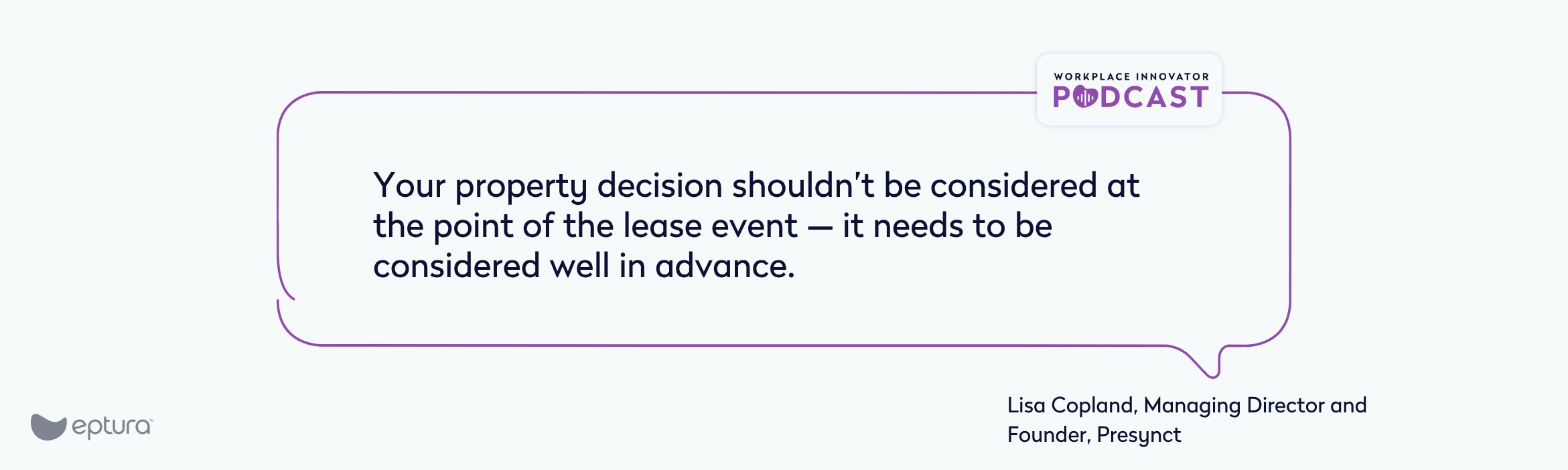
In episode 403 of the Workplace Innovator, “’Start with the Strategy, Not the Lease’ – The Integration of Design, Behavior, and Technology in Workplace Transformation” guest Lisa Copland, Managing Director and Founder of Presynct, emphasizes how early those decisions need to happen. “Your property decision shouldn’t be considered at the point of the lease event — it needs to be considered well in advance,” she explains, pointing to the importance of aligning workplace decisions with long-term business priorities.
But operational reality often looks very different.
In many organizations, facility and workplace teams are still responding to immediate demands like service requests, maintenance issues, and space changes with little time to step back and influence long-term direction. Strategy becomes something that happens elsewhere, while execution continues at the same relentless pace.
In episode 400, “’Do or Do Not’ – Celebrating Star Wars, Facility Management and the Future of the Workplace,” Wayne Whitzell, CFM, IFMA Fellow, describes what execution actually feels like day to day. “These FM teams operate with a skeleton crew in a cold sweat and get things done… then senior leadership comes back and says, ‘You’re just fine continuing as it is.’”
That tension isn’t a contradiction. Strategy-led decision-making is the goal, but execution can still pull teams into reactive cycles.
Closing that gap requires more than better planning. It requires giving operational teams the time, visibility, and influence to connect what they’re doing every day to the broader strategy driving the business.
Data vs. intuition: What should leaders trust?
Workplace decision-making has become significantly more data-driven over the past decade. Teams can leverage sensors, occupancy platforms, service data, and employee feedback tools to capture a constant stream of information about how people are using spaces.
That level of visibility creates valuable opportunities. Instead of relying on assumptions, leaders can now see patterns in real time, test different approaches, and continuously refine how workplaces perform.
In episode 401, “’If You Don’t Measure, You Can’t Improve’ – Neuroarchitecture, Data & Human-Centered Design,” Dr. Helia Taheri makes the case for treating measurement as a foundational capability rather than a one-time exercise. “If you don’t measure, you can’t manage. If you don’t measure, you can’t improve,” she explains.
Measurement alone doesn’t create clarity, though. In many cases, it introduces new challenges.
More data means more interpretation. Teams need to understand what signals matter, how different data points connect, and when to act on what they see. Without that context, organizations risk making decisions that are technically correct but strategically misaligned.
Why data alone isn’t enough to drive better decisions
That challenge often becomes clearer when you look at it from an operational perspective.
In the Asset Champion podcast episode “’Share Your Knowledge’ – Leadership Strategies in Asset Management and Facility Maintenance,” Jason Callis, CFM, SFP, LSSGB, Executive Director for Facility Operations & Asset Management at Aramark Destinations, focuses on what happens after the data is collected.
“AI is certainly going to be an amazing tool… you have to know what it’s actually saying in the data that it’s providing to you,” he explains, highlighting that insight depends on interpretation, not just access.
This is where intuition still plays a role. Experience, observation, and contextual understanding help leaders connect the dots between what data shows and what it means for people, processes, and performance.
The tension here is between data without context and judgment without evidence. The organizations seeing the best results are the ones that combine both into a single decision-making approach.
Technology vs. people: What moves performance?
Technology has become one of the most visible drivers of change in the workplace, with AI, automation, and integrated platforms transforming everything from space planning to maintenance workflows.
As these tools become more embedded in day‑to‑day operations, workplace and facilities leaders now need to manage interconnected systems that combine physical space, digital tools, and real-time data.
That shift is already reshaping expectations.
In the milestone 400th episode of the Workplace Innovator podcast, Vik Bangia, MCR, President and CEO of Verum Consulting, captures how widespread that change has become. “AI now affects every bit of this industry,” he explains, pointing to the growing role of automation and analytics across workplace operations.
AI is now layered across planning, service delivery, asset management, and decision-making processes all at once, creating new opportunities to improve efficiency and responsiveness, but it also increases complexity for the teams responsible for making those systems work together.
The increased capability shifts complexity instead of removing it.
As technology takes on more data processing and automation, the role of people changes. Instead of executing tasks manually, teams are expected to interpret outputs, make decisions faster, and manage more interconnected systems.
At the same time, the human side of workplace management hasn’t gone away. If anything, it’s become more important. In episode 400, René Jackson, MBA, CFM, facility management leader and IFMA community member, reinforces that point: “That’s part of my superpower — dealing with people,” she explains, highlighting how communication, motivation, and cultural understanding remain central to how workplaces function day to day.
This is one of the defining realities of the modern workplace. Technology expands what organizations can do, but people determine how effectively those capabilities are used.
The companies moving forward aren’t choosing between technology and people. They’re investing in both and building the skills needed to connect them.
Efficiency vs. experience: What are we really optimizing for?
Workplace leaders are under constant pressure to deliver measurable performance, and that pressure shows up in how organizations define success.
In many environments, performance is tightly linked to efficiency. Utilization rates, maintenance productivity, service response times, and cost control are all tracked closely, often with clear benchmarks and expectations. These metrics provide visibility and accountability, helping organizations manage resources and justify investments.
At the execution level, that focus becomes highly tangible. As Jason puts it, “We really ask… to document 7.2 hours of an 8-hour working day strictly to doing great work,” illustrating how precisely productivity can be measured and managed.
At the team level, performance depends on interaction. In episode 402 of the Workplace Innovator podcast, Minette Norman emphasizes that innovation emerges through group discussion, debate, and shared problem-solving.
Those ideas challenge traditional definitions of productivity. If output depends on collaboration, creativity, and engagement, then efficiency metrics alone can’t capture the full picture.
That’s the tension many organizations are working through now. Efficiency is easier to measure and manage, but experience is what shapes the behaviors that drive long-term performance.
The most effective workplace strategies don’t treat these as tradeoffs. They expand how performance is defined by combining operational efficiency with environments that enable people to do their best work.
Stay on top of the trends in intelligent worktech and facility management
Workplace and facility management are constantly evolving with new technologies, regulations, and best practices. Industry professionals always have something new to learn.
For more videos, podcasts, and webinars to keep you updated on the latest trends, visit our resource page.
Frequently Asked Questions

By Mike Petrusky
As Director of Podcasts at Eptura, Mike Petrusky hosts both the Workplace Innovator Podcast and the Asset Champion Podcast, sharing thought leadership with CRE, FM, and IT leaders in the digital and hybrid workplace. Mike has produced more than 500 podcast episodes listened to in over 111 countries. As an in-demand public speaker, Mike engages audiences at numerous industry events each year, including International Facility Management Association and CoreNet conferences, focusing on the human element of workplace and facility management.