

By Aleks Sheynkman
Director of Engineering
SpaceIQ
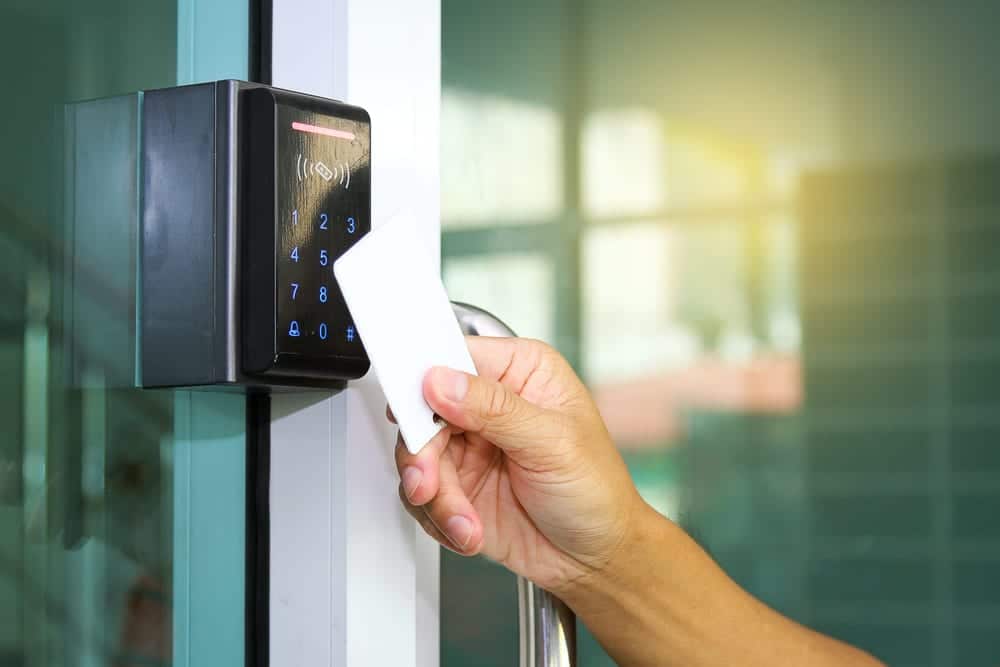
If you’ve ever worked on a big campus or in a secure building, you’ve likely had an employee ID badge. While they vary, most ID badges feature a few essentials: your mugshot, your name and title, the company name, an ID number, and a chip or magnetic strip. The ID badge is your all-access pass to the facilities, giving you access to some places and restricting movement to others. But what is an employee badge system really for? Why is access control so important?
Employee badging goes beyond dictating what areas you can and can’t access. It’s a framework for security, asset tracking, task management, and general facility management. While it might seem like a pain to swipe, scan, or insert your employee ID badge all the time, granting or denying access to certain spaces is an important mechanism of facility management.
Checks and balances
Think of a badge system like a series of checks and balances. Your badge gives you the freedom to access areas you can and should use—the parking garage, cafeteria, conference rooms, or entire floors of a building. It also keeps you out of spaces you don’t need. Unfortunately, most people overlook access points their badge allows, instead focusing on what it doesn’t allow.
Think of it like the grocery store. You’re free to grab a cart and stroll through the produce department, bakery, deli, dairy section, and up and down various aisles. Everything you need is there. You’re not allowed to go into the stock room, behind the registers, or on the loading dock. And why would you? Your purpose is to buy food from accessible areas.
Like the grocery store, office access control keeps you in familiar areas governed by clear expectations of what’s allowed. It’s not about putting up walls—it’s about creating routine, stability, and familiarity.
Reasons to restrict access
Prohibiting access to specific areas is easy with a badge system for employees. Here’s a look at why barring access to certain areas is advantageous for employers and employees:
- Areas may house sensitive information or dangerous materials
- Keeps different business segments from impeding on each other’s essential workspace
- Prevents visitors from wandering aimlessly and getting lost
- Reduces unwanted disruptions from people who aren’t familiar with certain areas
- Manages workplace populations to improve space utilization through selective access
- Prevents different business segments from poaching assets and materials
In many ways, restricting access enables employees. It ensures they can access the spaces they need and are free from disruptions and unknown expectations.
Reasons to grant access
Granting access to space seems like an obvious process, but it takes more consideration than you might think. Here are a few reasons it makes sense to give specific employees or groups ID badge access to different areas of the workplace:
- Accessible areas contain people or facilities they need to do their job properly
- These areas are part of greater office mobility and grant access to other spaces
- To improve interoffice or interdepartmental synergy between business segments
- Executives or managers may collaborate broadly, requiring broad access
- To improve automation, quickly granting access to specific employees or groups
- Encourages mindful use of particular areas or amenities within facilities
When access is as simple as swiping, scanning, or inserting an ID card, employees get into the habit of using the facilities accessible to them.
Badges are the gateway to mobility
It’s easy to see an employee ID badge system as restrictive—but in fact, it’s enabling! Badges aren’t meant to keep people out of the spaces they need to access. Rather, they create order within facilities. Visitors won’t stumble into your workspace. Coworkers won’t hijack your conference room. Temps won’t get lost and end up in the executive suite.
Think of an employee badging system as another layer of wayfinding or a function of office automation. It’s meant to make navigating the workplace easier and more fluid, giving employees access to the spaces and amenities they need.
Keep reading: What Are Wayfinding Kiosks and Digital Signage?

By Jonathan Davis
As a content creator at Eptura, Jonathan Davis covers asset management, maintenance software, and SaaS solutions, delivering thought leadership with actionable insights across industries such as fleet, manufacturing, healthcare, and hospitality. Jonathan’s writing focuses on topics to help enterprises optimize their operations, including building lifecycle management, digital twins, BIM for facility management, and preventive and predictive maintenance strategies. With a master's degree in journalism and a diverse background that includes writing textbooks, editing video game dialogue, and teaching English as a foreign language, Jonathan brings a versatile perspective to his content creation.