

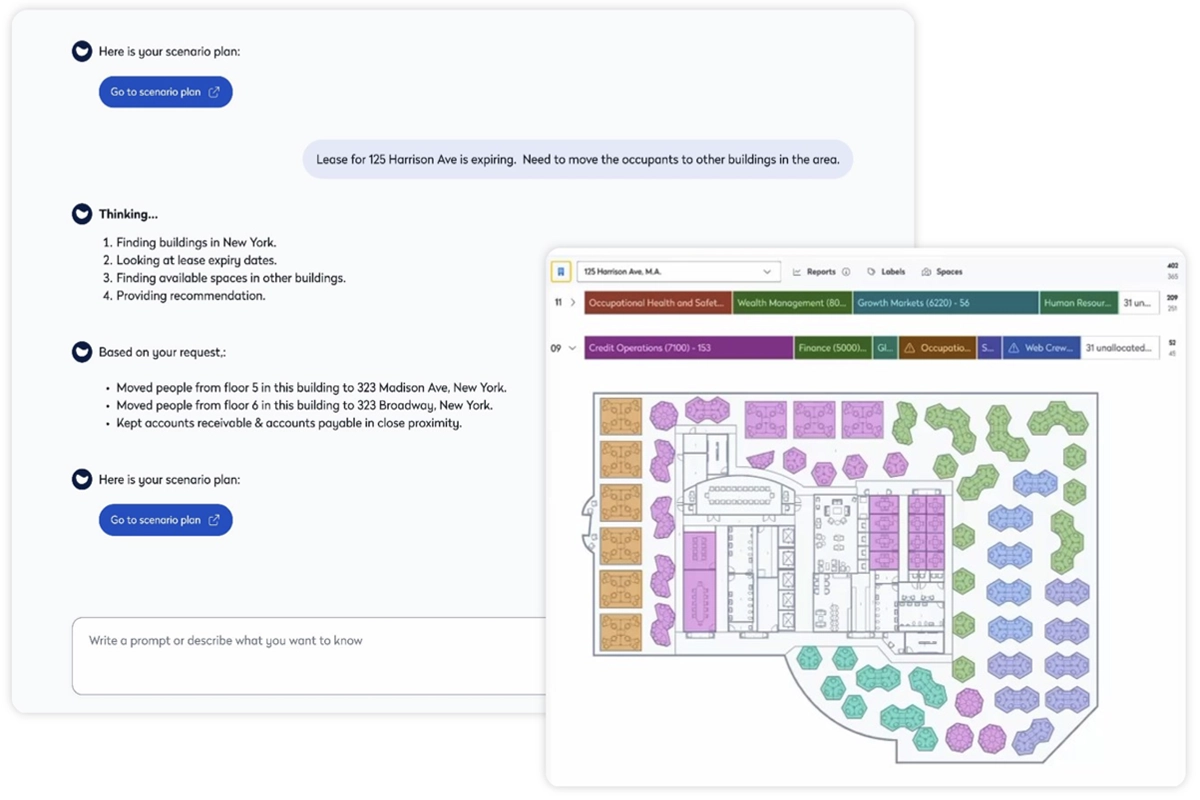
Workplace scenario planning combines the art and science of optimizing floorplans and rarely starts from a clean slate. Often, it begins in the middle of something already in motion: a leadership request, a budget review, or a shift in attendance patterns that doesn’t match expectations.
By the time planning conversations begin, the questions are already layered:
- How would shifting to a 3-day in-office policy change space demand across regions and roles?
- Where is there an opportunity to consolidate without disrupting collaboration or planned growth?
- How do headcount forecasts align with space availability over the next 12-18 months?
- What happens to utilization, cost, and team adjacency if space is rebalanced across key markets?
These aren’t isolated questions. Each adds new variables, more dependencies, and a growing need for clarity.
That pressure is increasing. As hybrid work models evolve and market conditions shift, portfolio decisions are happening more frequently and with less tolerance for uncertainty. In our 2025 Workplace Index research, 34% of businesses reported plans to increase office attendance, adding new complexity to how organizations balance space demand with employee experience.
The volume of data is growing alongside that complexity. Many organizations now operate across 6 to 40 different workplace systems, making it difficult to bring together a consistent view of space, people, and usage patterns.
Scenario planning has always been essential. What’s changed is the expectation for speed. Leading organizations are setting themselves apart with the ability to answer these questions using real-time, connected data and act on changes quickly with AI workflows.
Key takeaways
- Workplace scenario planning is shifting from periodic modeling to continuous decision-making
- Manual workflows limit speed, scale, and confidence in planning outcomes
- Automating scenario planning workflows enables faster iteration and better portfolio decisions
- AI and analytics help surface trends, test assumptions, and reduce reliance on manual modeling
- Leading CRE teams are aligning planning workflows with real-time data and operational execution
Workplace scenario planning is becoming a continuous capability
Scenario planning was once tied to specific events like lease renewals, annual planning cycles, or major organizational changes.
That model no longer holds.
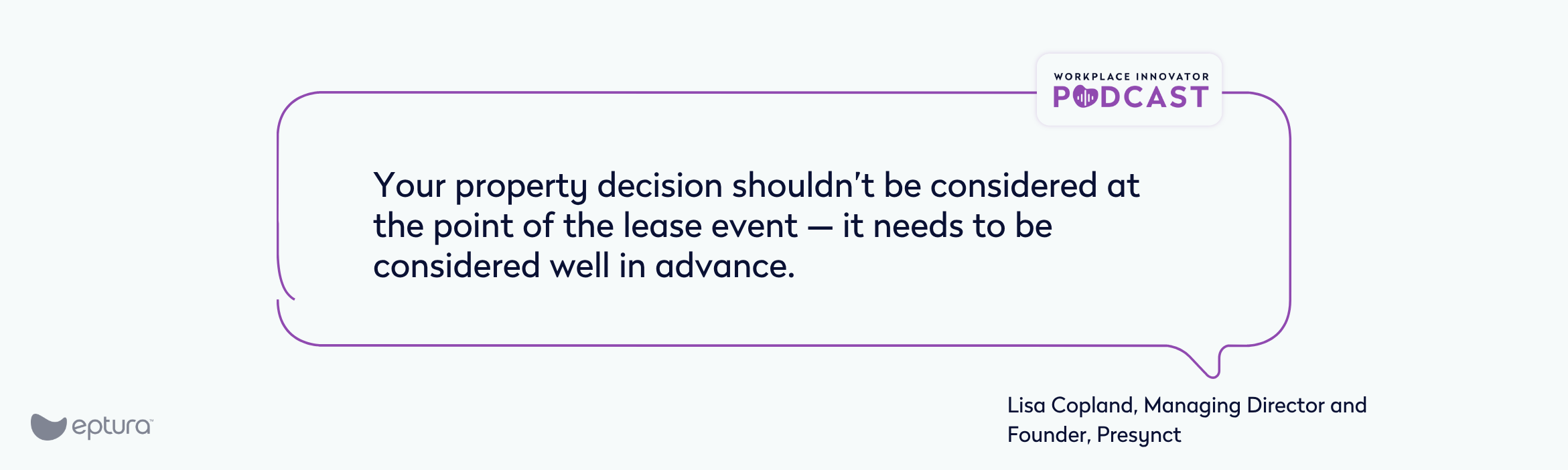
As Lisa Copland, Managing Director and Founder of Presynct, shared on a recent episode of the Workplace Innovator podcast, organizations can’t afford to wait for those triggers. With the rise of AI, leaders increasingly expect answers on demand, including for real estate decisions.
Hybrid work has also fundamentally changed how organizations use space. CBRE reports that office utilization has climbed to over 50% globally, reflecting a renewed focus on performance and experience.
At the same time, CRE leaders are shifting priorities. JLL found that 73% of organizations now rank portfolio optimization as their top objective, ahead of cost-cutting.
Together, these changes are reshaping expectations and require a different approach. Scenario planning is becoming an ongoing discipline embedded in day-to-day decision-making.
The complexity behind workplace scenario planning workflows
Most planning questions seem straightforward:
- What happens if we consolidate floors?
- How will headcount changes affect space demand?
- How do we align hybrid policies with space allocation?
Answering them requires far more effort.
Scenario planners typically need to aggregate data from multiple systems, reconcile it across sources, and validate its accuracy while ensuring models account for several variables and assumptions. Then comes the difficult task of translating outputs into recommendations and action and monitoring the outcomes.
Without a unified data foundation, fragmented inputs slow analysis and introduce risk.
This reflects a broader challenge across CRE teams. Although many organizations collect utilization data, only 7% rate their analytics capabilities as excellent. The gap between data availability and actionable insight remains significant.
Most organizations have access to historical usage data through bookings, badge swipes, sensors, or network signals. What’s often missing is the ability to connect those inputs in real time, model outcomes quickly, and move from insight to execution within a single workflow.
Why manual scenario planning workflows fall short
- Limited speed and scalability
Manual workflows restrict how many scenarios teams can evaluate. That makes it harder to test alternative strategies or respond quickly to leadership requests.
- Disconnected data environments
Fragmented systems lead to inconsistent inputs and slow validation processes. This fragmentation often creates decision-making bottlenecks across workplace teams.
- High reliance on manual analysis
Teams spend time building models instead of exploring insights, limiting their strategic impact.
- Gaps between planning and execution
Even when insights are available, translating them into operational changes often requires additional coordination and effort.
These challenges stem less from capability and more from how workflows are structured. That’s why many organizations are applying AI to facilitate scenario planning.
From manual modeling to automated scenario planning
Forward-looking organizations are moving from static workflows to continuous, automated planning capabilities.
This shift includes:
- Connecting workplace data into a single source of truth
- Enabling faster scenario creation and iteration
- Embedding insights into decision-making workflows
- Reducing reliance on manual modeling and reporting
The broader trend is clear: AI and automation are moving beyond individual tasks into full workflow transformation. McKinsey notes that leading organizations are reimagining entire operational domains with AI, rather than applying it to isolated tactics.
For workplace leaders, scenario planning is a perfect use case for this approach.
What automated scenario planning workflows look like
By applying AI automation to scenario planning, CRE teams benefit from:
- A unified workplace data foundation
Connected systems ensure planning starts from consistent, accurate inputs — aligning with best practices outlined in managing workplace space data as an enterprise system of record.
- Faster scenario generation
Automated workflows allow teams to explore “what if” questions quickly without building models from scratch.
- Rapid iteration and comparison
Teams can test multiple variables and compare outcomes side by side, increasing confidence in recommendations.
- Embedded, decision-ready insights
Instead of static reports, insights are integrated into planning workflows, making it easier to act.
How automation transforms workplace planning workflows
| Scenario planning workflow | Before AI scenario planning | After AI scenario planning |
|---|---|---|
| Portfolio optimization | Weeks of data gathering and modeling | Faster evaluation of cost, utilization, and space scenarios |
| Hybrid workplace planning | Decisions based on assumptions or limited data | Scenario testing driven by real utilization and attendance patterns |
| Organizational change and growth | Complex, time-intensive block and stack planning | Agile modeling that supports workforce shifts and expansion |
| Executive decision support | Static reports requiring manual updates | Dynamic insights aligned with real-time portfolio performance |
The business impact of automated scenario planning
As organizations refinine hybrid strategies and increase in-office expectations, the ability to model changes quickly is critical.
Automation strengthens decision quality so organizations can:
- Accelerate planning cycles
- Reduce reliance on manual data processes
- Improve confidence in planning decisions
- Explore a wider range of scenarios
The potential impact is significant. McKinsey estimates that AI-driven transformation could unlock hundreds of billions of dollars in value across real estate workflows.
Data-driven strategies are already influencing performance. For example, 83% of real estate firms using advanced analytics report faster decision-making.
Scenario planning as a strategic CRE capability
The role of scenario planning is expanding, enabling organizations to:
- Anticipate change
- Test strategies proactively
- Align with evolving business priorities
Centralized data and analytics enable CRE teams to model scenarios and respond to business needs with more clarity and speed.
Organizations that invest in automated workflows are better equipped to turn planning into a strategic advantage.
Moving from effort-intensive to insight-driven planning
For many organizations, the opportunity is clear:
- Spend less time preparing data
- Increase speed of decision-making
- Focus more on interpreting insights than building models
As workplace complexity grows, speed and confidence in planning decisions have become essential.
Automating workplace scenario planning workflows with AI makes that shift possible, turning planning workflows into a more responsive, data-driven function across the enterprise.
Modernizing workplace planning workflows
Modern workplace platforms help organizations connect data, automate workflows, and evaluate scenarios faster.
Explore how AI scenario planning can support more confident, data-driven decisions across your portfolio.
Frequently Asked Questions

By Erin Sevitz
As Vice President of Content and Customer Marketing at Eptura, Erin Sevitz oversees teams responsible for providing worktech insights and engaging 25 million Eptura users worldwide. With over 10 years in thought leadership on workplace management and the built environment, Erin brings deep industry knowledge to her role. Previously, she led communications for the International Facility Management Association, a global nonprofit dedicated to professional development for workplace strategists and building managers, and served as editor in chief for IFMA’s FMJ magazine.