

Financial services organizations rely on a growing mix of workplace technologies, including badge access systems, workplace reservation platforms, visitor management tools, facilities systems, and collaboration platforms. The challenge is that these systems often operate independently, making it difficult to gain a complete view of how workplaces are being used.
For banks, insurers, and other financial institutions, fragmented data can limit visibility across real estate, facilities, and security functions. CRE leaders may see bookings but not actual occupancy, facilities teams may lack insight into how usage affects service demand, and security data may remain disconnected from workplace analytics.
This challenge is widespread. Eptura’s 2025 Workplace Index found that two-thirds of organizations use between six and 40 workplace solutions, creating significant data fragmentation.
At the same time, AI is moving from experimentation to operational decision-making. Microsoft’s latest Work Trend Index found that nearly half of Copilot usage now supports analysis and decision-making, while research from MIT’s Project NANDA suggests many AI initiatives fail because organizations cannot provide reliable, connected, and governed data.
As financial services firms pursue Microsoft’s Frontier Firm vision, the focus is shifting from deploying more technology to connecting existing workplace, operational, and security data. Creating that trusted foundation gives leaders and AI systems the context needed to make smarter decisions, improve efficiency, strengthen compliance, and enhance workplace experiences.
Key takeaways
- Disconnected workplace, operational, and security systems limit visibility across complex financial services portfolios
- AI readiness increasingly depends on trusted workplace data rather than additional AI tools
- Connected data improves portfolio planning, employee experience, compliance, and operational performance
- Microsoft and Eptura help organizations connect workplace information with tools employees already use every day
- Becoming an AI-powered organization starts with building a trusted workplace-data foundation
Why financial services firms can no longer afford disconnected workplace data
Financial services organizations operate some of the most complex workplace environments in the world. A single institution may manage headquarters, regional offices, trading floors, operations centers, customer-facing locations, and specialized facilities distributed across multiple regions.
Responsibility for workplace performance spans multiple departments. CRE teams manage portfolios and space strategy. Facilities teams oversee building operations. Security teams manage access and governance. IT supports digital workplace infrastructure, while HR influences workplace policies and employee experience.
Historically, each function adopted technology to solve its own challenges. Over time, that created workplace ecosystems that often include:
- Badge and access control systems
- Visitor management platforms
- Desk and room booking software
- Asset management systems
- Facilities and maintenance platforms
- Occupancy technologies
- Microsoft Teams, Outlook, and collaboration tools
- Space and portfolio management systems
Each platform provides valuable information. The challenge emerges when leaders attempt to answer questions that require information from multiple systems.
A reservation platform may show 500 desk bookings, while badge records indicate substantially fewer employees entered the building. Maintenance records may reveal recurring issues on a particular floor, while occupancy information shows that same floor consistently experiences the highest traffic levels.
Individually, each system tells part of the story. Together, they provide operational context.
That context is becoming increasingly important. Workplace Index research found desk bookings increased 33% year over year, visitor volumes nearly doubled over three years, and many organizations continue increasing expectations for in-office attendance.
The challenge is no longer collecting workplace data. Financial services leaders need to make that information work together.
Why AI readiness has become a workplace data challenge
Many organizations assume AI success depends primarily on selecting the right platform, assistant, agent, or model.
Increasingly, the real challenge is ensuring AI has access to reliable organizational context.
Microsoft’s 2026 Work Trend Index found that 67% of workers believe organizational readiness, including governance, management support, processes, and infrastructure, determines whether AI delivers value. Only about one in five organizations combine effective AI skills with organizational readiness.
The findings align closely with workplace technology trends. Eptura research shows that many organizations operate across large numbers of disconnected workplace systems, generating fragmented data that limits visibility.
The implication is straightforward: AI can only act on the information it receives.
If workplace, visitor, security, facilities, space, and occupancy data remain fragmented, AI inherits that fragmentation. If the information is incomplete or inconsistent, AI can only provide incomplete answers.
For financial services firms pursuing Frontier Firm strategies, AI readiness increasingly depends on workplace-data readiness.
How connected workplace intelligence supports the Frontier Firm model
Microsoft describes Frontier Firms as organizations that combine AI, automation, and human expertise to transform how work gets done.
For workplace leaders, that evolution begins with context.
A workplace AI assistant cannot provide an accurate view of utilization if it only sees reservations. It cannot optimize maintenance schedules if maintenance data and occupancy information never intersect. It cannot accurately forecast workplace demand if badge records, bookings, visitor data, and space information remain disconnected.
Connected workplace intelligence creates context.
According to Microsoft’s AI readiness research, AI rarely fails because of reasoning limitations. More often, it struggles because organizations cannot provide trusted, connected information. Workplace data supplies much of that missing context, capturing not only what was planned but also what actually happened across buildings, people, assets, and services.
When organizations connect operational signals, they gain new capabilities. CRE teams can compare bookings with actual attendance. Facilities leaders can align maintenance activity with occupancy patterns. Workplace strategists can identify where hybrid policies create congestion or underutilization. Security teams can better understand workplace activity across locations.
These connections also create the foundation for automation and agentic AI.
Organizations gaining the greatest value from AI are often not the ones deploying the largest number of tools. They are the ones capable of supplying those tools with trusted business context.
Four benefits of connecting workplace, operations, and security data
Better workplace decision-making
CRE and workplace leaders regularly need answers to questions that determine portfolio strategy:
- How much space do we need?
- Which locations are underperforming?
- When are employees actually coming into the office?
- Where should we invest next?
Connected data helps replace assumptions with evidence.
Reservation data reveals employee intent. Badge activity confirms attendance. Occupancy information shows actual usage. Space data provides capacity context. Analytics reveal long-term patterns.
Together, these signals help leaders forecast demand, refine hybrid strategies, optimize portfolios, and make more confident investment decisions.
Research discussed in Microsoft’s and Eptura’s AI-readiness framework also suggests that attendance alone is an incomplete measure of workplace effectiveness. Badge swipes may indicate presence, but not collaboration, utilization, employee experience, or operational outcomes. The strongest decisions emerge when leaders evaluate multiple signals together rather than relying on a single metric.
Improved compliance and risk management
Visibility has additional importance in financial services because workplaces operate within tightly controlled risk and governance environments.
Organizations often need to understand who accessed facilities, which visitors were onsite, whether workplace policies were followed, and how physical workplace activity aligns with compliance requirements.
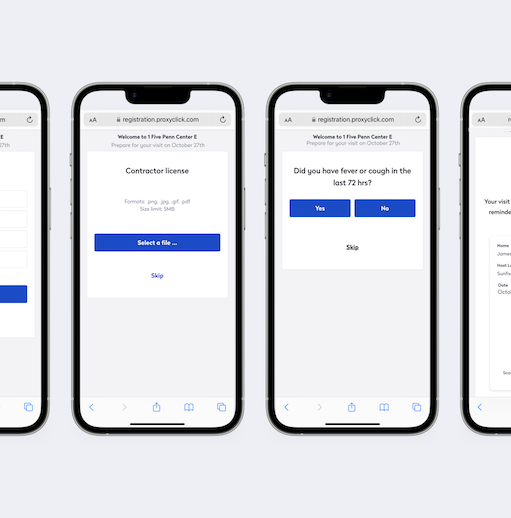
Visitor management provides a strong example of the value of connected workplace data. In many organizations, a visitor journey begins when an employee schedules a meeting. When visitor, workplace, collaboration, and access-control systems are connected, organizations can automatically initiate visitor registration, trigger identity-verification requirements, manage arrival workflows, provision access permissions, notify hosts, and generate audit records.
Instead of treating visitor management as a standalone reception process, firms can create an end-to-end workflow connecting meeting scheduling, building access, compliance requirements, security controls, and workplace operations. This creates a more consistent experience for guests while supporting the reporting, auditability, and governance requirements common in financial services.
For executives, the objective is not simply collecting more information. It is ensuring workplace decisions are based on consistent, accessible, and trustworthy data.
Enhanced employee and visitor experiences
Employees rarely think about workplace technology architecture.
They notice outcomes.
Can they find a workspace near colleagues? Can they reserve the right room? Can they see when teammates will be onsite? Can visitors move through reception efficiently?
Every one of these experiences depends on information flowing between workplace systems.
Increasingly, those workflows occur inside the tools employees already use every day. As Microsoft Places becomes more broadly available across Microsoft 365, employees can coordinate office days, locate teammates, discover appropriate workspaces, reserve desks, and access workplace services directly through Outlook, Teams, and Places.
Connected workplace ecosystems help organizations surface accurate workplace information wherever employees work. Rather than forcing users into separate applications, workplace data can be synchronized across Teams, Outlook, Places, and other Microsoft experiences. This reduces friction for employees while improving adoption and workplace visibility.
It also creates more reliable workplace signals. Reservation activity, attendance information, desk check-ins, and work-location preferences can reinforce one another, helping organizations move beyond simple booking counts to understand how workplaces are actually being used.
For financial services firms competing for talent and encouraging purposeful office attendance, that consistency matters. Employee experience increasingly depends on operational systems working together behind the scenes.
Greater operational efficiency through automation
Disconnected systems create administrative work.
Teams export reports. Information is reconciled manually. Data is cleaned and compared. Departments exchange spreadsheets before decisions can be made.
Many organizations effectively pay an integration tax for fragmented workplace technology environments.
Connected systems reduce that burden.
Maintenance teams can prioritize highly utilized spaces. Workplace platforms can release unused reservations automatically. Visitor workflows can trigger access permissions. Portfolio dashboards can update continuously instead of relying on manual reporting cycles.
Connected workflows can also eliminate manual coordination between departments. A workplace reservation can automatically trigger room preparation, catering requests, AV setup, facilities tickets, visitor registration, and compliance tracking. Instead of multiple teams performing independent processes, a single workplace event can initiate downstream operational workflows automatically.
For financial services firms regularly hosting client meetings, executive briefings, and regulated interactions, these connected workflows improve operational consistency while reducing administrative overhead.
Agentic AI expands these opportunities further. Rather than simply surfacing information, AI can identify patterns, recommend actions, and initiate workflows while employees remain responsible for oversight and decision-making.
Why AI is accelerating demand for connected workplace ecosystems
AI is raising expectations for workplace technology while simultaneously exposing weaknesses in existing data environments.
An AI system is only as useful as the information it can access.
If occupancy, maintenance, visitor, security, asset, and space data remain isolated, AI sees fragments of the workplace rather than the complete operating environment.
This helps explain why integration has become an AI strategy as much as a workplace technology strategy.
AI needs trusted workplace data, not simply more data
A common misconception is that AI initiatives require more data.
In reality, they require data AI can trust.
According to Microsoft’s and Eptura’s AI-readiness framework, AI-ready workplace data shares five characteristics: it is connected, behavioral, timely, governed, and contextual. Organizations must connect information across spaces, assets, people, visitors, bookings, and operational systems. Data should reflect actual workplace activity, remain current enough to support decisions, operate within clear governance controls, and provide business context rather than isolated metrics.
Connected workplace data also enables more practical AI use cases. Employees can use natural-language queries to find available workspaces, identify colleagues who plan to be onsite, coordinate team attendance, or reserve desks through familiar tools such as Microsoft Copilot, Teams, and Outlook. Facilities leaders can investigate maintenance backlogs and service-demand trends, while workplace strategists can evaluate portfolio scenarios and utilization patterns without manually assembling data from multiple sources.
These outcomes are possible because AI has access to connected workplace signals instead of isolated datasets. The value comes from combining collaboration context and workplace context so AI can understand not only how employees plan work, but also how workplaces actually operate.
What a connected workplace looks like in practice
A connected workplace creates an ecosystem where information can move freely between employee experiences, operations, security functions, analytics platforms, and AI systems.
One useful way to think about that ecosystem is through four interconnected layers:
- Workplace experience: Desk booking, room reservations, workplace services, employee journeys, and visitor management.
- Workplace operations: Facilities management, maintenance, asset management, service delivery, and space management.
- Security and compliance: Access control, visitor records, governance, audit requirements, and reporting.
- Intelligence and AI: Analytics, automation, predictive insights, and AI-powered decision support.
Each layer becomes more valuable when it can draw context from the others.
The Microsoft and Eptura approach to the connected workplace
For many financial services organizations, Microsoft technology is already embedded in how employees communicate, schedule meetings, collaborate, and coordinate workdays.
Microsoft Places is increasingly becoming the experience layer for workplace coordination, helping employees see where colleagues plan to work, discover available spaces, schedule office attendance, and navigate hybrid work through Microsoft 365. Teams Rooms supports collaboration across physical and virtual environments, Copilot brings AI into everyday workflows, and Microsoft Fabric and Power BI support enterprise analytics.
Eptura extends this environment with workplace, visitor, asset, facilities, and space intelligence.
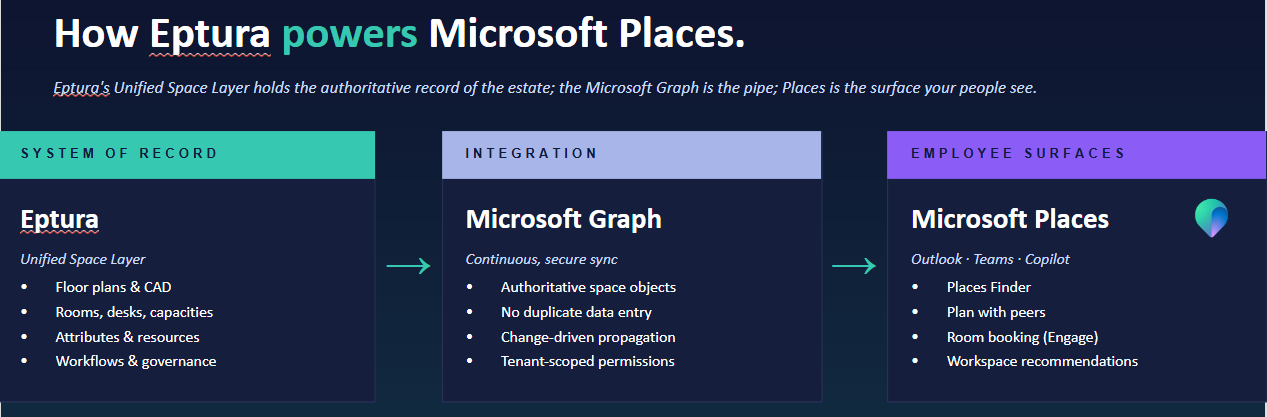
Eptura’s role is increasingly that of a workplace-data layer. Workplace and space information can be maintained in a centralized system of record and synchronized across Microsoft environments through Microsoft Graph. This helps organizations avoid maintaining duplicate workplace records while ensuring employees access consistent information whether they are booking rooms in Outlook, coordinating attendance through Places, collaborating in Teams, or viewing analytics through Power BI and Fabric.
This approach supports what many financial services organizations need most: a single source of truth for workplace information. Floor plans, room capacities, workplace resources, workplace policies, visitor workflows, and operational data can remain synchronized across Microsoft surfaces while maintaining governance and control.
The broader value is not any individual integration. It is the ability to connect physical workplace operations with the digital workplace employees already use every day.
When workplace context and work context come together, organizations gain better visibility for decision-makers, less friction for employees, improved governance for security teams, and stronger foundations for AI-powered decision-making.
Connected data is becoming a competitive advantage
Financial services organizations do not have a shortage of workplace technology. In many cases, the bigger challenge is turning years of technology investment into an ecosystem that provides a consistent view of people, spaces, assets, visitors, workplace services, and operations.
Connected data changes what those systems can deliver.
CRE leaders gain a clearer understanding of utilization. Facilities teams can align services with demand. Security and compliance teams gain stronger visibility into workplace activity. Employees encounter fewer disconnected processes. AI gains the context required to move beyond isolated assistance toward intelligent workflows.
Microsoft’s vision for workplace coordination and AI increasingly depends on connected workplace information. The organizations gaining the greatest value from technologies such as Microsoft Places, Copilot, Fabric, Teams, and Outlook are not necessarily deploying more technology. They are building trusted workplace-data foundations that connect people, space, operations, visitors, and security processes.
For financial services firms, that foundation is becoming a competitive advantage. When workplace information is connected, it becomes easier to coordinate hybrid work, improve compliance, streamline operations, optimize portfolios, and support AI-powered decision-making from a single source of truth.
As organizations pursue Frontier Firm strategies, the strongest foundation will not necessarily come from adding another application. It will come from connecting the information they already have and making it available wherever employees, leaders, and AI need it.
See how Microsoft and Eptura are helping financial services organizations become Frontier Firms
Join Microsoft and Eptura at Microsoft London on September 9, 2026, for Leading the Frontier: Reimagining the Workplace with Microsoft & Eptura.
The executive event will explore how AI-powered, connected workplaces are reshaping financial services, with sessions covering Microsoft Places, Teams Rooms, Copilot, workplace analytics, agentic AI, workplace data strategy, and connected operations.
See how financial services organizations can move from fragmented systems to AI-ready workplace ecosystems designed to improve decision-making, operational performance, compliance, and employee experience.
Register for Leading the Frontier: Reimagining the Workplace with Microsoft & Eptura
Frequently Asked Questions

By Erin Sevitz
As Vice President of Content and Customer Marketing at Eptura, Erin Sevitz oversees teams responsible for providing worktech insights and engaging 25 million Eptura users worldwide. With over 10 years in thought leadership on workplace management and the built environment, Erin brings deep industry knowledge to her role. Previously, she led communications for the International Facility Management Association, a global nonprofit dedicated to professional development for workplace strategists and building managers, and served as editor in chief for IFMA’s FMJ magazine.