


Most organizations don’t struggle to collect space data. They struggle to trust it.
Across planning, workplace management, asset tracking, and visitor workflows, space is often defined slightly differently in each system. Floorplans vary. Space hierarchies don’t align. Updates don’t consistently carry over.
At a time when workplace strategy depends on real-time insight, that inconsistency becomes more than an inconvenience. It becomes a blocker.
This matters more now than ever. Hybrid work has fundamentally changed how offices are used. Today, 92% of companies operate in a hybrid model, and usage patterns fluctuate daily rather than remaining fixed.
Without a consistent spatial foundation, organizations are making decisions in an environment where the underlying data is constantly shifting.
Key takeaways
- Space data inconsistency is a trust issue, not a collection issue. Most organizations already have the data — they just can’t rely on it across systems
- Fragmentation creates hidden operational drag. Teams spend more time validating and reconciling data than acting on it, slowing down decision-making
- Hybrid work amplifies the impact. With usage patterns constantly shifting, inconsistent data makes it harder to align space with real demand
- A unified spatial foundation is critical. Aligning planning and operations around a single, shared version of space enables faster execution and more confident decisions
The real problem: Fragmented space data limits visibility and trust
Space data fragmentation doesn’t always look like a major issue at first. Systems still function. Reports still exist. Work still gets done.
But the cracks show up in how much effort it takes to validate information.
Organizations are now relying heavily on space utilization data to guide decisions. In fact, 89% of organizations rank space utilization as their most important workplace metric, yet many are still pulling that data from disconnected systems.
At the same time, utilization itself reveals the scale of the problem. While office attendance has stabilized around 51–60% of pre-pandemic levels, actual space utilization often sits below 40%, meaning large portions of real estate are underused or misaligned with how people work.
The gap between what’s planned and what’s actually happening is where fragmentation becomes costly.
Teams spend time reconciling floorplans instead of acting on them. Reports require validation before they can be shared. Small inconsistencies cascade into larger inefficiencies.
The issue isn’t a lack of insight. It’s a lack of alignment.
Why planning and operations fall out of sync
Planning and operations rely on the same data, but they rarely operate from the same version of it.
Planning tools are designed to model the future. Operational systems reflect real-time conditions. When those systems are not aligned, every transition between planning and execution introduces friction.
That friction is amplified in today’s workplace.
Office usage is no longer predictable. Utilization peaks midweek and drops significantly at the beginning and end of the week, creating uneven demand across the same footprint.
At the same time, behavior is changing. Desk usage is increasing, meeting room usage is declining, and employees are spending more time in the office when they do come in.
Without a consistent data layer, planning decisions are based on assumptions, while operations are reacting to real-time conditions. The two rarely meet cleanly.
That’s why moves, restacks, and day-to-day changes often require manual coordination across systems. The data itself isn’t synchronized, so the work has to be.

A unified space layer across every product
Instead of connecting fragmented systems after the fact, a unified platform solves the problem at the foundation.
It standardizes how space is defined and shared across the entire ecosystem. Every capability references the same floorplans, space hierarchies, and location data.
This is a structural shift.
Rather than syncing multiple versions of space data, there is one version that every product uses.
That means when a floorplan is updated, it updates everywhere. When a space is redefined, every workflow reflects that change. Planning and operations are no longer working from parallel datasets.
They are working from the same one.
One place, one version of space
When space data is unified at the platform level, the experience changes in a very practical way.
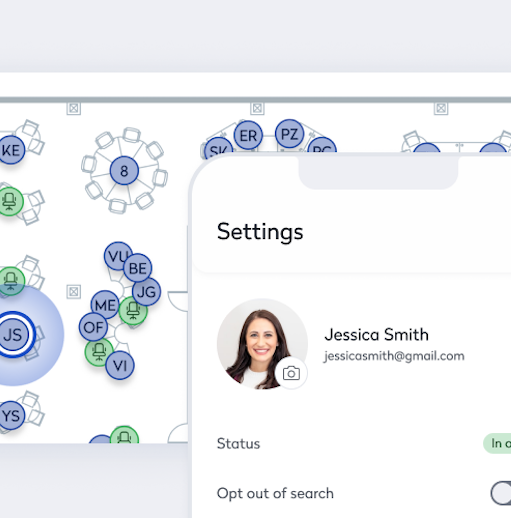
Instead of navigating multiple systems to understand what’s happening in a building, users see a single, consistent view of space.
Everything lives in one place. Everything uses the same structure.
This matters because workplace complexity has increased significantly. Desk bookings alone have grown by 33% globally year over year, while organizations continue to bring more employees back into the office.
As demand increases, the ability to quickly understand what space is available, how it’s being used, and what can be adjusted becomes critical.
A unified view removes the delay between insight and action.
There’s no need to cross-check data or confirm accuracy. The platform already ensures consistency.
What becomes possible with a unified foundation
When every product operates on the same spatial layer, workflows accelerate because they no longer depend on reconciliation.
This has a measurable impact.
Organizations that align space data across planning and operations consistently see faster execution and better utilization outcomes. Office restacks can happen up to twice as fast and move planning time can drop significantly because teams are no longer coordinating across disconnected systems.
More importantly, it enables better use of space overall.
With clearer visibility, organizations can address underutilization, rebalance layouts, and respond to shifting workplace patterns. That’s critical in a world where 36% of workstations go unused on a typical day, even in actively used offices.
The difference is not just efficiency. It’s the ability to act on data in real time instead of reacting after the fact.
Less friction, more focus
When space data is fragmented, a significant amount of time is spent managing it.
Teams check multiple systems. They validate reports. They coordinate updates manually. These small actions add up, creating what many organizations experience as operational drag.
This is happening alongside broader productivity challenges. Employees are already dealing with constant interruptions, averaging 275 interactions per day across meetings, emails, and messages.
Adding data friction on top of that makes it even harder to move quickly. A unified platform removes that layer of complexity.
There is no need to chase down updates or verify whether a floorplan is current. The system maintains consistency automatically, allowing teams to focus on planning, optimization, and execution instead of data alignment.
Unified platform vs. Fragmented systems
| Challenge | Fragmented Systems | Unified Platform |
|---|---|---|
| Space Data Consistency | Multiple, conflicting | Single, trusted source of truth |
| Planning & Operations Sync | Manual reconciliation | Real-time, automatic synchronization |
| Decision Confidence | Low, due to data gaps | High, with live analytics and insights |
| Hybrid Work Adaptability | Slow, reactive | Fast, proactive, data-driven |
Why this matters now
Workplace strategy is becoming more dynamic, not less.
Organizations are adjusting space based on real-time usage, employee behavior, and evolving business needs. At the same time, many are reducing their physical footprint, with 75% planning to shrink office space further.
That combination increases pressure on every square foot.
Without consistent data, it’s difficult to know what to keep, what to change, and what to eliminate. Decisions become slower and less confident.
A unified platform changes that by ensuring every decision is based on the same, accurate view of space.
Establishing a single foundation for smarter decisions
Keeping space data consistent is not about improving individual tools. It is about ensuring every part of the organization operates from the same foundation.
A unified platform achieves this by creating a shared spatial layer that removes the need for reconciliation and delivers a consistent, reliable view of space.
The result is clear; one floorplan, one structure, one source of truth.
When that foundation is in place, planning and operations stay aligned, workflows move faster, and decisions happen with confidence instead of hesitation.
Frequently Asked Questions

By Amanda Meade
Amanda Meade is a content creator at Eptura, specializing in workplace experience, meeting productivity, and emerging trends in workspace planning and visitor management. With a background in content marketing and SEO, she crafts clear, actionable content that helps teams work smarter through in-office collaboration. Throughout her career, Amanda has worked across industries, including home services, healthcare, real estate, and SaaS, developing a unique ability to distill complex topics into practical insights.