Nearly half of employees are adapting their workday to the workplace before they even arrive. According to Eptura’s 2026 Workplace Index, 44.6% of employees plan their day around workspace availability. The behavior may reflect unrelated personal preferences, commuting patterns, team schedules, or other factors, but when those individual choices repeat across teams and locations, they can provide valuable operational insight into demand, space suitability, and workplace conditions.
The finding becomes more meaningful alongside the rest of the employee data. At least sometimes, 30.1% are unable to find a space that supports their work, while 33.6% experience meeting delays caused by room or technology issues. Another 27.7% move workspaces at least a few times per month because of noise, comfort, privacy, or overcrowding, according to the index.
Availability involves more than open desks. Employees need suitable spaces and reliable information about what they will find when they arrive.
Key takeaways
- Employee planning behavior can reveal workplace uncertainty: Repeated schedule changes can help workplace teams identify where demand, space suitability, technology, or services may not align with employee needs
- Availability depends on context, not open desks alone: Employees need reliable information about suitable space, workplace conditions, colleagues, technology, and services before they can plan an effective day onsite
- Connected evidence supports stronger workplace decisions: Reservations, occupancy, service, visitor, asset, and portfolio data help teams investigate causes, test assumptions, and plan improvements with greater confidence
Together, these signals create a clearer view of how employees experience the workplace and where operational conditions influence their choices. Workplace and real estate teams can use that context to move from isolated events toward evidence-based decisions.
Treat employee planning behavior as an operational signal
Employees often develop workarounds when the workplace feels unpredictable. They may arrive earlier to find a quiet desk, avoid popular office days, book more space than they need, or choose remote work when they cannot confirm that the office will support their plans. Those behaviors do not establish that workplace operations are failing. They can reveal where employees are compensating for uncertainty.
That distinction matters because individual choices can become an important source of operational context when they repeat across locations and teams. If employees consistently change their schedules around workspace availability, workplace leaders can investigate where demand concentrates, which workspace types fill first, and whether the same room, technology, or service issues appear repeatedly. The finding should start a line of inquiry rather than supply a conclusion by itself.
You can begin by comparing employee behavior with booking, occupancy, service, and space data. Look for patterns by day, building, floor, neighborhood, and workspace type. A building may have empty desks while still running short of focus rooms, meeting spaces, or areas that support confidential work. The useful question is whether the available environment matches what employees are trying to accomplish.
Give employees visibility beyond the booking screen
Access to workplace technology remains uneven. Only 36.7% of employees say their organization provides workspace booking software or a mobile app, and just 17.1% report access to digital availability displays or maps. Meanwhile, 38.2% say their organization provides no technology for managing workplace interactions.
Booking access is an important starting point, but booking visibility and operational visibility are different.
A reservation system can show that a desk is open. Employees also need to know whether the available space supports the work they plan to do. Focus work may require quiet and privacy, collaboration may depend on sitting near colleagues, and a meeting may require the right room, functioning technology, and support services. When those signals remain disconnected, employees still carry much of the uncertainty.
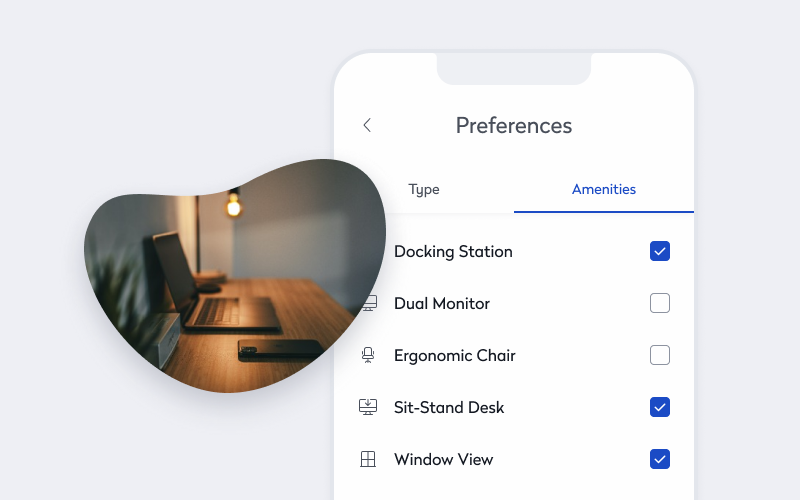
For workplace teams, visibility also extends beyond current availability. They need to understand where demand is building, which types of space employees seek, whether reservations match actual use, and how room conditions, service performance, visitor activity, and technology readiness affect the workplace experience. That broader operational view helps teams distinguish an apparent shortage from a suitability or reliability problem and gives them stronger context for future planning decisions.
You can create that view by connecting information about reservations, occupancy, rooms, services, visitors, and the physical spaces themselves. With connected workplace information, you can help employees make more predictable choices before they commute, identify where the experience shown in a booking tool differs from actual conditions, and see how changes in one part of the workplace ecosystem affect the others.
Match workspace capacity to the work employees need to do
The Workplace Index also identifies a tension between portfolio utilization and employee experience. 53% of managers estimate that at least a quarter of their current real estate is underutilized. At the same time, employees report difficulty finding suitable space and planning around availability.
Both conditions can exist because portfolio capacity is not evenly interchangeable. Space may be available in the wrong location, on the wrong day, or in a format that does not support current work patterns. An organization can have a large supply of assigned desks and still lack enough focus rooms or collaboration areas during peak periods. Employees may also avoid theoretically available areas when they cannot confirm that the space, equipment, or surrounding services will meet their needs.
You need more than occupancy data alone to make confident portfolio decisions. Utilization shows how much space is being used, but it does not explain whether that performance is typical for a comparable portfolio or whether the current space mix supports the work employees need to do.
Comparative portfolio benchmarks can provide context for utilization patterns, demand distribution, and space-mix decisions. For example, benchmarking can help teams determine whether low utilization reflects a portfolio-wide trend, a location-specific issue, or a mismatch between available space types and employee demand before deciding whether underused space should be reduced, redesigned, or repurposed.
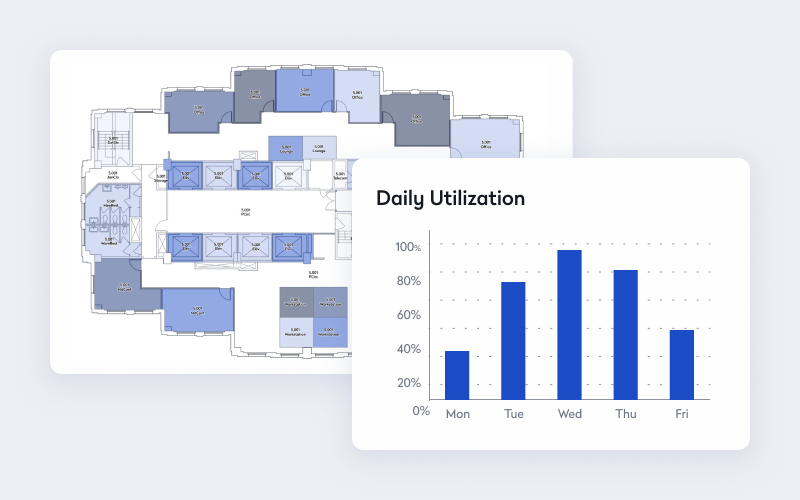
Used alongside employee behavior, service performance, and operational data, benchmarking can help validate assumptions and distinguish broad excess capacity from a shortage of specific workspace types, uneven demand across locations, or space that is technically available but unsuitable. The benchmark provides a point of comparison rather than a standalone target, helping workplace and real estate teams evaluate whether to reduce, reshape, replace, or redistribute space.
The distinction has practical consequences. 57.3% of managers say their organizations plan to increase workplace space during the coming year, even as many report substantial underutilization. The survey does not establish whether those plans represent net-new square footage, replacement of unsuitable space, or geographic redistribution. It does show why planning decisions need context. Before adding or removing capacity, you need to understand how people use the portfolio, what kinds of space they seek, and where the current mix falls short.
Turn integrated data into better workplace decisions
Most managers report progress connecting workplace technology. In the Workplace Index, 73.9% describe their systems as mostly or fully integrated, and 67.1% say they have a mostly or completely unified view of space, occupancy, services, assets, and visitors. Even so, 41.5% frequently rely on assumptions rather than live data, and 34.1% frequently experience decision delays caused by inconsistent data. Workplace leaders increasingly need evidence rather than assumptions when making decisions about space, employee experience, services, and portfolio investments.
Integration matters because workplace decisions rarely belong to a single dataset. A spike in desk bookings may look like a capacity problem until occupancy data shows high cancellation or no-show rates. Low utilization may suggest excess space until service requests reveal persistent equipment failures in the affected area. Repeated room changes may reflect employee preference, or they may point to problems with noise, privacy, comfort, or technology.
Workplace issues also rarely originate in a single system. Visitor activity can increase demand in specific areas, equipment failures can make a reserved room unusable, service delays can reduce the effective supply of suitable space, and unused reservations can distort the apparent capacity picture. Connecting reservation, occupancy, service, visitor, asset, and portfolio information helps teams trace how those conditions interact so they can investigate causes rather than respond only to symptoms.
By connecting these signals, you can investigate conditions and act with greater confidence. You can align employee experiences with space planning, facilities services, visitor processes, and portfolio strategy while giving workplace, real estate, facilities, information technology, and human resources teams a more consistent basis for cross-functional decisions.
As workplace teams collect more information about reservations, occupancy, service requests, visitor activity, assets, and space performance, identifying meaningful patterns becomes more difficult.
AI-assisted analysis can surface patterns across those datasets that teams might otherwise miss. It can also help them investigate anomalies, explore complex information, and evaluate planning options more efficiently. Its value is decision support: people still need to interpret the operational context, test the findings, and remain responsible for decisions that affect employees and the portfolio.
Build a feedback loop that reduces employee workarounds
You can create a more predictable workplace through repeated observation and adjustment. Identify where demand exceeds suitable capacity, then compare reservations with actual use. Track when employees relocate, which spaces generate service requests, and where room or technology problems delay meetings. You can use those patterns to distinguish a broad shortage from a specific issue involving visibility, workspace type, reliability, or policy.

Next, communicate realistic availability before employees commit to the trip. Keep workplace information current, make suitable spaces easier to find, and show the context employees need to choose confidently. Then measure what happens after changes to layouts, services, booking rules, or the workspace mix. If the same workarounds continue, the intervention may not have addressed the condition employees were responding to.
The 44.6% finding should be tested against each organization’s operational data. A lower percentage over time could indicate that employees have a clearer view of the workplace, although it would need to be considered alongside attendance, utilization, employee feedback, and business needs. You can use the feedback loop to replace assumptions with evidence and make workplace planning more responsive to actual behavior.
See how one company connected workplace reservations across 14 locations
A global analytics company needed to reduce workplace uncertainty across countries and time zones. Employees did not have a consistent reservation experience for coordinating where they would work, while workplace teams lacked the utilization visibility needed to understand demand and plan future changes. Those gaps made individual workplace decisions less predictable and left portfolio teams with less evidence about how space was being used.
The organization unified workplace reservations across 14 locations in seven countries. Employees gained a more consistent way to find and reserve suitable workspace before arriving, while workplace teams gained real-time utilization insights and adoption data they could use to understand demand and inform workplace design. The organization reduced uncertainty by giving employees a more reliable picture of where they could work and helping workplace teams understand how demand shifted across locations.
The implementation showed what can happen when employees and workplace teams work from more consistent information:
- More predictable workplace decisions: Employees had a clearer, repeatable way to find and reserve suitable space across locations before committing to their plans
- Greater confidence across a distributed portfolio: Consistent reservation information made it easier to coordinate workplace use across countries and time zones
- Stronger evidence for workplace planning: Real-time utilization insights and adoption data gave workplace teams more context for decisions about demand, workplace design, and future space needs
- Rapid adoption at scale: The rollout reached more than 1,100 active users in 90 days, giving the organization a broader evidence base for understanding workplace behavior
These challenges are not specific to analytics companies. Any organization managing multiple locations can face the same need to simplify reservations, improve utilization visibility, and give employees more confidence that the workplace will support their plans.
See how the company reached more than 1,100 active users in 90 days and used adoption data to inform workplace design in the full success story.
Frequently Asked Questions

By Erin Sevitz
As Vice President of Content and Customer Marketing at Eptura, Erin Sevitz oversees teams responsible for providing worktech insights and engaging 25 million Eptura users worldwide. With over 10 years in thought leadership on workplace management and the built environment, Erin brings deep industry knowledge to her role. Previously, she led communications for the International Facility Management Association, a global nonprofit dedicated to professional development for workplace strategists and building managers, and served as editor in chief for IFMA’s FMJ magazine.