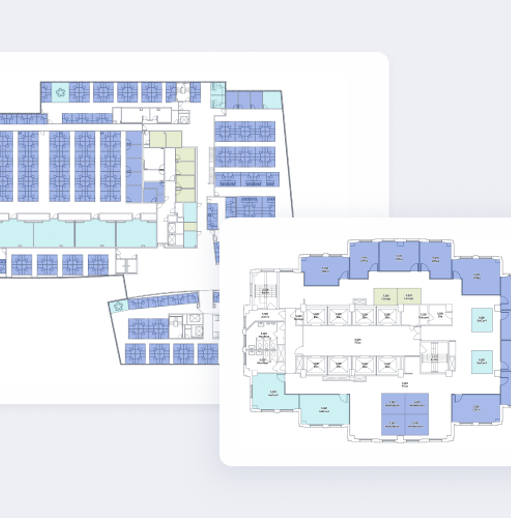



Space planning isn’t a new concept, yet many companies still use legacy products to govern their workplace. They’re entrenched in familiar software that’s “good enough” instead of looking for a modern application. The time has come to make the leap to an online space planning tool. Not only is it more efficient, the modern features and capabilities of an online space planning platform provide the competitive edge needed to thrive in today’s agile environments.
Looking for reasons to upgrade? Here are five to justify making the leap. Take a look at how these features lend themselves to everyday workplace optimization.
1. Birds-eye workplace view
While a legacy space planning tool may give you a top-down view of the workplace, it likely does so in silos, looking at businesses by segment, instead of holistically. But this isn’t how we look at space today, and it’s not an effective way to govern the workplace.
Online space planning software evaluates the entire workplace and how different business segments interact with each other. How often was Conference Room C occupied last month? According to the stack plan, which floors have open seating? How can you arrange facilities to put Marketing and Sales together for better synergy? Online tools provide the insights a workplace needs to stay efficient.
2. Mobile space planning
These days, a facility manager isn’t chained to a desk. They’re out on the floor making adjustments in real-time. They need space planning software that’s as adaptable and mobile as they are.
Online space planning software is accessible for any mobile device—be it a laptop, tablet, or smartphone. When a facility manager stands in the middle of a busy, buzzing workplace, they’ll have the power of data-backed decision-making in their hand. Whether it’s coordinating space reservations or adapting to a change in workflow, mobile space planning helps facility managers adapt the workplace on-the-fly. It’s a necessity in today’s agile workplaces.
3. On-the-go oversight and adaptability
Manage multiple locations? Have a workforce that’s split between remote employees and in-house staff? This diversification and workforce fragmentation factors heavily into space planning. A modern space planning app accounts for these complexities and gives space planners the ability to seamlessly identify the needs of various workgroups and locations.
A manager at Facility B can quickly assess the floor plan of Facility A to help this location adapt. A space planner can even work remotely themselves, providing off-site advice for critical oversight. Online planning tools open the door to better space efficiency, no matter where or when they’re needed.
4. Easy ecosystem integration
Space planning tools aren’t the only software helping the workplace evolve—however, they’re often governing the digital office ecosystem. The problem is legacy products don’t always play nice with others. Modern software is better-engineered to integrate and collaborate with essential applications and digital processes.
Consider integrations like messaging apps, sensor and beacon data streams, and other facility management resources. A centralized space planning platform that ties these applications together is a valuable tool in greater workplace management goals. For example, you can design a floor plan, share it to the business’ cloud for collaboration, and message stakeholders for their input—all through a common platform.
The more digital the workplace becomes, the more essential integration among digital systems becomes. Companies can’t afford to keep finding workarounds for legacy products. They need software solutions that seamlessly integrate and don’t impede collaboration.
5. Collaboration across teams
To keep facilities running effectively takes team effort. Facility managers may be the driving force behind action and adaptation, but they’re far from the only decision-makers and stakeholders shaping the workplace. Department heads, executive leadership, and employees all have a voice in the modern workplace. They need a way to effectively collaborate. When everyone’s voice is heard, better changes take root.
Online space planning tools are great for collaboration—largely because they live in the cloud. Whether it’s getting feedback on an action plan, input on a potential workplace change, or general task delegation, cloud apps make broad communication simple. Integration with apps like Slack only add to information organization and help eliminate endless email chains and interoffice memos.
Move beyond “good enough”
When it comes to space planning software, “good enough” doesn’t cut it anymore. Legacy systems let companies map and manage their workplaces, but they can’t support the agile demands of a diverse work environment. Online space planning tools are the new norm and for good reason. They’re smarter, faster, and more efficient than we are at recognizing what makes the workplace work well.
Keep reading: Space Planning Software Buyers and Info Guide.

By Jonathan Davis
As a content creator at Eptura, Jonathan Davis covers asset management, maintenance software, and SaaS solutions, delivering thought leadership with actionable insights across industries such as fleet, manufacturing, healthcare, and hospitality. Jonathan’s writing focuses on topics to help enterprises optimize their operations, including building lifecycle management, digital twins, BIM for facility management, and preventive and predictive maintenance strategies. With a master's degree in journalism and a diverse background that includes writing textbooks, editing video game dialogue, and teaching English as a foreign language, Jonathan brings a versatile perspective to his content creation.