Workplace and asset leaders have navigated a decade of disruption. The pandemic reshaped work, hybrid models changed how people use space, and supply chain and labor pressures complicated operations. Meanwhile, connected systems, operational data, and AI expanded what organizations could understand and act on.
Across hundreds of conversations on the Workplace Innovator and Asset Champion podcasts, one lesson remained clear: the professions changed, but their foundations did not. Success still requires understanding people and assets, building trustworthy information, connecting teams and systems, adapting to evidence, and showing how investments supported organizational priorities.
Key takeaways
- Purpose should guide workplace and asset decisions: Start with people, assets, and intended business outcomes, then choose the environments, processes, information, and technology that support them
- Connected, trustworthy information turns signals into coordinated action: Reliable workplace, maintenance, occupancy, service, and asset data helps teams understand shared operational conditions and make better-informed decisions
- Technology creates value when people remain accountable: Analytics and AI can surface patterns, reduce manual work, and identify risks earlier, while people continue to provide context, judgment, oversight, and responsibility
These principles have remained relevant even as operating models, expectations, and technology have changed. Together, they give workplace and asset leaders a practical foundation for adapting without losing sight of purpose, operational performance, or the people their decisions affect.
The future was already taking shape before the disruption
Workplace transformation did not begin when offices closed in 2020. The first Workplace Innovator podcast conversation in April 2018 described the workplace as a strategic environment shaped by facility management, corporate real estate, human resources, and information technology. “Introduction to the Workplace Innovator Podcast” connected employee experience with collaboration, talent attraction, technology, and what it called the “digital workplace revolution.” The discussion treated the workplace as an organizational system rather than a collection of buildings.
Asset management followed a related path.
Episode nine of the Asset Champion podcast from July of 2020, “The Rapid Evolution of Preventive & Predictive Maintenance Technologie,” traces the move from analog records and reactive work toward historical asset information, analytics, preventive maintenance, and predictive approaches. Better records could help teams understand failure patterns, choose between repair and replacement, schedule work earlier, and connect maintenance decisions with financial outcomes.
Episode guest Emmett Cooke, asset management industry-veteran and retired Senior Sales Consultant for IBM, explains how historical maintenance data can change a repair-or-replace decision: “Without historical data, you aren’t able to find out what you discover with the data, which is that five of those units we’ve repaired three times more than the other units. So, what do you do about that? That’s the kind of decisions that come out of the historical data that can make a real difference to the bottom line.”
Those early conversations established the direction of travel. Workplace leaders were taking on strategic responsibilities. Asset teams were building stronger information foundations. Both groups needed closer collaboration across functions and a clearer connection between operational activity and organizational outcomes. Digitization supported the shift, but the real change involved how leaders framed their responsibilities.
The capabilities organizations were already developing were about to face an extraordinary stress test. Reliable information, connected teams, and adaptable processes would matter most when familiar assumptions no longer held.
The best plans were the ones that could change
Workplace and asset leaders repeatedly encountered circumstances they could not neatly plan around. Sudden changes in workplace use, supply-chain constraints, labor pressures, shifting employee expectations, and new technology challenged established assumptions, often with incomplete information.
The central issue extended across both professions: How could organizations make sound decisions while the conditions behind those decisions kept changing?
COVID provided an unusually severe example. In May 2020, “Planning for the Return to Offices and the Future of the Workplace during COVID-19” captured organizations making high-stakes choices without a universal model.
In that episode, Kay Sargent of HOK warned against rushing toward a single answer: “Companies have to make a decision about the level of risk they’re willing to take and what it means for their business. And that’s going to be different for every single company. It’s not one checklist that’s going to solve everybody’s problems.”
The lesson extended beyond office policy and beyond the pandemic. Organizations could not rely on predicting exactly what would happen next. Workplace and asset teams needed reliable information, cross-functional coordination, clear decision rights, and feedback that showed whether a strategy was working. They also needed the ability to change direction when it was not. Resilience came from adaptability supported by timely information, forecasting, scenario planning, and the ability to respond as conditions changed.
Hybrid work changed the question from attendance to purpose
Early return-to-office debates often focused on timing, policy and attendance. Hybrid work pushed the conversation toward a useful question: What should the workplace help people accomplish?
The March 2022 conversation “Why Return to the Office? Exploring the Value and Purpose of the Future Workplace” reflected that shift. Phil Kirschner discussed workplace culture in relation to employee needs and the business outcomes organizations require. The office had to clearly demonstrate its value within a hybrid work ecosystem by supporting experiences and activities that mattered, including collaboration, concentration, connection, learning, and access to tools or spaces that employees could not easily replicate elsewhere. Rather than replacing other work settings, the workplace needs to serve as a destination for activities that benefit from intentional in-person experiences.
Looking through the lens of purpose changes how teams evaluate workplace performance.
The 2025 episode “‘Have a Data Strategy’ – Elevating Employee Experiences by Researching the Future at Work” offered a sharper way to assess value. Kyle de Bruin, managing director at Leesman, cautioned, “The value of your real estate asset is not just about filling the thing up from a commercial perspective—that may be the trap that we’ve fallen into in the past.”
So, a building can reach an occupancy target and still fail to support the work people came to do. A quieter day can still create value if employees find the right colleagues, complete focused work, use specialized resources, or achieve intended business outcomes. Organizations can evaluate that value through measures such as employee experience, collaboration effectiveness, workplace utilization, and productivity.
Kyle also shared that the average home office outperformed the average corporate office by 10 points on the Leesman Index. The finding does not establish that home always provides the better workplace, though. Instead, it highlights the importance of intentionally designing workplaces that support collaboration, focus, connection, and access to resources employees cannot easily replicate elsewhere. It also underscores the need to continuously evaluate workplace performance and employee needs.
That competition raises the standard. Organizations need offices that support tasks, offer dependable technology, and provide an experience worth commuting for. Booking patterns, occupancy, employee feedback, service requests, and space performance can help teams understand what people need and where the workplace falls short. Teams can then connect specific shortcomings with changes to space, services, technology, or policy.
The practical lesson reaches beyond hybrid policy. Leaders should define the outcome they expect from workplace use before selecting a metric. If the goal involves collaboration, they need evidence about team interaction and access to appropriate space. If the goal involves focused work, they need to understand noise, privacy, technology, and availability. If the goal involves connection, they need to know whether employees can coordinate schedules and find the people they came to see.
Workplace success depends less on counting arrivals and more on understanding intent. When teams know what employees want to accomplish, they can shape spaces, services, and policies around meaningful work.
More data did not automatically create better decisions
Workplace and asset management followed a technology journey: digitize, collect, connect, understand, and act. Each stage created possibilities, while each exposed weaknesses that the previous stage could leave hidden.
Capturing data exposed a larger problem
Asset management efforts focused on replacing paper records and reactive practices. Historical maintenance information helped teams identify recurring failures, schedule preventive work, and make more informed repair-or-replace decisions. Returning to Emmett’s earlier discussion in “The Rapid Evolution of Preventive & Predictive Maintenance Technologies,” stronger asset histories could support predictive approaches and connect maintenance choices with financial outcomes.
Collecting data solved only the first problem. Organizations soon had information spread across computerized maintenance management systems, building systems, drawings, sensors, financial platforms, and spreadsheets. Workplace teams faced a parallel challenge across reservations, occupancy, employee experience, service delivery, and real estate data. More systems produced more signals, but fragmentation made it harder to establish a shared view.
In the late-2025 episode “‘Stay Grounded in the Purpose’ – Implementing Asset Management Technology,” Ryan Linthicum, managing principal, and Brett Milburn, GISP, principal and director of digital solutions at Langan Engineering & Environmental Services, discussed a broader technical landscape that included AI, machine learning, geospatial analytics, enterprise integration, digital twins, and the Internet of Things. They also emphasized the continuing challenges of data silos, governance, lifecycle management, and maintaining a clear operational purpose.
The evolution changes the central management question. The first digital era focused on capturing data. The current era requires organizations to make fragmented data reliable, connected, understandable, and actionable.
Reliable information requires an operational foundation
Organizations increasingly need a connected operational foundation that brings together workplace, asset, maintenance, occupancy, service delivery, and business data. When information is connected across systems and teams, leaders can make decisions based on a shared understanding of operational reality rather than isolated signals.
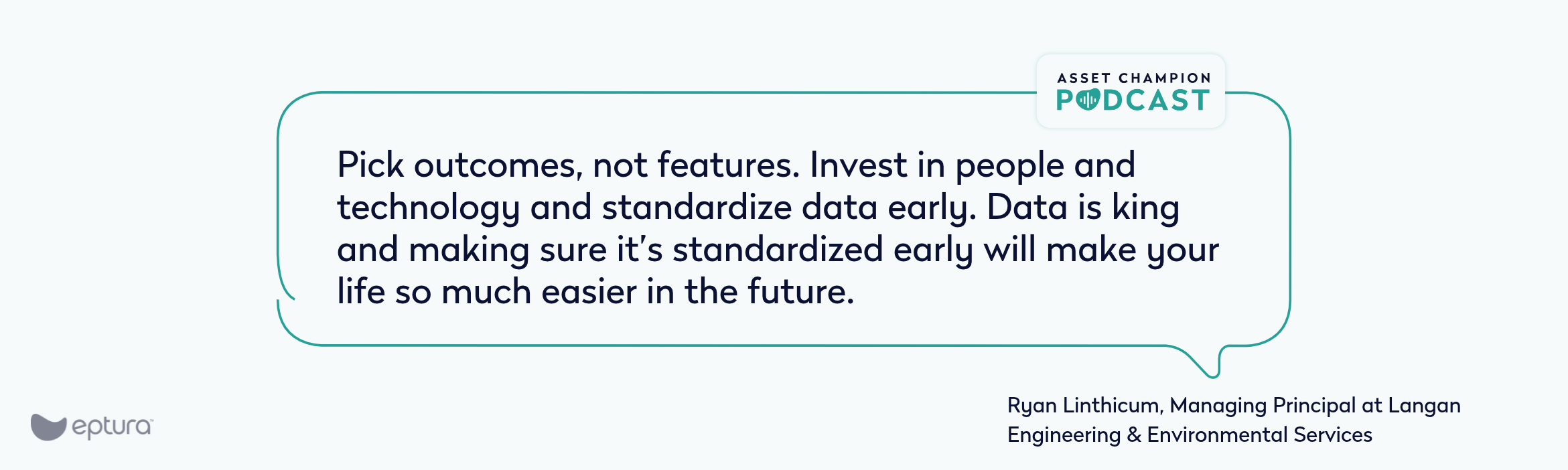
Ryan offered a practical starting point: “Pick outcomes, not features. Invest in people and technology and standardize data early. Data is king and making sure it’s standardized early will make your life so much easier in the future.”
Turning that foundation into better decisions depends on four conditions:
- Reliable data needs consistent definitions, ownership, and maintenance.
- Connected data needs systems and teams that share context.
- Understandable data needs views that match the decision.
- Actionable data needs a clear process for deciding who responds, what happens next, and how teams measure results.
Together, those conditions give teams the confidence and context to move from collecting signals to coordinating action.
Shared context connects decisions across teams
Those requirements bring workplace and asset teams closer together. An occupancy pattern can influence cleaning, energy use, maintenance access, and portfolio planning. Asset condition can affect employee experience, space availability, and capital priorities. Lifecycle decisions improve when maintenance history, cost, risk, and operational demand share a consistent foundation. Finance, information technology, human resources, facility management, corporate real estate, and operations may need different views, yet they increasingly depend on the same organizational reality.
More information creates value when people trust it and can use it to make a decision. Without standardized data, governance, and integration across systems, advanced analytics can produce faster confusion. With a connected foundation, teams can move from isolated observations toward coordinated action, using shared information to support decisions across workplace, facilities, asset management, and business operations.
AI makes the old problems harder to ignore
AI expands the information teams can analyze and the patterns they can surface. It magnifies the consequences of weak data, disconnected systems, and unclear accountability. AI represents a force shaping work, alongside human sustainability and well-being, climate change, and geopolitical shifts. Leaders need to consider how those forces interact instead of treating technology as the destination of workplace evolution.
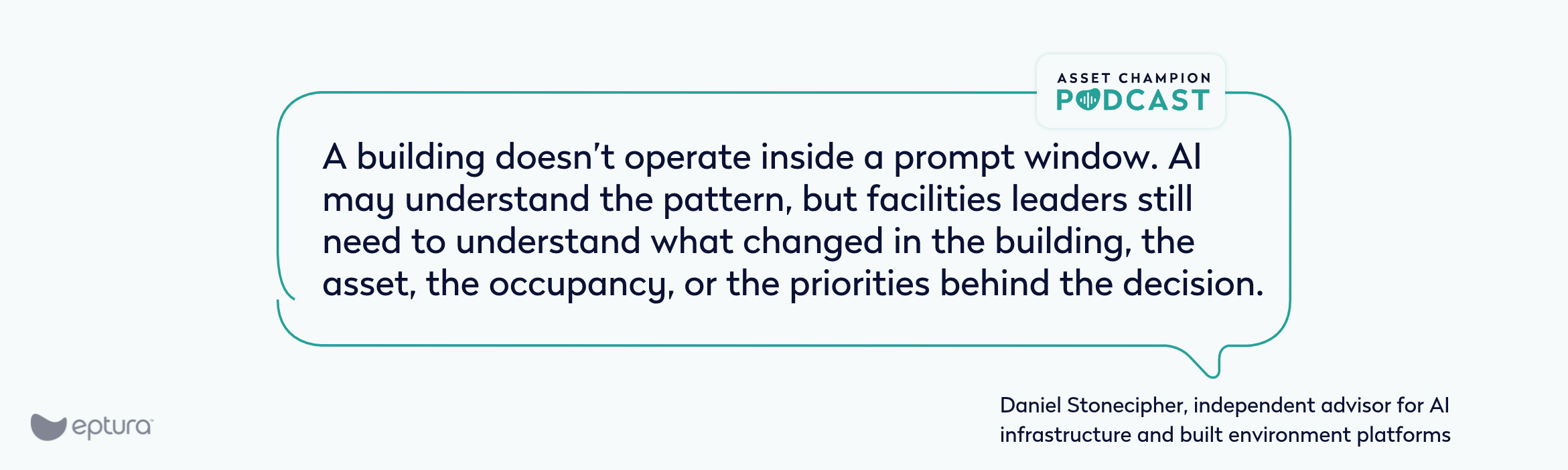
The 2026 Asset Champion conversation “‘The Real Promise of Operational AI’ – Trust, Accountability and Understanding AI for the Built Environment” distinguishes between analyzing information and improving an operational decision. Daniel Stonecipher explains, “A building doesn’t operate inside a prompt window. AI may understand the pattern, but facilities leaders still need to understand what changed in the building, the asset, the occupancy, or the priorities behind the decision.” Operational accountability clearly still belongs to people.
At the same time, AI can help teams identify trends faster, surface operational risks earlier, prioritize maintenance activities, reduce manual analysis, and support more informed decisions. The greatest value comes when AI capabilities are embedded within operational workflows and paired with trusted data and clear accountability.
“‘Let’s Keep On Moving’ – AI, Curiosity, and the Future of FM and Workplace Operations” connects that argument with applications such as analyzing work-order data, identifying trends, and connecting information across systems. Drew DePriest pairs experimentation with data quality, governance, oversight, and continuous learning because human ownership remains essential.
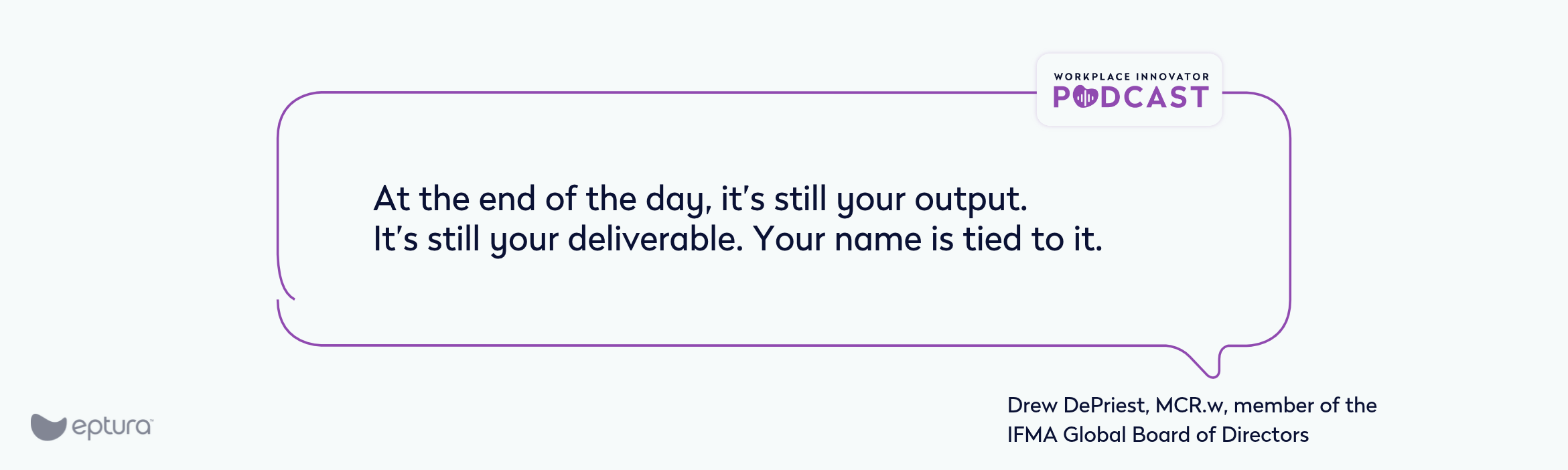
“At the end of the day, it’s still your output. It’s still your deliverable. Your name is tied to it,” explains.
Kay Sargent adds a human dimension in “‘Be Intentional’ – A Decade of Innovation & Designing for Our Future“. She describes “cognitive sovereignty” as people’s ability to think independently, question information, and exercise judgment. Polished answers can arrive quickly, but experience and critical thinking still determine whether an answer makes sense. Her phrase “attention fracking” captures a related risk: continual interruptions can erode the sustained focus people need to process information deeply.
Leaders should ask whether people have the time, space, and habits required to evaluate recommendations. Asset teams need the same discipline when AI informs maintenance priorities, safety decisions, or capital plans.
Efficiency also needs a defined purpose. Automating unwanted administrative work can create genuine value. If efficiency gains simply generate additional administrative burden, information overload, or unnecessary complexity, leaders should question whether technology is creating meaningful value. The most effective uses of technology reduce low-value work and allow teams to focus more time on strategic, operational, and employee-focused outcomes.
AI raises the value of human judgment. Organizations will understand their data, processes, objectives, and decision rights. They will test bounded uses, review results, and distinguish between a system that surfaces a pattern and a person who decides what that pattern means. Strong operational knowledge provides the context needed to challenge a plausible answer before it becomes an expensive or risky action.
The challenges changed. The fundamentals did not.
Across both professions, four durable lessons connect the changes described above. Together, they provide a practical foundation for making decisions when operating conditions change and priorities shift.
Start with people and purpose
Why design spaces this way? Why ask people to work this way? What do employees value? What should people accomplish? Start with people and the outcome, then choose the environment, process, data and technology that support it.
Get the fundamentals right
Know the assets. Maintain accurate information. Understand how people use space. Establish repeatable processes and complete basic operational work consistently. Connected platforms, predictive tools and AI make those foundations more valuable because advanced capabilities depend on reliable inputs and disciplined execution.
Connect information and people
The professions increasingly operate across traditional boundaries. Facility management, corporate real estate, human resources, information technology, finance, maintenance, and operations bring different responsibilities and perspectives. Shared information helps them coordinate decisions without erasing those differences. Strong collaboration gives data context and gives action clear ownership.
Prepare for change without pretending you can perfectly predict it
Organizations cannot perfectly predict the next disruption, settle on one working model for every workforce, or know how AI, climate change, and geopolitical shifts will reshape every role, location, or process. Leaders can see what is changing, understand the information, ask better questions, consider longer-term consequences, make informed decisions, and adjust when evidence changes.

Long-term consequences deserve particular attention in workplace and real estate decisions. Buildings may stand for 70 years or more. Leases, locations, asset strategies, and workplace choices can influence organizations long after current technology trends fade. Leaders cannot future-proof every building or process, but they can make deliberate choices about where each decision leads.
Intentional organizations build trustworthy information, clear communication, and accountable decision processes before disruption forces improvisation. Their records help teams learn across workplace, maintenance, and asset decisions, challenge inherited practices, and change direction without treating every disruption as a new problem.
The next chapter is about outcomes enabled by technology
Technology will keep changing what workplace and asset leaders can understand and improve. Yet across every economic, societal, and technological shift, the fundamentals remain: define the purpose, build trustworthy information, ask better questions, and keep people accountable for the decisions that follow.
Better tools can reveal patterns and connect signals, but progress still depends on careful, human-centered choices about what organizations design, automate, and prioritize. Preparing for the future means using new capabilities thoughtfully while considering the people affected today and the lasting consequences.
Kay reminds us: “We need to just slow our roll, be intentional, remember who we’re designing for, and create a world that our children will be thankful for.”
Start your exploration of our 600-plus insight-packed episodes on the Eptura podcast hub.
Frequently Asked Questions

By Mike Petrusky
As Director of Podcasts at Eptura, Mike Petrusky hosts both the Workplace Innovator Podcast and the Asset Champion Podcast, sharing thought leadership with CRE, FM, and IT leaders in the digital and hybrid workplace. Mike has produced more than 500 podcast episodes listened to in over 111 countries. As an in-demand public speaker, Mike engages audiences at numerous industry events each year, including International Facility Management Association and CoreNet conferences, focusing on the human element of workplace and facility management.