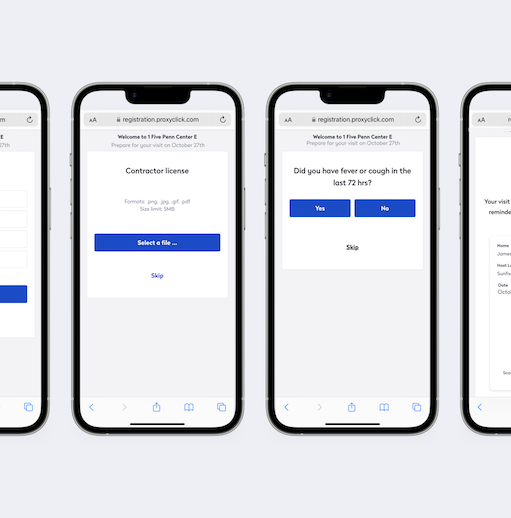



A candidate arrives for a final-round interview at a law firm. Their meeting is scheduled, the hiring team is expecting them, and a conference room has been reserved. Yet they remain stuck in reception while credentials are manually verified and approvals are tracked down. As employees move seamlessly through secured doors around them, the candidate is left wondering whether anyone knows they’re waiting.
Most legal firms would view this as a minor operational hiccup. In reality, moments like these reveal a much larger workplace challenge. Organizations that spend years building trust with clients, recruits, and employees can unintentionally undermine that trust through disconnected workplace experiences.
That risk is growing. Recent Workplace Index data shows professional services firms now average more than three days per week in the office, with desk bookings up 33% year over year — while visitor volumes have nearly doubled in the past three years. Together, these trends are increasing pressure on legal workplaces to deliver seamless, secure, and scalable in-person experiences.
The issue is rarely a lack of security controls. Instead, it stems from workplace systems that weren’t designed to work together.
Key takeaways
- Security friction in legal firms is often a coordination problem rather than a control problem
- Manual approvals, disconnected systems, and workplace workarounds can create compliance risks that are difficult to identify through traditional audits
- Integrated workplace platforms help connect visitor management, access control, workplace operations, and employee data to create a more consistent experience
- Stronger workplace experiences and stronger security outcomes are not competing goals when policies are embedded into workflows
- Reductions in exception requests, improved audit trail completeness, and time savings across reception and IT teams signal successful workplace integration —and often correlate with measurable business impact
The compliance cost hiding in plain sight
Legal firms operate in one of the most highly regulated professional environments. Every day, employees handle privileged communications, confidential client information, financial records, intellectual property, and sensitive litigation materials. Protecting these assets requires robust security controls, but it also requires visibility into how workplace processes function in practice.
Many organizations assume compliance risks originate from missing policies or insufficient controls. More often, the risks emerge in the spaces between systems. This fragmentation is more common than many leaders expect. Workplace Index research shows the average organization relies on 17 standalone workplace technologies, while only 4% report having a fully integrated platform. For legal firms, this lack of connectivity directly impacts their ability to deliver consistent experiences and maintain defensible compliance.
A visitor approval completed through email, a temporary access request handled over the phone, or a manual badge override performed at reception may seem harmless in isolation. Together, these activities create operational blind spots that are difficult to track and even harder to audit. These gaps are often the result of workplace systems operating independently.
Visitor management platforms, access control systems, employee directories, workplace reservation tools, and security applications may all contain relevant information, but that information isn’t always connected. Employees and administrators are often forced to bridge gaps manually, introducing opportunities for inconsistency.
The most visible points of friction tend to receive the most attention. Long reception lines, delayed visitor check-ins, and access issues are easy to identify because they disrupt daily operations. However, the greater compliance risks are often far less visible.
An employee who retains permissions after changing roles, a contractor with access beyond the duration of a project, or a visitor record that doesn’t align with access logs may never generate a complaint. Yet these inconsistencies can create significant challenges during audits, investigations, or compliance reviews.
For legal firms, compliance is not simply about enforcing policy. It’s about demonstrating how policies are consistently applied across the organization. That level of accountability becomes increasingly difficult when workplace systems operate in isolation.
More controls don’t solve a coordination problem
When organizations identify security concerns, the instinctive response is often added to more controls. Additional approvals, stricter verification processes, and increased oversight can seem like logical solutions. Yet when underlying workflows remain fragmented, adding layers of enforcement rarely addresses the root cause.
Every legal firm eventually develops two security systems. The first exists within official policies, governance frameworks, and documented procedures. The second develops organically through everyday workplace behavior.
Employees, administrators, and workplace teams are constantly balancing compliance requirements against operational realities. A partner may message reception to approve a visitor. An assistant may coordinate directly with facilities to expedite access. A workplace manager may temporarily override a process to avoid delaying an important client meeting. These actions typically occur because people are trying to solve immediate problems, not because they are intentionally circumventing policy.
Over time, however, these workarounds have become normalized. What begins as an exception evolves into an unofficial operating model that exists alongside formal procedures. Security leaders often refer to this phenomenon as shadow access, but the term can be misleading. Shadow access is not the problem itself. It is evidence that official workflows are creating friction.
This distinction matters because it shifts the conversation from enforcement to design. Organizations that focus exclusively on restricting workarounds often overlook the conditions that made those workarounds necessary in the first place. Additional controls layered onto fragmented workflows can increase frustration, generate more exceptions, and create additional administrative burden.
As Megan Riley, Global Facilities Services Systems Supervisor, explains, “Don’t be afraid to break something down into some baby steps. It’s really hard to do everything all at once, and have it be done right. It’s a lot easier to add and expand when you’re ready than it is to clean up a messy system.”
Her perspective underscores a critical shift in mindset. The challenge is not convincing employees to care about security. In legal firms, employees already understand the importance of protecting client information and maintaining compliance. The challenge is creating workplace systems where secure behavior is also the easiest and most intuitive path forward.
When policy is embedded rather than enforced
The strongest legal workplaces are moving beyond traditional approaches that rely on constant oversight and intervention. Instead, they are embedding policy directly into workplace processes and technology.
This shift reflects a broader evolution in workplace management. Rather than treating security, visitor management, workplace operations, and employee experience as separate functions, organizations are increasingly connecting them through shared data and integrated workflows. This requires moving away from siloed systems toward connected environments where identity, access, visitor activity, and workplace operations share the same data foundation.
When policies are embedded into workplace systems, many routine decisions happen automatically. Identity, role, visit purpose, timing, location, and authorization status become part of a unified framework. Employees no longer need to navigate multiple systems to accomplish simple tasks, and workplace teams spend less time coordinating information manually.
The value of that integration is not theoretical.
As one facilities systems leader at a global enterprise explained, “What we really like about Eptura is streamlining everything into one platform — tying everything together and looking at all of these different systems as a whole.”
Consider the experience of a visiting client, consultant, contractor, or expert witness. Their arrival may require identity verification, visitor registration, host notification, workspace coordination, and access provisioning. In disconnected environments, these activities occur across multiple systems managed by different teams. Delays and inconsistencies are almost inevitable.
In connected workplace environments, those same activities operate as part of a coordinated process. Information moves seamlessly between systems, allowing visitor records, access permissions, workplace reservations, and security requirements to remain aligned. The experience becomes smoother not because security has been reduced, but because the systems supporting security are working together.
This approach extends beyond visitors. Employee onboarding, role changes, workplace reservations, and access management all benefit from greater coordination. Security teams gain more visibility, facilities leaders gain more operational insight, and workplace managers can make decisions using a shared source of truth rather than fragmented data.
The outcome is not simply a more efficient workplace. It is a workplace where compliance becomes part of the process instead of an additional task employees must remember to perform.
The measurable case for integration in legal environments
Workplace leaders increasingly need to justify technology investments through measurable outcomes. Fortunately, the benefits of integration extend beyond convenience and can be evaluated through both operational and compliance-focused metrics.
The data is starting to make that case clear. More than 50% of organizations are actively moving toward integrated workplace platforms, and operational leaders attribute an average 3–8% incremental revenue increase to effective use of the office in hybrid work models.
At the same time, professional services organizations maintain some of the highest office utilization rates across industries, with legal firms often exceeding three days per week in-office. Rising visitor volumes and high on-site activity mean that every inefficiency — whether in access, coordination, or documentation—scales quickly.
Every visitor arrival, workspace reservation, access request, and employee movement represents an opportunity to either create friction or build confidence. Integrated workplace platforms reduce that friction by embedding documentation and coordination directly into workflows. Approvals and access decisions are automatically recorded, audit trails become more complete, and exception handling becomes less frequent because processes are designed to align with how work actually happens.
Organizations also gain clearer visibility into operational indicators that often reveal underlying workplace challenges. High volumes of exception requests, temporary access approvals, and manual interventions typically signal that systems are not fully supporting user needs. As workplace processes become more connected, these signals tend to decline — replaced by more consistent, standardized workflows that require fewer workarounds.
Time savings represent another measurable outcome.
- Reception teams spend less time resolving visitor issues
- IT teams manage fewer access-related requests
- Facilities teams spend less effort coordinating across disconnected systems
These efficiencies may seem incremental on their own, but they compound across the organization, reducing operational drag while improving service delivery.
This shift also aligns with how workplace leaders are redefining success.
As Larry Morgan, Director at SAP, noted, “Five years ago, we were always about being efficient—budget driven… Now… we need to become much more effective driven. Are we being effective in our service delivery models?”
Integration enables that move from efficiency alone to measurable effectiveness. It not only reduces administrative burden but also improves the organization’s ability to demonstrate compliance with confidence. Policies remain essential, but compliance ultimately depends on evidence — being able to show how decisions were made, who approved them, and when actions occurred. Connected workplace data makes that level of transparency far easier to achieve.
Looking ahead, integrated systems also lay the foundation for more advanced, predictive workplace operations.
As Geoff Williams explains, “ We are going to shift from a reactive, preventive world to a much better predictive world… probably to things that are going to self-heal.”
The outcome is not just a more efficient or more compliant workplace. It is a more intelligent and adaptive one, where data continuously informs decisions, risks are identified earlier, and operations evolve alongside the needs of the business.
Client trust starts before the meeting begins
Legal firms invest significant resources in protecting information, maintaining compliance, and strengthening client relationships. Yet trust is rarely built through policy documents or security protocols alone. It is built through experiences.
The client arriving for an important meeting. The candidate interviewing for a role. The consultant supporting a major project. The attorney preparing for a high-stakes case. Each interaction contributes to how people perceive the organization.
When workplace systems operate independently, security and workplace experience often feel like competing priorities. Employees encounter unnecessary friction, visitors face avoidable delays, and workplace teams spend valuable time managing exceptions. Over time, these small moments accumulate into larger operational challenges.
Connected workplace strategies offer a different path forward. By bringing together visitor management, access control, workplace operations, employee data, and security processes, legal firms can create environments that are both secure and easier to navigate. Security becomes more consistent because policies are embedded into workflows. Compliance becomes more defensible because actions are automatically documented. Workplace experiences improve because people spend less time navigating systems and more time focusing on meaningful work.
The future of workplace security in legal environments is not about adding more controls. It is about creating stronger connections between the systems, people, and processes that support the workplace every day.
Frequently Asked Questions

By Amanda Meade
Amanda Meade is a content creator at Eptura, specializing in workplace experience, meeting productivity, and emerging trends in workspace planning and visitor management. With a background in content marketing and SEO, she crafts clear, actionable content that helps teams work smarter through in-office collaboration. Throughout her career, Amanda has worked across industries, including home services, healthcare, real estate, and SaaS, developing a unique ability to distill complex topics into practical insights.