Operational evidence helps agencies create defensible budgets, while connected facility information helps teams understand hidden infrastructure risks. The next question is whether you can use your capital-planning technology to turn those inputs into prioritized investments, funding scenarios, review-ready decision records, and projects you can follow through delivery and results.
Delaying investment carries a real cost for federal agencies. The Department of Defense and civilian agency deferred maintenance and repair backlogs more than doubled from $171 billion in fiscal year 2017 to $370 billion in fiscal year 2024, according to the Government Accountability Office (GAO).
Key Takeaways
- Turn evidence into investment candidates: Choose software that preserves the need, assumptions, alternatives, costs, and outcomes behind every request
- Compare portfolios, not isolated projects: Test weighted priorities, funding scenarios, dependencies, readiness, and remaining risk across multiple fiscal years
- Carry decisions through delivery: Keep the approved baseline connected to project changes, actual results, and the next planning cycle
Together, these capabilities help federal facilities teams evaluate more than where information is stored. They show whether the system can support the full investment decision from a documented need through delivery and measured results.
Convert supported needs into complete investment candidates
Before a need can compete for funding, teams must define what they propose to change, the likely cost and timing, the responsible parties, the dependencies, the alternatives considered, and the outcome the investment should achieve.
You should be able to structure each request consistently without disconnecting it from the evidence that created it. A reviewer should be able to move from the proposed investment back to its underlying facility, asset, condition, risk, and operational context.
What should capital planning software support for investment justification?
When evaluating a platform, test whether you can build a complete project request from an identified need. You should be able to define the proposal, connect it to the affected portfolio, and prepare it for comparison without rebuilding its justification in separate files.
For investment justification, verify that you can:
- Define the proposed scope, owner, timeframe, and estimated cost
- Link the request to the affected facilities, spaces, assets, or systems
- Retain the operational and mission evidence behind the need
- Document alternatives, dependencies, assumptions, and constraints
- Define the expected result and how teams will measure it
- Record why the need warrants consideration in the current cycle
The goal is not to collect the same facility evidence again. You need to use the existing evidence to create a structured request that teams can validate, compare, revise, and advance through the investment process.
Preserve traceability as the need moves into planning
Capital needs often change as facilities, engineering, finance, and leadership review them. Teams may refine scope, replace early estimates, challenge assumptions, combine related work, or decide that repair, repurposing, consolidation, disposal, or monitoring offers a better path.
You should be able to preserve that evolution in the capital-planning system. If reviewers cannot see where a request originated, which assumptions changed, and why the recommendation developed, they may need to reconstruct the decision from emails, spreadsheets, and separate operational systems.
How should capital planning software connect facility needs to proposed investments?
Test whether you can follow a proposed investment back to the facility need that created it, then revise the request without losing that relationship. You should be able to explain how the team moved from an observed problem to its current recommendation.
For decision traceability, test whether you can:
- Connect a request to the underlying deficiency, location, asset, or facility
- Retain supporting condition, cost, risk, utilization, and mission records
- Update estimates and assumptions without losing earlier context
- Show which alternatives the team considered and why
- Combine related needs without obscuring their original sources
- Maintain supporting documents and decision notes with the request
Traceability lets reviewers test the recommendation instead of accepting a summary at face value. It also helps planners avoid duplicate requests and recognize when several deficiencies point to one coordinated investment.
Compare a portfolio under realistic funding constraints
A capital plan requires more than a priority score. Agencies need to decide which combination of investments they can execute within available funding, time, staffing, procurement capacity, and operational constraints.
The strongest comparison shows how the portfolio changes under different funding levels. It also identifies dependencies, projects that are not ready to proceed, and risks that remain under each scenario.
What scenario planning capabilities should capital planning software include?
Evaluate whether you can build several fundable portfolio options, not simply sort one project list. You need to adjust priorities, test funding ceilings, sequence dependent work, and show leaders the consequences of each allocation.
For portfolio scenario planning, require the ability to:
- Apply and adjust weighted prioritization criteria
- Compare repair, replacement, repurposing, disposal, and deferral options
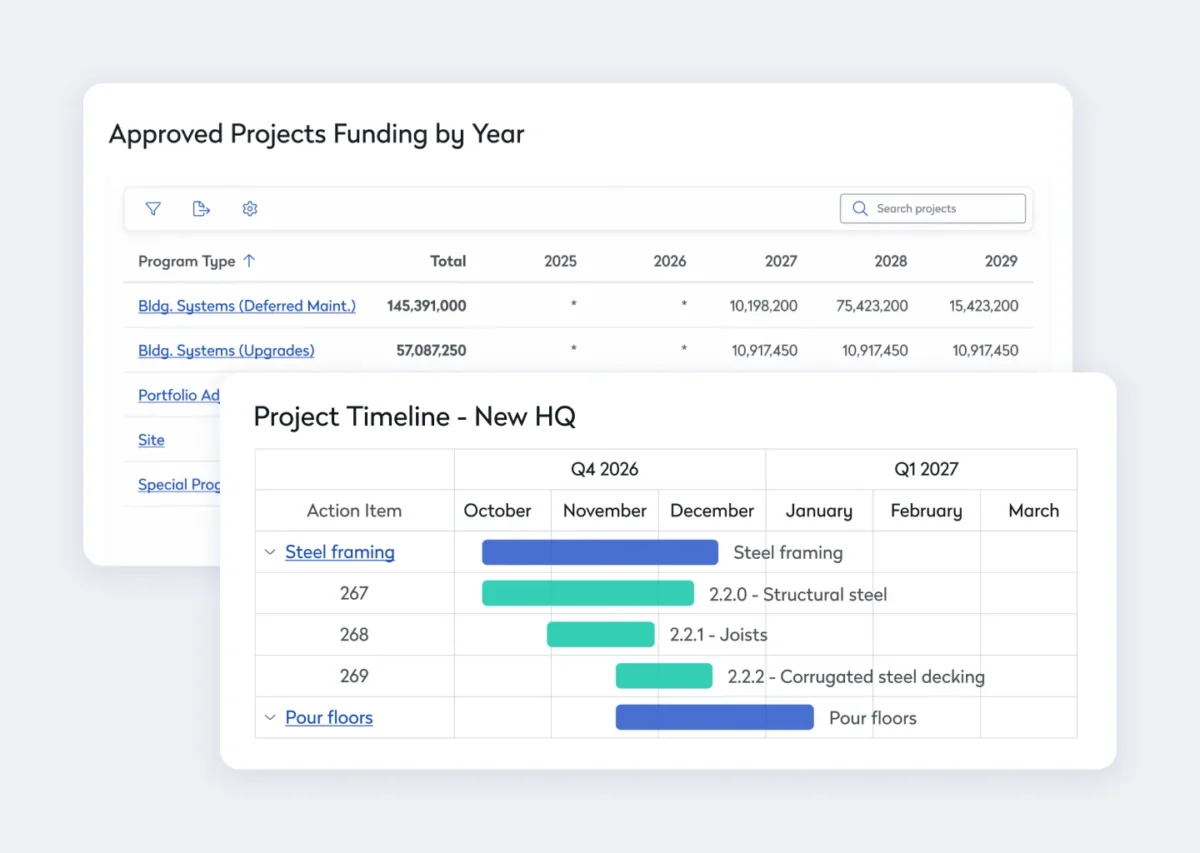
- Model alternative funding levels across multiple fiscal years
- Account for project readiness, sequencing, and dependencies
- Compare proposed allocations across missions, regions, and asset classes
- Show what each scenario funds, enables, or leaves unresolved
- Preserve the remaining mission, safety, reliability, and cost risks
Agency leaders still determine priorities and risk tolerance. You should be able to use the software to compare choices transparently, understand consequences, and revise the portfolio when funding or conditions change.
Give reviewers a decision record they can examine
Capital requests move through facilities, engineering, finance, procurement, leadership, and other agency-specific reviews. Each group may need different details, but they should evaluate the same underlying request and assumptions.
Connected information does not make an investment procedurally ready. Acquisition planning, appropriations, environmental review, stakeholder approvals, and governance requirements may still apply. You should be able to use the platform to maintain a consistent decision record as those reviews proceed.
What should capital planning software provide for investment review?
Evaluate whether you can assemble a review package that lets each stakeholder examine the same recommendation, assumptions, and decision history. Reviewers should not need to reopen multiple systems to understand the request or see how it changed.
For investment review, verify that you can present:
- Current scope, cost, schedule, owner, and funding requirement
- Evidence and mission consequences supporting the request
- Alternatives considered and reasons for the recommendation
- Prioritization criteria, score, ranking, and key assumptions
- Dependencies, constraints, and consequences of deferral
- Expected outcomes and measures of success
- Review comments, decisions, revisions, and approval status
A consistent record supports more disciplined comparisons and reduces the need to reopen multiple files for every review. It also establishes the baseline that should move forward when leaders approve the investment.
Carry the approved baseline into delivery and results
Approval should not create a new information break. Project teams need the scope, costs, assumptions, risks, dependencies, and expected outcomes that decision-makers approved, not only a project title and budget amount.

Teams also need to capture how delivery differed from the plan. Those differences help leaders understand the result and improve future estimates, scenarios, and investment decisions.
How should capital planning software connect approved investments to project delivery?
Before selecting a platform, verify that you can carry the decision leaders approved into active project delivery. You need to compare execution with the approved baseline, document changes, close the project, and return actual results to the next planning cycle.
For delivery and outcome management, test whether you can:
- Transfer the approved scope, budget, schedule, risks, and dependencies
- Assign accountability and follow milestones through delivery
- Compare planned and actual cost, schedule, and scope
- Record changes, decisions, and their effect on expected outcomes
- Retain completion, commissioning, and closeout information
- Update affected facility and asset records after delivery
- Measure whether the work reduced the risk that justified investment
- Feed actual results into the next capital-planning cycle
Closing that loop allows teams to maintain the decision chain from supported need to approved baseline, delivered project, measured result, and better-informed next cycle. Actual costs, timelines, scope changes, and outcomes then become evidence for future capital decisions.
Select a system that supports the full investment decision
The first two steps in the series establish reliable inputs. The third tests whether you can use your technology to turn those inputs into a repeatable capital investment process.
Look beyond whether a product stores condition, maintenance, asset, or project data. Evaluate whether you can use it to structure investment candidates, preserve traceability, compare portfolio scenarios, support disciplined review, and measure results after delivery. When those capabilities stay connected, every capital cycle can begin with stronger evidence and end with information that improves the next decision.
To efficiently manage capital planning and project delivery, explore Archibus for Government.
Frequently Asked Questions

By Jonathan Davis
As a content creator at Eptura, Jonathan Davis covers asset management, maintenance software, and SaaS solutions, delivering thought leadership with actionable insights across industries such as fleet, manufacturing, healthcare, and hospitality. Jonathan’s writing focuses on topics to help enterprises optimize their operations, including building lifecycle management, digital twins, BIM for facility management, and preventive and predictive maintenance strategies. With a master's degree in journalism and a diverse background that includes writing textbooks, editing video game dialogue, and teaching English as a foreign language, Jonathan brings a versatile perspective to his content creation.