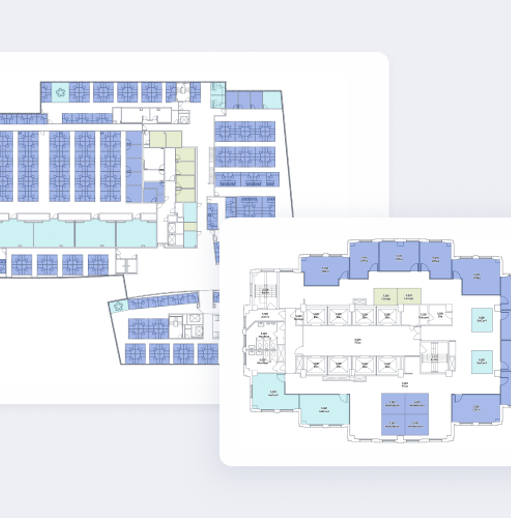



Federal facility budgets face pressure from every direction as agencies work to address aging infrastructure, rising repair costs, changing workplace requirements, modernization initiatives, and growing deferred maintenance backlogs while demonstrating responsible stewardship of taxpayer dollars.
At the same time, agencies continue to face pressure to maximize the value of their facilities and real estate portfolios. Ongoing GSA workplace optimization initiatives, for example, encourage agencies to better understand space utilization, align facilities with mission needs, and make smarter decisions about resource allocation.
For facility managers, that means budget season is about demonstrating where investments will have the greatest operational impact and providing the data needed to support those decisions. While many agencies already possess the information required to build stronger budgets, the challenge is turning operational data into leverageable financial insights.
Key takeaways
- Build stronger budgets using the data you already have. Maintenance histories, asset condition assessments, occupancy metrics, and facility performance data can help transform budget requests from estimates into evidence-based recommendations.
- Prioritize funding where it delivers the greatest impact. Connected operational data helps facility managers evaluate capital projects, identify maintenance risks, compare funding scenarios, and allocate resources more strategically.
- Turn facility data into defensible funding requests. When maintenance, asset, space, and capital planning information are connected, facility leaders can communicate needs more clearly, justify investments with confidence, and align funding decisions with agency goals.
When maintenance, asset, and space data work together, facility managers gain the insight needed to support more informed funding decisions.
How to turn everyday facility data into stronger budget decisions
Every work order, condition assessment, inspection, occupancy update, and asset inventory record contains information that can help support budgeting decisions. Yet many facility teams still struggle to connect operational data with financial planning because information remains spread across multiple systems, spreadsheets, and departments.
When facility leaders can view maintenance, asset, space, and capital planning information together, trends become easier to identify. Instead of relying on assumptions, teams can make funding recommendations based on documented operational realities.
The same principle applies during budget season. The more complete your view of facilities operations, the easier it becomes to identify funding priorities, justify investments, and communicate needs to leadership.
Use maintenance history to justify operations and maintenance funding
Maintenance teams often know where funding gaps exist long before budget discussions begin. The issue is rarely awareness. It’s evidence.
Maintenance records provide a powerful way to demonstrate operational demand. Work order histories can reveal recurring equipment failures, rising labor requirements, increasing corrective maintenance costs, and growing maintenance backlogs. These trends help explain why additional funding may be necessary and what operational risks could emerge if resources remain unchanged.
For example, an air handling unit that requires frequent repairs may appear manageable in isolation. But work order histories may reveal that maintenance costs have steadily increased over the past several years, technicians are dedicating significant labor hours to repairs, and equipment downtime is beginning to affect building occupants. Those trends provide a more compelling budget justification than a simple request for replacement funding.
Maintenance data can also strengthen the case for preventive maintenance investments. By documenting asset performance and maintenance outcomes over time, facility managers can demonstrate how proactive maintenance helps control costs, reduce downtime, and extend equipment life. Instead of framing maintenance as an expense, they can show how it protects larger capital investments and reduces long-term risk.
Organizations that connect maintenance and asset information in a single system can move beyond anecdotal explanations and provide leadership with documented evidence of maintenance demand, resource requirements, and long-term cost trends.
Use asset condition data to prioritize capital investments
Federal agencies rarely have enough funding to address every facility need at once. Roof replacements, HVAC upgrades, electrical improvements, accessibility projects, laboratory renovations, and modernization initiatives often compete for the same budget dollars. Determining which projects should move forward requires more than intuition.
Condition assessments, maintenance histories, replacement costs, asset criticality, and lifecycle information provide the data needed to prioritize investments objectively. Together, these metrics help identify where deferred work could increase operational risk, affect mission delivery, or create substantially greater costs in the future.
This lifecycle perspective is critical because the decisions agencies make after an asset is installed often have a greater impact on long-term costs than the initial purchase itself. On the Asset Champion podcast episode“The Power of Construction” – A Holistic View of the Asset Lifecycle, Kris Lengieza, Field Chief Innovation Officer at Procore Technologies, explained that “the construction process represents only about 20% of an asset’s lifecycle, with operations and maintenance of the building encompassing the rest.” Facility managers who can connect maintenance history, asset condition, and lifecycle performance data gain a clearer picture of future funding needs and can make stronger, more defensible capital planning decisions.
The challenge continues to receive attention at the federal level. In testimony before Congress, GAO highlighted how funding constraints contribute to growing maintenance backlogs and delayed capital improvements across federal facilities. The agency also warned that deferred maintenance can worsen asset conditions and significantly increase lifecycle costs over time.
Asset data also supports scenario planning. Facility managers can evaluate multiple funding scenarios, compare project priorities, and understand the consequences of delaying investments. Rather than presenting leadership with a single recommendation, they can explain how different funding levels affect risk, asset performance, and long-term costs.
That approach helps create more transparent and defensible capital budgets while ensuring limited funding is directed toward projects that provide the greatest value.
Use occupancy and space data to identify savings opportunities
Across government, agencies continue to examine how facilities support evolving workforce needs. GSA’s workplace optimization and space planning initiatives emphasize smarter utilization, improved workplace planning, and better use of federal real estate.
The focus on utilization is growing. Recent reporting on federal real estate found that thousands of federal buildings failed to meet a 60% utilization benchmark, highlighting the importance of accurate occupancy and space data when making operational and funding decisions.
Space data gives facility managers the information needed to support these discussions. Occupancy trends, utilization metrics, departmental assignments, and floor plan data can highlight opportunities for consolidation, renovation, reassignment, or modernization.
When facility teams understand how space is actually being used, they can support budget requests with data while demonstrating responsible stewardship of agency resources.
How to build more defensible funding requests with connected facility data
Eventually, every budget request reaches decision-makers who ask the same questions:
- Why does this project matter now?
- What happens if funding is delayed?
- Which investments should take priority?
- How does this request support the agency mission?
Answering those questions requires more than estimates and professional judgment. It requires evidence.
Connected facility data allows facility managers to combine maintenance trends, asset condition information, occupancy metrics, historical costs, and project requirements into a clear operational narrative. Instead of presenting isolated requests, they can explain the relationship between facility conditions, operational risks, workforce needs, and funding requirements.
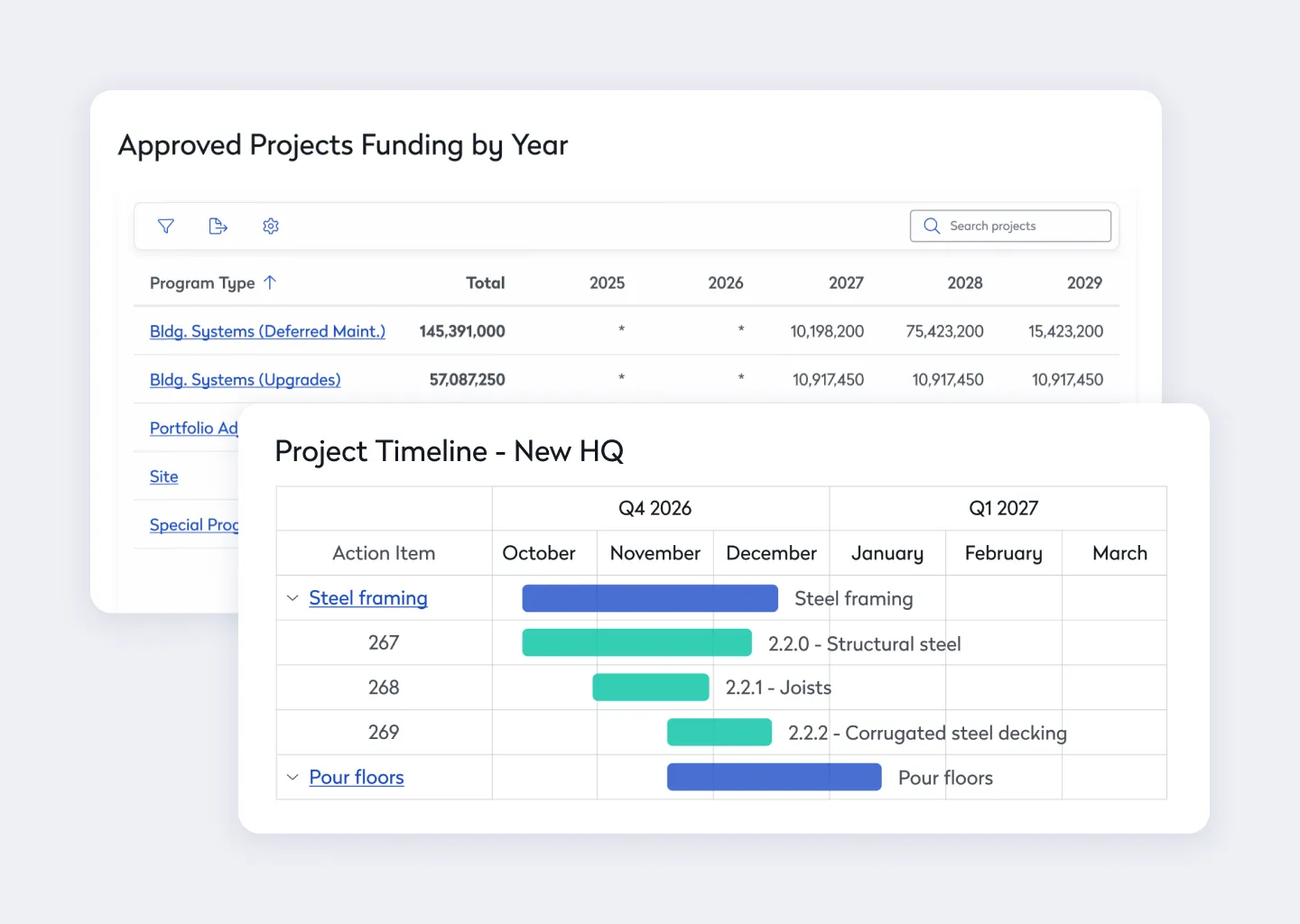
This approach also aligns with broader federal expectations around transparency and accountability. GAO has repeatedly emphasized the need for agencies to provide decision-makers with better information about deferred maintenance needs, funding requirements, and mission-critical facilities investments.
When leadership can clearly see the operational impact of a proposed investment, budget discussions become less about defending assumptions and more about evaluating documented business needs.
What to look for in a facility management platform before budget season
Successful budget planning starts long before funding discussions begin. The facility teams that build the strongest business cases are often the ones that can quickly access reliable information about asset performance, maintenance costs, facility conditions, capital needs, and space utilization.
That doesn’t mean budgeting has to become more complicated. In fact, the right technology can simplify the process by connecting operational data that already exists across the organization.
If you’re evaluating facility management technology, look beyond individual features and focus on the capabilities that help turn everyday facility data into actionable budget insights.
Scenario planning that helps you prepare for multiple funding outcomes
Federal budgeting rarely follows a predictable path. Funding levels change, priorities shift, and projects compete for limited resources.
A modern facility management platform should help you evaluate multiple funding scenarios before budgets are finalized. Rather than building a budget around a single assumption, you should be able to compare best-case, expected, and constrained funding scenarios and understand how each option affects maintenance backlogs, capital projects, operational risks, and facility performance.
When leadership asks what projects can be deferred, which assets present the greatest risk, or how additional funding could improve outcomes, you should already have the data to support the conversation.
Reporting that eliminates manual data gathering
Many facility teams spend weeks tracking down information from spreadsheets, work order systems, asset inventories, and capital planning documents before meaningful budget discussions can begin.
Look for a platform that automatically connects maintenance, asset, space, and project information into a single reporting environment. The goal is not to generate more reports. The goal is to reduce the time spent gathering data so you can spend more time evaluating priorities and building business cases.
Asset lifecycle visibility across the entire portfolio
Most facility managers can identify equipment that’s nearing the end of its useful life. What often proves more difficult is understanding replacement priorities across an entire portfolio.
Strong asset lifecycle management capabilities help you evaluate age, condition, maintenance history, replacement value, expected service life, and operational criticality in one place. That broader perspective makes it easier to identify which assets represent the greatest risk and which investments should move to the top of the capital plan.
Instead of reacting to individual failures, you can plan strategically for future replacement needs and make capital requests based on documented trends rather than isolated incidents.
Facility condition data that supports funding requests
Leadership teams and budget reviewers want evidence, not estimates. Facility condition assessments become significantly more valuable when they’re connected to maintenance histories, asset data, operational impacts, and capital planning information. Together, those data points help explain not only what condition a facility is in today, but also what risks and costs may emerge if investment is delayed.
The ability to connect condition data with operational consequences helps transform maintenance needs into defensible funding requests that are easier for decision-makers to evaluate and support.
Space analytics that reveal both costs and opportunities
Effective budget planning is often about understanding where resources can be used more effectively.
Look for tools that provide visibility into occupancy, utilization, departmental assignments, and space allocation trends. These insights can help identify opportunities for consolidation, repurposing, modernization, or improved space utilization.
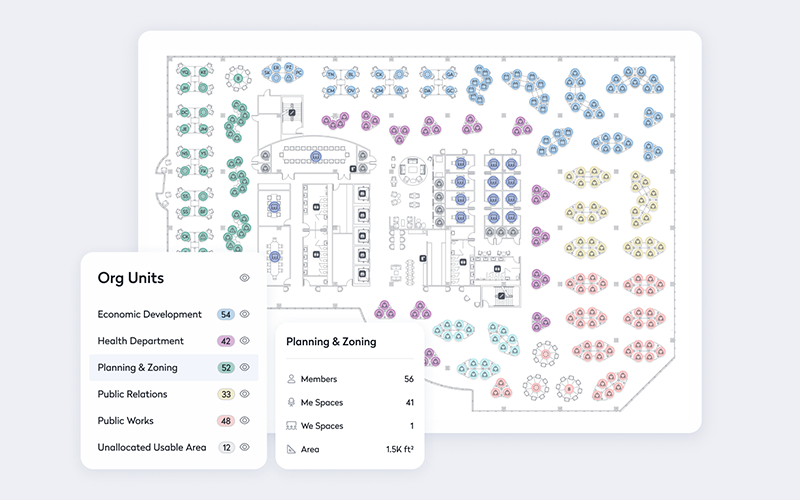
When facility managers can demonstrate both funding needs and opportunities to optimize existing resources, they create a more balanced and credible budget narrative.
A single source of truth for facility decision-making
When maintenance teams, space planners, asset managers, and leadership all rely on different sources of information, budget discussions often become debates about whose numbers are correct. A centralized platform creates a shared view of facility performance, ensuring everyone works from the same information.
That consistency builds confidence in the data, improves collaboration across departments, and helps leadership make decisions more quickly.
Ultimately, the most valuable facility management platforms don’t just help you manage buildings. They help you connect operational data to financial decisions, giving you the information needed to prioritize investments, justify funding requests, and enter budget season with greater confidence.
Turn operational data into a budgeting advantage
As agencies continue to balance modernization priorities, deferred maintenance challenges, and evolving workplace requirements, facility leaders who can connect operational data to financial outcomes will be better positioned to secure resources, prioritize investments, and support mission success.
Learn how you can centralize facility, asset, maintenance, and space data in a secure environment to create accurate, actionable budgets.
Frequently Asked Questions

By Jonathan Davis
As a content creator at Eptura, Jonathan Davis covers asset management, maintenance software, and SaaS solutions, delivering thought leadership with actionable insights across industries such as fleet, manufacturing, healthcare, and hospitality. Jonathan’s writing focuses on topics to help enterprises optimize their operations, including building lifecycle management, digital twins, BIM for facility management, and preventive and predictive maintenance strategies. With a master's degree in journalism and a diverse background that includes writing textbooks, editing video game dialogue, and teaching English as a foreign language, Jonathan brings a versatile perspective to his content creation.