

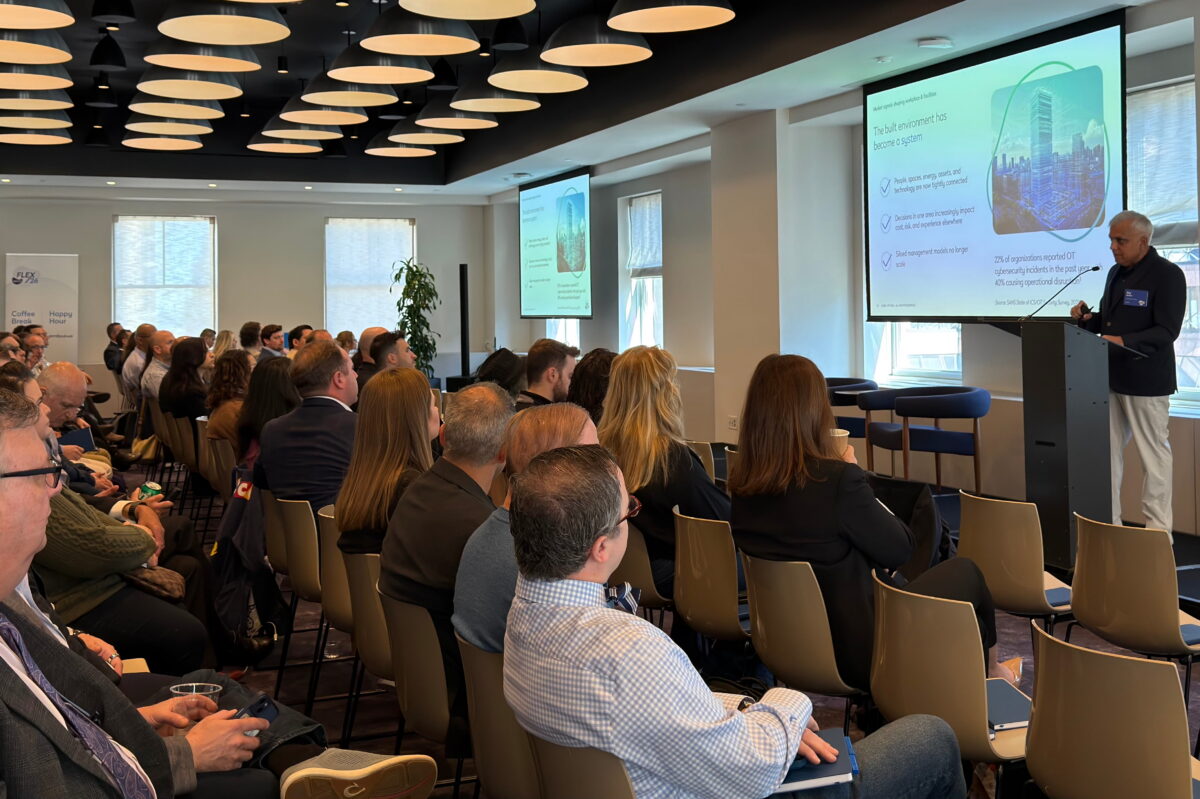
At Flex/26 in New York in mid‑May, conversations repeatedly returned to the same question facing workplace and operations leaders: how to make better decisions as the built environment becomes more complex and more constrained. In his opening remarks, Raj Batra, Chief Executive Officer at Eptura, gave that challenge a clear frame. He described a shift away from managing individual systems such as space planning or attendance policies and toward managing the built environment as an interconnected whole.
The conversations at Flex/26 didn’t stop at outlining the problem. Presenters and participants focused on sharing how leaders can simplify decision‑making, reduce friction, and make progress even in increasingly complex environments.
Key takeaways
- Managing the built environment now requires connected thinking: Leaders are moving beyond individual systems and policies toward more integrated approaches that account for how space, assets, and experience influence one another
- Observed behavior is shaping strategy across teams: Workplace and operations leaders are adjusting decisions based on how people actually use spaces, assets, and services rather than relying solely on planned models
- Focus creates momentum in complex environments: The most practical progress comes from narrowing in on a single decision, metric, or constraint and using that focus to drive measurable improvement
Decisions about space, assets, and workplace experience increasingly affect one another, often with less margin for error and higher expectations. As a result, leaders are being asked to think beyond individual tools or policies and focus on how the entire environment operates together.
One environment, shared constraints
The conversations at Flex/26 approached the built environment from different angles, but they consistently pointed to the same underlying challenge: how to operate effectively when conditions are tighter, faster, and more interconnected.
Across both workplace and operations discussions, leaders described similar constraints — less margin for error, more compressed demand, and a growing need to coordinate decisions across teams and systems.
We’re especially grateful to our speakers and to our sponsors, Embrava and Pointr, whose support helped make Flex/26 New York possible and whose ideas and energy shaped conversations throughout the day.
Workplace leaders are designing for how people actually work
For workplace leaders, the conversation has moved beyond policy. In the fireside chat on “Transforming the workplace experience at AIG,” featuring Jeff Peel, Director of Corporate Real Estate Technology at AIG, the discussion focused on how workplace expectations have evolved alongside employee behavior.
Questions centered on how organizations define workplace experience today, how strategies have shifted in recent years, and how leaders balance cost control with creating environments that employees actually use. The conversation also explored how workplace policies evolve over time — particularly as teams respond to real usage patterns rather than relying solely on planned models.
Across the discussion, a consistent theme emerged: workplace strategies are increasingly shaped by observed behavior. Attendance patterns, booking habits, and day‑to‑day usage all influence how organizations adjust space, policies, and experience over time.
The conversation also surfaced the complexity of managing workplaces across locations. Different offices operate under different constraints, making it difficult to apply a single approach across an entire portfolio. As a result, leaders are moving toward flexible frameworks that can adapt to local conditions without losing strategic alignment.
Operations leaders are keeping systems reliable under mounting pressure
For asset and operations teams, the same pressures show up in different ways.
In the fireside chat on “Reducing asset downtime while controlling total cost of ownership,” featuring Jared Hattaway, CMMS Product Lead at Savage Services, the discussion centered on how organizations maintain reliability in complex operating environments.
The conversation explored common causes of asset and fleet downtime, the actions that have the greatest impact on reducing failures, and how teams prioritize maintenance under real‑world constraints. It also examined how organizations track total cost of ownership and make trade‑offs between cost control and operational performance.
A consistent reality emerged: maintenance teams are balancing competing priorities, including uptime, resource availability, and budget constraints. Decisions are rarely isolated. Instead, they ripple across operations and require careful coordination.
What’s changing in how teams manage the built environment
Across sessions, a consistent set of themes emerged around how organizations are adapting to more complex operating conditions. These shifts span workplace, operations, and the systems that connect them, pointing to a broader change in how teams plan, execute, and continuously adjust the built environment.
Behavior is reshaping strategy
Usage patterns, booking behaviors, and day‑to‑day workarounds often reveal gaps between intended strategy and real‑world execution. Instead of designing around expected behavior, teams are adapting in real time — adjusting space allocation, refining policies, and changing access based on actual usage.
That shift requires better data, faster feedback loops, and systems that support continuous iteration rather than static plans.
Workplace experience is becoming a business lever
Conversations in sessions like “Scaling corporate hospitality experiences amid change,” featuring Jessica Purwin, Managing Director and Global Head of Corporate Services Operations at Jefferies, expanded how leaders define workplace experience.

The discussion connected experience to broader business outcomes, including employee engagement, client interactions, and operational alignment across teams. Experience is no longer treated as a support function — it directly affects performance, from attracting talent to enabling client‑facing work.
To deliver that impact at scale, organizations need more consistent service delivery, stronger coordination between teams, and clearer visibility into how people engage with space and services.
Where strategies break down is everyday friction
Another pattern centered on friction. In “Making flexible work actually work,” featuring Cameron Gagne, Director of Marketing and Partnerships at Embrava, the discussion focused on what happens after organizations adopt hybrid models.
The conversation explored why strategies that look strong on paper often break down in practice where small, everyday challenges like finding space, coordinating teams, or navigating the workplace create outsized inefficiencies.
Addressing that friction requires more than policy changes. Teams need to remove operational barriers that make day‑to‑day work harder than it should be, particularly where disconnected workflows and manual coordination slow execution.
Visibility is foundational to better decisions
Visibility also emerged as a recurring theme. In “Spatial intelligence: Connecting workplace strategy, operations, and experience,” featuring Ege Akpinar, Chief Executive Officer at Pointr, the discussion focused on where organizations lose context between planning and execution.
Without a clear view across space, assets, and operations, teams are forced to make decisions based on incomplete or delayed information. Improving visibility isn’t just about reporting — it’s about connecting data across systems so teams can understand what’s happening in the moment and act with confidence.
From insight to execution in the workshops
Both tracks included workshops designed to help attendees apply ideas discussed throughout the day. Rather than focusing on theory, these sessions centered on real decisions teams are facing now.
Turning workplace data into leadership decisions
In the workplace workshop, led by Erin Sevitz, VP of Content and Customer Marketing at Eptura, attendees focused on building a leadership‑ready scorecard.
Participants identified a small number of metrics tied to a single outcome like cost, experience, or operational efficiency and connected each metric to a clear decision. The emphasis was on usefulness, not volume, and ensuring metrics could be reviewed and acted on consistently.
Moving from reactive to proactive operations
In the asset workshop, attendees assessed their maintenance maturity, identified a single operational bottleneck, and outlined changes that could realistically improve performance over the next 90 days.
By narrowing the focus to one constraint and one asset or system, participants were able to connect proposed changes directly to outcomes like reduced downtime, improved productivity, or better cost control.
What to take back to your team
If there was one consistent takeaway from Flex/26 New York, it’s that progress starts with focus. Meaningful improvement often comes from narrowing in on one decision, one metric, or one constraint and using that focus to drive momentum.
For workplace teams, that may mean defining a scorecard tied to a single outcome. For operations teams, it may mean addressing one bottleneck contributing to downtime. Either way, the approach is the same: prioritize what matters most, tie it to measurable outcomes, and build from there.
Join the conversation
Flex/26 reinforced that the teams making progress aren’t trying to solve everything at once. They’re aligning around shared data, clearer decisions, and practical next steps that fit their operating reality.
If the insights shared here resonated with your own challenges or if you’re looking to connect with others navigating similar transformations, explore our exciting upcoming events.
Frequently Asked Questions
By Mike Petrusky
As Director of Podcasts at Eptura, Mike Petrusky hosts both the Workplace Innovator Podcast and the Asset Champion Podcast, sharing thought leadership with CRE, FM, and IT leaders in the digital and hybrid workplace. Mike has produced more than 500 podcast episodes listened to in over 111 countries. As an in-demand public speaker, Mike engages audiences at numerous industry events each year, including International Facility Management Association and CoreNet conferences, focusing on the human element of workplace and facility management.