


AI adoption is accelerating rapidly across every industry and department, and it’s not hard to understand why. AI can draft reports in seconds, summarize lengthy documents, analyze data patterns, and automate repetitive tasks that once consumed hours of every workday.
For IT leaders, however, this rapid shift presents significant security challenges. While employees increasingly rely on AI tools to enhance their productivity, many are bypassing official channels, creating what security experts call “shadow AI.”
The answer starts with providing secure alternatives. When AI capabilities are embedded directly into your workplace management platforms, employees get the productivity benefits they’re seeking without the security risks that keep IT leaders awake at night.
Key takeaways
- Banning AI creates the problem it tries to solve: When employees can’t access approved tools that match their productivity needs, they’ll find unauthorized alternatives, transforming a governance challenge into a hidden security risk you can’t monitor or control
- Integration eliminates the approval bottleneck: Platforms with AI built directly into workplace workflows close the gap between employee needs and IT security requirements, removing the primary driver of shadow AI adoption across your organization
- Governance without alternatives is just policy theater: Clear AI usage policies only work when paired with approved tools that deliver the productivity gains employees want
The most effective approach combines explicit guidance with embedded capabilities, treating employees as partners in secure AI adoption rather than security threats to be managed.
The shadow AI problem: Hidden tools, real risks
Shadow AI, the use of AI tools by employees without IT approval or oversight, has unfortunately become standard practice. 68% of employees now use unauthorized AI tools at work, up dramatically from 41% in 2023, according to Gartner. Even more concerning, 59% of employees actively conceal their AI usage from employers.
The average enterprise now has approximately 1,200 unauthorized AI tools in use, yet IT teams are only aware of 4 to 5 of them. 78% of AI users are bringing their own AI tools to work, with 85% of Gen Z employees using AI technologies not provided by their employer, according to Microsoft.
The risks are real. The IBM 2025 Cost of Data Breach Report found that shadow AI breaches cost organizations an average of $4.63 million, roughly $670,000 more than standard data breaches.
Why traditional “just say no” approaches fail
When faced with shadow AI, many IT departments’ first instinct is to ban unauthorized tools outright. If you can’t see it, can’t control it, and can’t secure it, blocking it entirely seems logical.
However, bans rarely work.
Research from MIT’s State of AI in Business 2025 found that while only 40% of companies have purchased official AI subscriptions, workers from over 90% of companies report regular use of personal AI tools for work tasks. Even when organizations explicitly prohibit AI use, employees find workarounds.
It’s not hard to see why.
Microsoft estimates that AI tools save workers an average of 7.75 hours per week, which is equivalent to 12.1 billion hours in productivity gains across the UK economy alone.
Workplace and facility management thought leaders have also embraced the idea that AI promises many new possibilities.
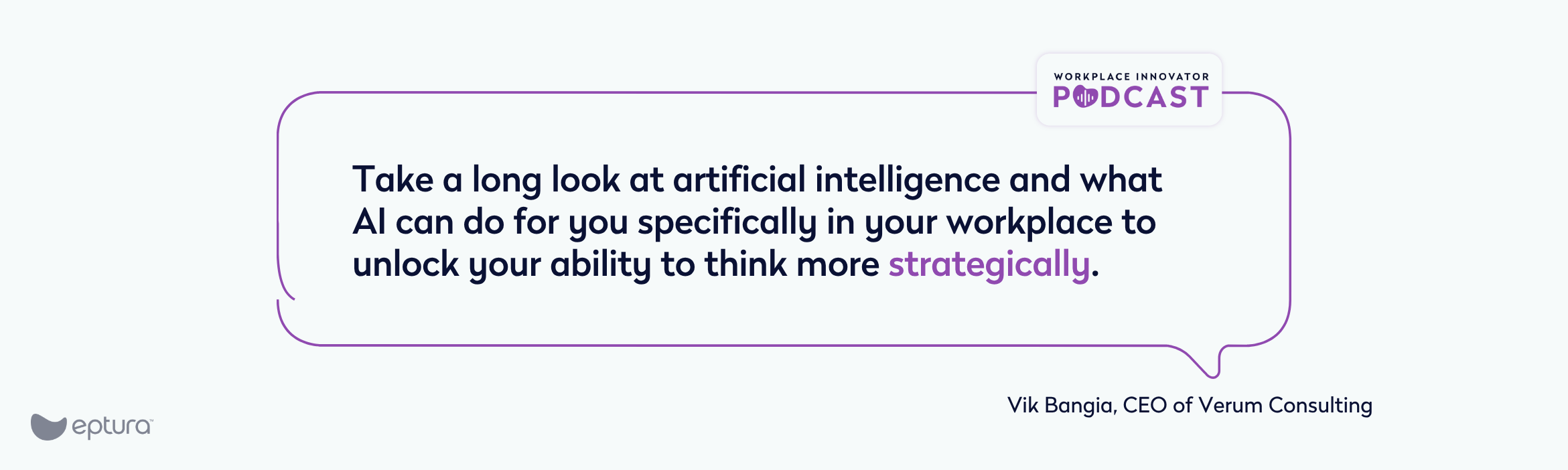
“Take a long look at artificial intelligence and what AI can do for you specifically in your workplace to unlock your ability to think more strategically,” says Vik Bangia, CEO of Verum Consulting, in the Workplace Innovate episode “’Get Ahead’ – Unlocking the Ability to Think More Strategically in the Workplace using AI.”
So, when employees skirt your rules related to AI, they aren’t acting maliciously. They’re trying to perform their jobs more effectively. When official tools are unavailable, slow to approve, or less capable than consumer alternatives, employees will use whatever accomplishes the task.
The gap between corporate approval speed and AI capability is where shadow AI thrives.
A two-path approach to eliminating shadow AI: Governance and approved tools
Forward-thinking IT leaders are adopting a strategy that balances security with innovation. Instead of fighting shadow AI with blanket bans, they’re providing clear guidance and secure alternatives.
Establish clear AI governance policies
The first step is creating an AI acceptable use policy that defines boundaries without being punitive. Effective policies should be concise and focused, clearly stating which tools are approved, what data employees can use, what needs review, and how to request new tools.
Best practices for AI governance policies include:
- Define approved and prohibited tools explicitly: Maintain a comprehensive catalog of vetted AI tools that comply with your organization’s security and data privacy standards. Many companies allow enterprise-grade platforms like Microsoft Copilot or ChatGPT Enterprise but ban free, unverified apps.
- Establish data handling rules: Create clear guidelines around what types of data can be entered into AI tools. For example, intellectual property, customer data, and financial information should never be entered into free, public versions of large language models
- Assign real owners: Create a cross-functional governance council that brings together IT, data science, legal, compliance, and business stakeholders.
- Make training mandatory and practical: Currently, 58% of employees haven’t received formal training on safe AI use at work. Regular training should cover data privacy, bias and fairness, and regulatory requirements.
The key is treating employees as partners in risk management rather than potential threats to be controlled. When people understand both the benefits and the risks, compliance increases naturally.
Provide secure, approved AI tools embedded in workplace systems
Governance alone isn’t sufficient. The second, and arguably more important, prong is giving employees approved AI tools that actually meet their needs.

Here, integrated workplace and facility management platforms have become a strategic advantage. Rather than forcing employees to seek external AI tools for everyday tasks, organizations can deploy systems that have AI capabilities built directly into workflows.
When AI is embedded in their workplace management platform, they can:
- Automatically generate space utilization reports and recommendations
- Get intelligent suggestions for meeting room assignments based on team needs and preferences
- Receive predictive maintenance alerts before equipment fails
- Create data-driven workplace strategies without exporting sensitive data to external tools
- Automate visitor management and compliance workflows
The security advantage is clear: data never leaves the controlled environment. There’s no risk of employees pasting confidential occupancy data, employee schedules, or facility information into public AI chatbots. The AI operates within the same security perimeter as the rest of the business system.
What to look for in AI-enabled workplace platforms: A checklist
When evaluating workplace and facility management solutions with built-in AI, use these category-specific checklists to ensure enterprise-grade security and governance.
Security and compliance
Verify the platform provides:
AI governance and operational controls checklist
Confirm the platform includes:
Integration and workflow embedding
Ensure the platform delivers:
Continuous security and monitoring
Validate the platform maintains:
From shadow AI to shared standards
Organizations that shift from reactive prohibition to proactive enablement will be positioned for success. This requires clear AI governance policies combined with workplace management platforms that have AI built in.
Ready to explore how built-in AI can enhance your workplace while maintaining security? Learn more about AI in the modern workplace and discover how we help organizations move from shadow AI to secure, integrated solutions.
Frequently Asked Questions

By Erin Sevitz
As Vice President of Content and Customer Marketing at Eptura, Erin Sevitz oversees teams responsible for providing worktech insights and engaging 25 million Eptura users worldwide. With over 10 years in thought leadership on workplace management and the built environment, Erin brings deep industry knowledge to her role. Previously, she led communications for the International Facility Management Association, a global nonprofit dedicated to professional development for workplace strategists and building managers, and served as editor in chief for IFMA’s FMJ magazine.