

Maintenance teams can complete the same types of work across similar assets yet produce very different results. One location may respond quickly, complete preventive maintenance on schedule, and maintain dependable asset records. Another may contend with missed requests, shifting priorities, repeat visits, and work orders that remain open long after technicians finish repairs.
The difference often comes down to workflow. A maintenance workflow gives requests a consistent path through intake, prioritization, planning, execution, documentation, and review. When organizations connect every stage through a shared operational record, maintenance teams gain the context they need to complete work consistently while leaders gain a more reliable view of performance, cost, and risk across facilities.
Key takeaways
- Consistency creates better decisions: Standardized maintenance workflows ensure requests, inspections, work orders, and documentation contribute to a shared operational record that leaders can use to make informed decisions
- Connected information improves execution: When planners and technicians can access asset history, maintenance records, inspections, inventory, and schedules in one place, they spend less time searching for information and more time completing work
- Maintenance data becomes more valuable over time: Every completed work order strengthens the operational record, helping organizations identify patterns, reduce reactive work, improve planning, and support future asset decisions
Modern maintenance technologies can strengthen that process without taking decisions away from the people responsible for the work. Workflow automation reduces delays, mobile tools connect field and office teams, and AI-backed workflows helps planners find answers and identify next steps. Together, those capabilities allow maintenance teams to spend less time searching for information and more time acting on it.
What does a successful maintenance workflow look like?
A successful maintenance workflow gives everyone a clear understanding of what happens next. Requesters know how to report an issue, supervisors apply consistent priorities, planners assemble the information and resources technicians need, and technicians capture results as part of completing the job. Managers can use the resulting shared operational record to understand workload, recurring failures, costs, asset performance, and emerging risks across facilities.
The workflow covers more than a work order. A work order records and authorizes a maintenance task, while the workflow defines how that task moves through the organization. Maintenance management provides the broader strategy for balancing preventive and reactive work, controlling costs, and protecting asset performance. The workflow turns that strategy into repeatable daily execution.
Good workflows also connect maintenance activity to larger organizational outcomes.
Consistent intake and prioritization help teams direct labor toward work with the greatest operational impact. Better planning can reduce delays and repeat visits. Complete inspection and closeout records support audits, budget decisions, failure analysis, and long-term asset planning. Across multiple facilities, a shared process also helps leaders compare performance and maintain standards as operations grow more complex.
Common workflow mistakes that create inconsistency
Organizations often discover workflow problems when backlogs start growing, preventive maintenance completion rates decline, or technicians spend more time searching for information than performing work.
Common sources of problems include:
- Accepting requests through unofficial channels: Emails, calls, direct messages, and hallway conversations make it difficult to confirm that someone recorded, prioritized, and assigned every request
- Applying priorities inconsistently: When departments define “urgent” differently, routine issues can displace work that affects safety, compliance, production, or critical services
- Starting work without enough information: Incomplete asset records, missing procedures, and uncertain parts availability can send technicians to jobs they cannot finish
- Separating inspections from maintenance: Inspection findings that remain in spreadsheets or another system cannot provide planners and technicians with complete operational context
- Treating documentation as administrative work: Minimal or delayed notes leave the organization without the information needed to support future repairs, audits, and planning
- Keeping maintenance and asset information disconnected: Separate records make it harder to connect recurring work, asset condition, inventory, warranties, and lifecycle costs
Organizations can address these problems by standardizing how work enters the maintenance process, giving planners and technicians access to connected information, and making documentation part of execution.
Standardize how work enters and moves through maintenance
Consider a manufacturing facility where operators report some problems by email, supervisors call technicians directly for urgent repairs, and employees submit other requests through a maintenance system. Supervisors must piece together the workload before they can decide what to assign. Technicians may begin work without a formal record, while lower-profile requests disappear until someone asks about them again.
A centralized request process gives teams one place to capture the problem, affected asset or location, operational impact, and relevant supporting details. Configurable forms and standard categories help supervisors compare requests without interpreting a different level of detail every time. Automated work order creation can move approved requests into the maintenance queue without forcing teams to enter the same information twice.
Preventive maintenance tasks, inspection findings, sensor alerts, and service requests may enter the workflow through different triggers, but they should contribute to one operational view. Workflow automation can route requests through repeatable approvals and escalation paths, while work order controls help teams generate, assign, track, and close work in one system. Connected processes allow teams to coordinate maintenance and inspections instead of manually rebuilding the story behind each asset or request.
Prioritize work according to risk and operational impact
Clear priority definitions help maintenance teams protect critical operations without labeling every request urgent. Effective work order processes depend on those priorities remaining consistent across teams and facilities. Supervisors can assess safety implications, compliance deadlines, asset criticality, production impact, service disruption, and the likelihood that the problem will worsen. The resulting priority can then guide response expectations, assignments, and escalation rules.
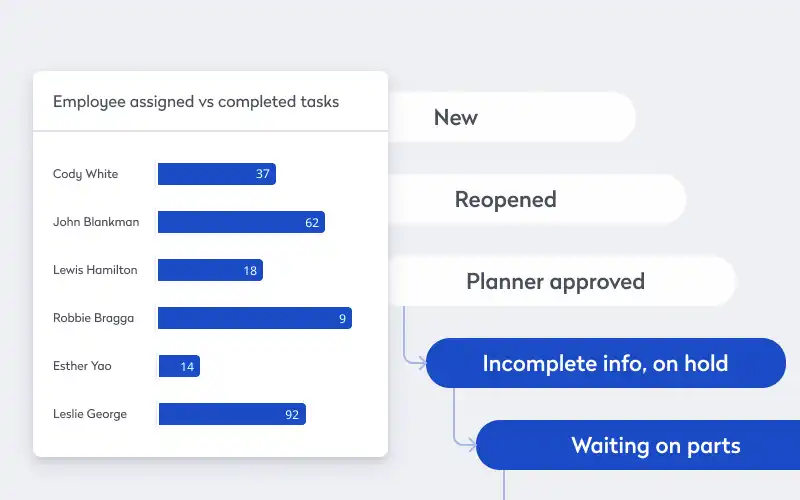
For example, a leaking sink in an office and a leak near sensitive manufacturing equipment may share the same basic fault description. The second issue carries a different operational risk and requires a different response. Consistent criteria help the team make that distinction based on business impact rather than who submitted the request or which supervisor reviewed it.
Use AI to move from questions to action faster
As maintenance operations become more complex, planners need faster ways to understand what deserves attention first. Reviewing backlogs, asset histories, maintenance schedules, inspection results, and open work orders manually can slow decision-making and make it harder to identify emerging risks.
AI-assisted analysis can help teams move from questions to action faster by bringing those sources together in a single operational view. Instead of spending time building reports or searching through multiple systems, planners can quickly surface patterns, investigate recurring failures, understand maintenance history, and identify the next steps that will have the greatest operational impact.
In “’The Real Promise of Operational AI’ – Trust, Accountability and Understanding AI for the Built Environment”, Daniel Stonecipher, Independent Advisor for AI Infrastructure & Built Environment Platforms, explains why AI’s value comes from improving operational decisions rather than replacing human expertise.
“The prediction is only one input. The operational decision requires context, and context is where facility professionals create value.”
That distinction matters when organizations evaluate AI-powered maintenance tools. By bringing together work orders, maintenance schedules, asset history, inspections, and inventory information, AI can help teams identify patterns and surface relevant information faster. Maintenance professionals remain responsible for evaluating recommendations within the context of business priorities, operational constraints, and risk tolerance, but they can spend less time gathering information and more time acting on it.
These capabilities become most valuable when they can draw from connected work orders, asset history, inspections, inventory information, and maintenance schedules. That shared operational context helps planners understand why work remains overdue, whether similar issues are emerging elsewhere, and how current decisions may affect future maintenance performance. Maintenance professionals still make the decision, but they spend less time gathering information and more time acting on it.
Give technicians what they need before work begins
Strong planning reduces avoidable delays after a technician accepts a work order. Before scheduling the job, planners should confirm the affected asset, required skills, safety procedures, likely parts, tools, permits, service history, inspection results, and operational restrictions. Reusable work order templates can make that information consistent for recurring tasks without forcing planners to rebuild instructions each time.
Imagine a facilities team preparing to service an air-handling unit in an occupied hospital. The planner needs to understand which spaces the unit serves, whether the team must coordinate an outage, which components the technician needs, what previous inspections revealed, and how technicians addressed earlier failures. Sending someone with only “check HVAC issue” in the work order shifts planning into the field and increases the likelihood of a second visit.
Connected asset records bring maintenance history, inspections, documentation, inventory, warranties, and equipment relationships into a single operational view. Complete asset history allows planners to see what failed previously, how technicians repaired it, which parts they used, and whether similar issues have appeared elsewhere. Asset hierarchies add context by connecting a piece of equipment to its units, subunits, and components, helping teams target work and update the correct record.
Parts visibility supports the same outcome. Planners need to know whether the organization has the necessary inventory and where technicians can find it. Connecting inventory to work orders helps teams prepare materials before work begins, while part kitting can group the components required for recurring jobs. Those capabilities reduce search time and lower the risk that a technician reaches the asset without something essential.
Warranty details can also change how the team approaches the job. When coverage information appears within the maintenance workflow, planners can check whether a repair qualifies before assigning internal labor or purchasing parts. That visibility supports cost control and gives leaders better information for repair-versus-replace decisions across the asset lifecycle.
Identify risks before they become disruptive failures
Planning improves when teams can recognize deteriorating performance before an asset fails. Maintenance histories, inspection results, condition data, and recurring fault patterns can help planners move work into the schedule while they still have time to coordinate labor, parts, and operational access.
AI and machine learning can help organizations analyze maintenance activity, asset condition, and service trends to identify risks earlier and support maintenance planning.
A risk signal still needs a workflow behind it. The team must evaluate its significance, compare it with other priorities, select an appropriate response, schedule the work, and document the result. Connecting risk detection to the same process used for preventive and corrective maintenance helps organizations reduce reactive work without creating another disconnected stream of alerts.
Support consistent execution in the field
Detailed plans provide limited value if technicians cannot access them where the work happens. Maintenance teams work in mechanical rooms, production areas, remote sites, and other locations where returning to a desktop adds time. Mobile capabilities can bring work orders, asset histories, procedures, inspection requirements, and parts information into the field.
Offline access helps technicians continue working in areas with limited connectivity, while synchronization keeps the operational record current when service returns. Real-time visibility into parts availability can also help technicians locate inventory across warehouses before they leave a job site or make another trip.

Digital checklists and inspection forms provide another layer of consistency. Technicians can follow required steps, record readings, document compliance, and flag follow-up work within the same process. Inspection results then become part of the same operational record as maintenance activity instead of remaining in separate systems or spreadsheets.
Barcode workflows can also help technicians identify assets, associate work with the correct equipment, and log parts against each job. Together with mobile access and standardized inspections, those tools help field teams maintain accurate records while work happens, improving visibility for planners, compliance teams, and maintenance leaders.
Make documentation part of completing the work
A repair may restore an asset to service, but incomplete documentation prevents the organization from learning from that work. Technicians should record labor, parts, condition, failure details, inspection results, and the action taken before closing the work order. Photos, readings, or supporting documents can add useful context when the task or compliance requirement calls for them.
The process needs to respect field conditions. Long forms and duplicate entry encourage rushed notes or delayed updates at the end of a shift. Configurable forms can ask for the information relevant to the job, while mobile access lets technicians update status and records as work progresses.
Voice-powered support can reduce that administrative burden further. Technician Copilot preview materials describe voice-powered task management that reduces manual input and interruptions to fieldwork. Faster documentation can contribute to more complete maintenance records, more accurate work histories, and better information for the planners who handle the next repair.
Each completed job should improve the shared operational record. When the next technician opens the asset history, the record should show what happened, what the earlier technician found, which parts the job required, and whether the condition points to a larger reliability issue.
Turn completed work into better business decisions
A consistent maintenance workflow creates a dependable record of demand, execution, and results. Maintenance leaders can use that information to examine completion times, schedule compliance, preventive maintenance completion, backlog patterns, repeat failures, labor use, parts consumption, and inspection results. Each measure should answer an operational question rather than fill another dashboard.

If several identical assets experience repeat failures, leaders need enough detail to compare symptoms, causes, repairs, parts, and operating conditions. The pattern may point to a maintenance procedure, operating practice, component issue, or replacement decision that requires attention. Without consistent documentation and a complete asset history, each failure looks like an isolated event.
Organizations can create additional value by connecting maintenance information with financial, operational, and portfolio data. Data connectors can bring asset performance and maintenance information into enterprise analytics environments, where leaders can compare it with broader business metrics without interrupting daily maintenance workflows.
That enterprise view can help leaders understand how maintenance performance affects operating costs, capital plans, service reliability, compliance exposure, and asset lifecycle decisions. AI-assisted access can then help planners and supervisors investigate the operational record, identify patterns, and move from question to action faster while retaining responsibility for the decisions.
Eptura in action: Creating consistency for stronger maintenance outcomes
The value of a consistent workflow becomes clearer when organizations connect maintenance activity, asset information, inspections, and documentation into a shared operational record. The City of West Kelowna, for example, achieved a 20% increase in maintenance productivity by improving how maintenance work, asset information, and operational processes were managed. When teams spend less time searching for information, coordinating work, and recreating context, they can spend more time executing planned work and improving asset performance.
To learn how the City of West Kelowna improved maintenance productivity, increased visibility into maintenance operations, and created more consistent processes across its asset management program, read the complete customer success story.
Frequently Asked Questions

By Jonathan Davis
As a content creator at Eptura, Jonathan Davis covers asset management, maintenance software, and SaaS solutions, delivering thought leadership with actionable insights across industries such as fleet, manufacturing, healthcare, and hospitality. Jonathan’s writing focuses on topics to help enterprises optimize their operations, including building lifecycle management, digital twins, BIM for facility management, and preventive and predictive maintenance strategies. With a master's degree in journalism and a diverse background that includes writing textbooks, editing video game dialogue, and teaching English as a foreign language, Jonathan brings a versatile perspective to his content creation.