


Managing visitors across multiple locations isn’t just an administrative task; it reflects how well your organization balances safety, brand consistency, and operational control.
For workplace and security leaders, the challenge isn’t finding a visitor management system (VMS); it’s finding one that scales with your business. As your footprint grows, so does the need for a platform that delivers the same trusted, compliant experience from headquarters to regional offices.
Key takeaways
- Scalability matters. The best systems scale from one office to dozens without requiring separate configurations or logins
- Consistency builds trust. Unified visitor workflows and branding create a familiar, professional experience at every site
- Data drives decisions. Centralized analytics and reporting transform visitor information into actionable insights that support safety and operational efficiency
Managing visitors across multiple locations isn’t just about check-ins anymore; it’s about ensuring safety, compliance, and a consistent guest experience everywhere your organization operates. Whether you manage a few regional offices or a global portfolio, a multi-location VMS helps unify operations under a single, intelligent framework.
But not all visitor systems are built for enterprise complexity. The features that work for a single site often fall short when scaled across multiple facilities, time zones, and teams.
Top visitor system features to prioritize
As you evaluate your options, it helps to recognize that not every organization faces the same visitor management challenges. The right multi-location VMS should adapt to your operational scale, whether you’re standardizing processes across a few offices or coordinating hundreds of global sites.
Small vs. large organizations: Different needs, same goals
A small organization might only need a simple way to welcome guests and record check-ins. For larger enterprises, multi-site visitor management becomes a strategic necessity tied to risk, compliance, and brand reputation.
- Smaller organizations typically focus on ease of use, lightweight setup, and basic reporting
- Enterprises, by contrast, need robust configuration tools, centralized control, and data visibility across dozens or even hundreds of offices
The stakes are also higher. In highly regulated sectors, such as finance, manufacturing, or healthcare, visitor data must meet strict security and privacy standards. Global operations introduce additional complexity: different languages, varying legal frameworks, and region-specific safety procedures.
An effective multi-location VMS bridges these differences with one consistent, compliant foundation that’s flexible enough for each site’s unique context.

-
Centralized control with local flexibility
The hallmark of any enterprise-grade system is centralized visibility. A multi-location VMS should let security, facilities, and HR teams manage the entire visitor ecosystem from one control center while still allowing local autonomy.
When every office runs its own visitor platform, data becomes fragmented, oversight becomes reactive, and policy enforcement becomes inconsistent. Centralized management solves this by providing a unified dashboard where administrators can set company-wide security standards, define check-in workflows, and configure reporting.
Key features to look for:
- Centralized admin console: Monitor activity, enforce compliance, and update policies across all sites from a single interface
- Granular permissions: Define user roles by location, so a site manager in Berlin can control their own check-ins without overriding global policies
- SSO and identity provisioning: Integrate with existing employee directories for frictionless access and deactivation when roles change
This balance between global governance and local control gives organizations agility without sacrificing accountability.
-
Consistent brand and guest experience
Your visitor experience is an extension of your brand. Disconnected systems make that experience feel uneven, something guests notice immediately.
A unified, multi-site visitor management system ensures that whether someone visits your Tokyo innovation center or your New York headquarters, they’re greeted with the same level of professionalism and polish.
Depth factors to evaluate:
- Custom branding: The ability to tailor check-in screens, welcome messages, and badges with logos, colors, and tone consistent with your brand identity
- Localized language and instructions: Support for multiple languages and regional compliance prompts (e.g., fire safety procedures, nondisclosure agreements)
- Multi-format communication: Automated email or SMS confirmations, on-site alerts, and host notifications that match your brand’s voice
The goal is not uniformity for its own sake’s consistency that reinforces trust. When every site reflects the same brand standards, visitors feel confident that your operations are cohesive, credible, and secure.
-
Global security and compliance oversight
Security teams managing multiple sites face a paradox: local threats require fast action, but global oversight requires visibility. A strong enterprise VMS solves both.
Instead of piecemeal visitor logs and manual updates, organizations need systems that automatically track visitor access, flag high-risk individuals, and maintain continuous audit trails.
Key considerations:
- Global watchlists: Maintain a shared database of banned or restricted visitors accessible from all locations
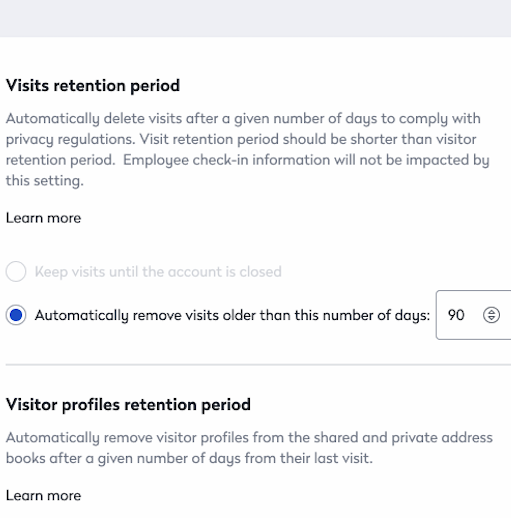
- Regulatory compliance tools: Built-in GDPR and data-retention settings to meet regional privacy laws without manual monitoring
- Integrated access control: Sync visitor data with physical access systems for automated entry permissions and badge activation
- Comprehensive audit history: Record every visitor interaction for incident tracking, internal investigations, and compliance audits
With these capabilities, compliance shifts from a reactive checkbox exercise to a proactive, embedded part of your daily security operations.
-
Fast, scalable rollouts for new locations
Expansion is a sign of growth, but without scalable systems, it can create administrative chaos. If each new office requires manual setup, multiple software licenses, and redundant configuration, your visitor management program becomes a bottleneck.
An advanced multi-site visitor management system allows rapid deployment through blueprinting and automation.
Best practices include:
- Template replication: Copy global settings—branding, policies, workflows—to new sites instantly
- Regional customization: Adjust only what’s unique, such as emergency contacts, local compliance clauses, or parking instructions
- Remote provisioning: Add new admins, update permissions, or deactivate access from anywhere
This kind of scalability doesn’t just save time, it ensures new facilities launch with the same security, compliance, and experience standards as your established offices.
-
Real-time oversight and emergency readiness
In a crisis, real-time data saves lives. Whether it’s an evacuation, lockdown, or power failure, knowing who is on-site—and where—helps organizations act quickly and confidently.
A robust multi-location VMS provides instant visibility across all facilities.
What to prioritize:
- Live visitor dashboards: Track every check-in and check-out in real time across global locations
- Automated emergency lists: Generate headcounts or evacuation lists instantly for each building
- Cross-location alerts: Push notifications to all visitors or employees during critical events, regardless of where they checked in
- Integration with safety systems: Connect visitor data with building management or mass-notification platforms for coordinated responses
Enterprises that treat visitor data as part of their broader emergency planning framework achieve faster response times and improved compliance with health and safety regulations.
-
Actionable data and continuous improvement
For large organizations, visitor data is more than a log—it’s intelligence. Modern enterprise VMS platforms turn data into insights that inform staffing, workplace design, and operational strategy.
Examples of data-driven impact:
- Resource planning: Identify peak visitor hours to adjust reception staffing or security coverage
- Facility optimization: Understand site traffic patterns to right-size office space or conference rooms
- Compliance analytics: Automate reports for internal audits or external regulators
- Trend forecasting: Use historical visitor trends to anticipate demand during peak seasons or special events
This visibility not only drives continuous improvement but also connects visitor management to larger corporate goals—sustainability, productivity, and operational excellence.
-
The right multi-location VMS brings it all together
An effective multi-location visitor management system does more than replace a paper logbook. It becomes an operational hub for safety, security, and workplace experience.
When evaluating solutions, prioritize those that deliver:
- Centralized control and scalable oversight across all offices
- Consistent guest experiences aligned with brand and compliance standards
- Integrated security and data governance for global assurance
- Fast deployment and flexibility for ongoing growth
- Analytics that inform real decisions across departments
Organizations that invest in these capabilities gain more than efficiency; they gain confidence. Every visitor, employee, and contractor interaction becomes part of a seamless, secure ecosystem built to support global operations.
Frequently asked questions

By Amanda Meade
Amanda Meade is a content creator at Eptura, specializing in workplace experience, meeting productivity, and emerging trends in workspace planning and visitor management. With a background in content marketing and SEO, she crafts clear, actionable content that helps teams work smarter through in-office collaboration. Throughout her career, Amanda has worked across industries, including home services, healthcare, real estate, and SaaS, developing a unique ability to distill complex topics into practical insights.