


A lot has been changing across workplace, facilities, corporate real estate, and asset management. AI is moving out of isolated experiments and into operational decision-making. Asset teams are under more pressure to justify repair, replacement, and lifecycle investments. Security systems are becoming part of the broader workplace experience, while real estate leaders are being asked to show how the portfolio contributes to business performance.
These shifts may look like separate trends, but they keep leading back to the same challenge: organizations need to connect information across functions if they want to make faster, better-informed decisions.
For busy workplace and facility management (FM) professionals, the bigger story is not any single technology. It is how workplace, asset, security, and real estate strategies are beginning to work together.
Key takeaways
- AI value depends on connected data: The biggest opportunity is not simply automating individual tasks. It is giving leaders better context across workplace, occupancy, asset, and portfolio information so they can make more informed decisions
- Asset strategy is becoming a business issue: Repair-versus-replace decisions, technician workflows, asset records, and lifecycle planning can directly affect cost, resilience, and business continuity
- Security and workplace experience are converging: Access, visitor management, occupancy, wayfinding, and employee experience increasingly depend on connected systems and shared information
- Portfolio performance needs a broader definition: Occupancy matters, but leaders also need to understand utilization, operating costs, asset condition, employee needs, and the business impact of real estate decisions
How is workplace AI moving from experimentation to business strategy?
The workplace AI conversation is becoming more practical. Leaders are spending less time asking whether AI belongs in corporate real estate and facilities management and more time asking what it can improve, what information it needs, and how its outputs can support better decisions.
The Workplace Innovator conversation on AI innovation and the future of corporate real estate places AI within a much broader transformation taking place in CRE. Forecasting, portfolio planning, workplace experience, and leadership decisions increasingly depend on the ability to interpret large volumes of operational data.
The potential is significant, but so is the dependency on data quality. AI cannot create a reliable enterprise view when occupancy information lives in one platform, asset records in another, and portfolio data somewhere else entirely.
Conversations at Flex/26 Melbourne reinforced that connection between AI, utilization, and connected workplace technology. The discussion is moving beyond deploying AI toward creating the technology and data environment required to make it useful.
This is an important distinction. Workplace teams rarely need another dashboard for its own sake. They need answers to questions that cut across systems. Which locations are consistently underused? Where are maintenance issues starting to affect employee experience? What happens if a lease is reduced or a floor is reconfigured? Where is demand changing faster than the portfolio?
AI has more value when it can help leaders connect those signals.
Insights on turning real estate into a measurable advantage reinforce the same point. Good decisions depend on more than collecting information. Leaders need reliable baselines, context around what metrics mean, and ways to understand the likely impact of potential changes.
The emerging role of AI is therefore less about replacing workplace judgment and more about making the information behind that judgment easier to interpret.
Why is asset strategy becoming a bigger business conversation?
Asset management can look highly operational from the outside. Work orders get completed. Inspections are recorded. Parts are replaced. Preventive maintenance is scheduled.
The consequences of those activities reach much further.
An unreliable asset can interrupt operations or increase downtime. Keeping aging equipment in service can drive up labor and repair costs, while replacing equipment prematurely ties up capital that might deliver more value elsewhere.
That is why asset strategy is increasingly moving beyond the maintenance department.
Level of Repair Analysis (LORA) provides a useful example. Repair-versus-replace decisions can become overly simplistic when teams focus only on the immediate cost of fixing an asset. LORA provides a more structured way to weigh factors such as reliability, lifecycle costs, operational impact, and remaining useful life.
An asset can technically still be repairable and still be the wrong asset to keep repairing.
Making that distinction depends on accurate information. The Asset Champion episode “[Asset] Ghostbusters!” – Orchestrating Asset Intelligence and Driving Away Zombies in Facilities Management explores what happens when asset records are incomplete, duplicated, outdated, or disconnected from what actually exists in the field.
Poor asset data does not stay contained in an asset database. It affects maintenance scheduling, inventory planning, capital decisions, compliance, and forecasting.
Field teams play an important role in improving that information. Mobile maintenance tools give technicians access to work orders and asset history where the work takes place while making it easier to capture updates at the source. That can shorten the gap between what is happening to an asset and what enterprise systems say is happening.
The direction is clear: organizations are moving from managing maintenance activity toward understanding asset performance over time.
What happens when security becomes part of the workplace experience?
Security used to be easier to think of as its own function. Access systems controlled doors. Workplace platforms managed reservations. Visitor systems handled guests. Facilities teams managed the building.
Employees do not experience the workplace that way.
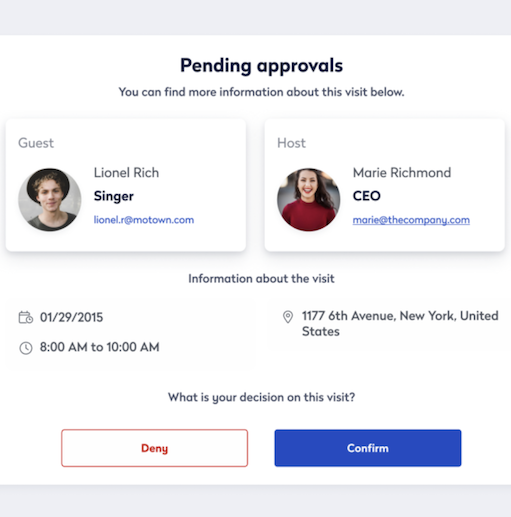
Someone coming into an office may book a desk, enter with a badge, locate a meeting room, move through access-controlled areas, and interact with workplace services throughout the day. A visitor may register before arrival, check in, receive temporary credentials, meet a host, and navigate an unfamiliar building.
All of those touchpoints shape the same experience.
Insights into how financial services firms are connecting workplace and security demonstrate why bringing these systems closer together matters.
Reservation data can indicate expected attendance while access information provides another view of actual building use. Visitor activity adds context about who is onsite. Occupancy patterns can influence how facilities teams allocate resources, while security teams can use workplace context to better understand activity across sites.
Wayfinding belongs in this discussion, too. Traditional signage remains important, but workplace navigation increasingly depends on current information about rooms, amenities, workspaces, and destinations.
That makes wayfinding and workplace navigation part of the connected workplace experience rather than simply a signage decision.
The challenge is creating that connection without adding unnecessary friction. Employees expect workplace technology to feel intuitive, while security teams still need appropriate controls. Facilities teams need dependable information, and IT needs to maintain governance across the technology environment.
That requires collaboration among groups that may once have made technology decisions separately.
The Workplace Innovator conversation “Innovation Starts with Why” – Strategy, Change, and the Human Side of Facility Management adds an important dimension. Integration by itself is not a strategy. Teams first need to understand what they want to accomplish and how technology supports that outcome.
How should organizations measure portfolio performance now?
For years, workplace and real estate performance often centered on familiar numbers such as occupancy, square footage, cost, and lease commitments.
Those metrics still matter, but they rarely provide enough context on their own.
The webinar From Space to Strategy: Turning Real Estate into a Measurable Advantage looked at what happens when organizations connect workplace information with broader portfolio decisions.
The challenge with any utilization figure is that the number rarely tells you what to do next.
A building with low average utilization might represent an opportunity to consolidate. It could also contain teams that come in heavily on particular days, specialized spaces that serve an important business function, or locations where employee demand is increasing.
The decision becomes stronger when utilization is considered alongside lease timing and costs, space demand, asset condition, employee needs, and long-term business plans.
This broader view changes the role of corporate real estate.
Instead of reporting how much space the organization owns or leases, CRE leaders can explain whether the portfolio is supporting the business effectively and where changes could create measurable value.
The same need for evidence applies to facilities budgets. Operational data can help teams demonstrate why an infrastructure, maintenance, or capital investment is necessary rather than relying primarily on experience or urgency to make the case.
Maintenance histories, condition information, utilization data, risk, and scenario planning can turn a funding request into a defensible business case.
When leaders can connect operational information to business risk and expected outcomes, real estate and facilities investments become easier to explain and prioritize.
Why does connected operational data keep showing up in every trend?
AI needs it. Asset planning depends on it. Security convergence becomes harder without it. Portfolio performance cannot be measured consistently when every location and system tells a different story.
Connected data has quietly become the common thread running through many of the most important workplace conversations.
Sustainability and compliance offer a useful example. These programs often require organizations to pull information from multiple sites, systems, assets, and teams. When that information is inconsistent, reporting becomes slower and more difficult to defend.
The same problem appears elsewhere.
A maintenance team may need asset history to determine whether another repair makes financial sense. Real estate teams need accurate workplace data before making consolidation decisions. Security leaders benefit from understanding expected and actual building attendance. Sustainability teams may depend on facility and asset information to measure progress.
The individual systems do not necessarily have to disappear, but the information they generate needs to be trustworthy and usable across workflows.
That does not mean everyone should have access to everything. Permissions, governance, ownership, and security remain critical. The goal is to reduce situations where leaders know information exists but cannot connect it quickly enough to the decision in front of them.
Why won’t technology alone solve these workplace challenges?
The more connected workplace technology becomes, the more obvious another reality gets: people still determine whether it works.
Organizations can invest in sophisticated AI, workplace platforms, asset systems, and analytics, but those investments will struggle if teams do not understand why processes are changing or how the technology supports their work.
In “Innovation Starts with Why” – Strategy, Change, and the Human Side of Facility Management, Martin Ruppe discusses why technology decisions need to follow organizational goals rather than the other way around.
That matters because workplace transformation increasingly crosses departmental lines.
An AI initiative may involve CRE, facilities, IT, and data teams. A visitor journey can touch security, workplace experience, and front-of-house operations. Asset planning can require input from finance, operations, reliability teams, and executives.
The Workplace Innovator episode “Build a Community” – Making Connections and Finding Your Path in Facility Management brings another piece into the conversation: professional relationships, continued learning, and the ability of FM leaders to build strong networks inside and outside their organizations.
As facilities management becomes more strategic and technology-dependent, technical expertise is only part of the job. Leaders also need to communicate priorities, translate operational information into business terms, and bring different groups into the same conversation.
The organizations that get the most value from connected workplace technology will likely be the ones that also invest in connected teams.
Stay on top of the trends in intelligent worktech and facility management
AI, asset strategy, security convergence, and portfolio performance are not developing independently.
AI depends on the information generated by workplace and asset systems. Portfolio decisions require a clear picture of how people use buildings and what those buildings cost to operate. Security is becoming part of the same employee and visitor journey managed by workplace teams. Asset information increasingly informs both financial and operational planning.
The more connected these disciplines become, the more important it is for leaders to understand how a decision in one area affects another.
For more videos, podcasts, webinars, and expert insights on the latest trends in workplace, facility, real estate, and asset management, visit the resource page.
Frequently Asked Questions

By Mike Petrusky
As Director of Podcasts at Eptura, Mike Petrusky hosts both the Workplace Innovator Podcast and the Asset Champion Podcast, sharing thought leadership with CRE, FM, and IT leaders in the digital and hybrid workplace. Mike has produced more than 500 podcast episodes listened to in over 111 countries. As an in-demand public speaker, Mike engages audiences at numerous industry events each year, including International Facility Management Association and CoreNet conferences, focusing on the human element of workplace and facility management.