


Corporate real estate leaders have access to more workplace data than ever, but having more data does not automatically make portfolio decisions easier. Hybrid policies continue to change, employee attendance fluctuates, and workplace information often sits across separate systems. Leaders need to understand not only what the numbers say, but what is happening behind them and what to do next.
That challenge was at the center of Eptura’s webinar, “From Space to Strategy: Turning Real Estate into a Measurable Advantage,” featuring Kev Jones, VP of Product Management at Eptura, and Sarah Kilmartin, Director of Sales Strategy & Intelligence at Eptura.
The session began with several figures that illustrate the state of today’s workplace:
- Average utilization is 53%, compared with a 65% target
- 70% of organizations have formal hybrid policies
- 83% of organizations use desk-sharing ratios
- 94% of meetings involve six or fewer people
But the presenters were clear that the session was not intended to add another set of benchmarks to the conversation.
“What we don’t want to do in this session is provide more statistics. We want to unpick these themes,” Jones said.
Kilmartin reinforced that point: “I’m a great believer in data and stats really help frame the discussion, but they often don’t tell the story behind the stats.”
For workplace and real estate leaders, that distinction matters. Data can reveal where a potential problem exists. The next challenge is understanding why it exists and having the tools and processes to act on it.
Key takeaways
- Hybrid work requires continuous planning. As Jones said, “Hybrid is not static.” Attendance patterns, employee expectations, and business requirements continue to change, making historical assumptions less reliable for long-term planning
- Reliable data matters more than more data. Reservations do not always represent actual attendance. Check-ins, access control data, auto-release policies, and other signals can help organizations distinguish employee intent from actual workplace behavior
- Disconnected systems limit visibility. Connecting booking, access control, space planning, visitor management, and other workplace systems helps leaders develop a more complete view of how their portfolio performs
- Utilization needs context. A portfolio-wide utilization percentage cannot explain differences between peak and low-demand days, individual locations, teams, or types of space. Leaders need to understand what is driving the numbers
- Workplace analytics should lead to action. As Jones put it, “Analysis paralysis is real.” Organizations need tools and processes that help them move from identifying a problem to evaluating options and implementing changes
- Scenario planning reduces uncertainty. Modeling consolidation, expansion, reconfiguration, flexible space, and other options helps organizations understand potential consequences before making costly, long-term real estate decisions
- Real estate performance should connect to business outcomes. Cost remains important, but organizations can also measure the portfolio against utilization, operational efficiency, employee experience, flexibility, and changing business requirements
Hybrid work is still changing
Hybrid work has made workplace planning less predictable, but the challenge is not simply that fewer people come to the office every day. Organizations are trying to plan portfolios around patterns that continue to shift.
“Hybrid is not static. It certainly continues to evolve and there are new challenges that come along alongside it,” Jones said.
Organizations may have formal hybrid policies and desk-sharing strategies in place, but those policies do not necessarily give real estate teams the information they need to make long-term decisions.
“There isn’t necessarily the view on the data and the portfolio that’s needed to keep up with those policies,” Kilmartin said.
At the same time, expectations for real estate teams have changed. Executives want greater visibility into how space is performing, where costs can be reduced, and whether the portfolio still aligns with business needs.
“There has been a significant change in the expectations and an increase in the challenges that real estate are having to accommodate,” Kilmartin said.
This creates a difficult position for workplace leaders. They may need to make decisions about consolidations, expansions, lease renewals, or workplace redesigns while the underlying patterns continue to change.
As Jones explained, “It [is] more challenging to make big decisions based on kind of thin data or a lack of understanding.”
More workplace data does not always mean more clarity
The answer is not necessarily another dashboard or another stream of data.
Without context and the right planning capabilities, having more information can create a different problem.
“Analysis paralysis is real,” Jones said. “You see it, you spot a problem or you think you spot a problem, but you don’t have the toolkit to kind of act on that problem in a way that can deliver the results that you need to effect the change.”
That gets to one of the webinar’s central themes: Workplace analytics should help organizations make decisions, not simply identify problems.
Leaders need to move from asking what their utilization percentage is to understanding what that number means for the portfolio. Is low utilization consistent throughout the week? Are certain floors empty while others reach capacity? Do employees have enough desks but struggle to find meeting rooms? Is the organization paying for space it is unlikely to need in the future?
Without that context, a utilization percentage provides only part of the story.
“You don’t have a clear picture,” Jones said. “And I think that this is, from speaking with our clients and our organizations, that this is a planning problem at the moment.”
Understand the difference between intent and actual presence
Creating that clearer picture starts with the quality of the data itself.
One example discussed during the webinar is the difference between booking a workplace resource and actually using it.
“There is a difference between somebody’s presence on the day, checked in, versus somebody that says they’re going to be in,” Jones said.
A desk reservation shows intent. It does not necessarily confirm that an employee arrived and used that desk.
“Often organizations don’t distinguish between those two different data points,” Jones said.
The same problem exists with meeting rooms. Employees can make recurring reservations that remain on the calendar even when meetings are canceled or moved. Someone may reserve a desk and decide to work remotely without releasing it.
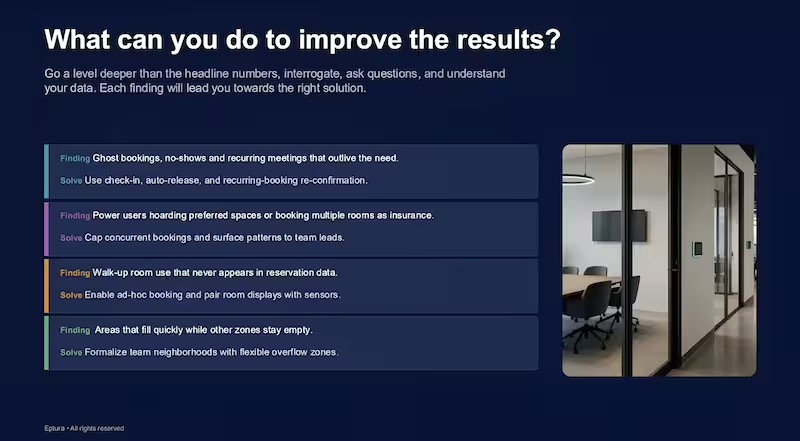
“Ghost bookings and no-shows, recurring meetings that are never fulfilled…skew the data,” Jones said.
If workplace leaders treat every reservation as confirmed utilization, those behaviors can create an inaccurate baseline. That becomes particularly important when the organization begins using those numbers to inform expensive portfolio decisions.
Before deciding that an office needs more space or that an existing location can be consolidated, leaders need confidence that the underlying utilization data reflects what employees are actually doing.
Connect workplace systems to improve data quality
One way to build that confidence is by connecting workplace systems that can help verify activity.
Access control is a useful example.
“Access control is a fantastic one there, where everybody enters the building, everybody scans a card, and you can use those systems to confirm the intent that was stated,” Jones said.
Booking data might show that an employee planned to work from a particular office. Access data can provide another signal showing whether that employee entered the building.
“That builds accurate pictures of who’s in the building, but it also builds up your delta about how bookings are treated and how they are fulfilled,” Jones said.
The principle extends beyond access control.
Space planning, booking, visitor management, facilities operations, employee experience, and portfolio planning all produce information that can contribute to a broader understanding of workplace performance. When those systems remain disconnected, leaders may be forced to reconcile information manually or make decisions using only part of the available evidence.
Connecting systems makes it possible to compare different signals and build a more reliable picture of how people, space, and workplace services interact.
Improve the baseline before making bigger decisions
Organizations do not necessarily need to solve every workplace data challenge at once.
A more practical approach is to improve the reliability of the baseline first and then use that stronger foundation to support larger decisions.
The webinar highlighted several ways organizations can improve the quality of workplace utilization data, including:
- Requiring employees to check in when they arrive
- Establishing auto-release times for unused reservations
- Asking employees to confirm recurring bookings
- Connecting booking platforms with access control systems
- Setting concurrent booking caps to prevent employees from holding multiple preferred spaces
- Introducing more intelligent or automated booking processes
These changes may appear operational, but they have strategic implications.
Releasing an unused desk makes that space available to another employee. Requiring check-ins creates a clearer distinction between reservations and actual usage. Confirming recurring meetings reduces inaccurate room utilization data. Connecting bookings and access events helps workplace teams compare intent with behavior.
Over time, these processes can create a more trustworthy baseline for planning.
Organizations can then re-baseline their workplace data and approach decisions about consolidation, reconfiguration, lease renewals, and expansion with greater confidence.
Use workplace analytics to answer business questions
Once organizations have reliable data, the next step is turning it into decisions.
Occupancy, utilization, and workplace analytics can help leaders determine:
- Where space is consistently underused
- Where demand exceeds available capacity
- Which types of spaces employees use most
- Whether utilization varies significantly by day or team
- Where reconfiguration could improve performance
- Whether a location should be expanded, consolidated, or maintained
The statistic that 94% of meetings involve six or fewer people, for example, becomes more useful when an organization compares it with its existing room inventory.
If much of the portfolio consists of large conference rooms while most meetings involve relatively few people, there may be an opportunity to reconsider the mix of spaces. The important question is not simply how many meeting rooms exist, but whether their size and configuration align with actual demand.
The same principle applies to desks and other workplace resources. Portfolio optimization requires understanding what employees need, when they need it, and whether the existing workplace can support that demand efficiently.
Plan for multiple portfolio scenarios
Better visibility also allows organizations to move beyond reacting to current conditions and begin planning for different futures.
Scenario planning is particularly valuable because real estate decisions often have long-term consequences. A lease renewal, consolidation, office expansion, or redesign can affect the organization for years.
Instead of relying on a single forecast, leaders can model several possibilities.
What happens if attendance increases? What if a business unit grows? Could teams be consolidated without creating capacity problems on peak days? How would a different desk-sharing ratio affect requirements? Could flexible space absorb temporary changes in demand?
Flex space is increasingly part of that discussion. Jones noted that organizations are considering “non-traditional building or real estate as part of their overall offering to their employee workforce.”
That creates options beyond simply keeping or eliminating an office. Organizations can evaluate traditional leased space alongside more flexible alternatives and determine which combination best supports employees and business requirements.
Scenario planning does not remove uncertainty, but it gives leaders a structured way to evaluate it before committing capital.
Modern problems require modern workplace processes
Technology has changed how and where employees work, yet some organizations continue trying to manage new workplace patterns with processes designed for a more predictable office environment.
“Sometimes organizations are looking to solve for new problems or new world problems or evolving problems with older traditional processes and software,” Jones said.
Static spreadsheets and disconnected systems can make it difficult to keep pace when utilization changes weekly and executives expect more frequent answers about portfolio performance.
Modern workplace technology can help organizations connect the operational details of the workplace with longer-term real estate strategy.
The goal is not technology for its own sake. It is creating the visibility and planning capabilities leaders need to understand current conditions, evaluate potential changes, and measure the results.
As Jones explained earlier in the session, the presenters wanted to “turn that into something tangible for you, talk about our experiences that we have speaking with our customers, with the market, and then look at some best practices that we’ve learned together with our customers along the way.”
Turn real estate data into measurable business value
The broader takeaway from the webinar is that real estate performance cannot be understood through cost or utilization alone.
Organizations need to connect workplace data with outcomes such as portfolio efficiency, employee experience, operational performance, and business agility.
That requires moving through a clear progression:
- Improve the data. Reduce ghost bookings, distinguish reservations from actual presence, and connect systems that can verify workplace activity
- Build a reliable baseline. Understand how employees are actually using desks, rooms, buildings, and services
- Add context. Look beyond portfolio averages to understand variations by location, day, team, and space type
- Model the options. Use scenario planning to evaluate consolidation, expansion, reconfiguration, flexible space, and other portfolio strategies
- Take action and measure the results. Use workplace insights to make changes and continue monitoring whether those decisions deliver the intended outcomes
That is ultimately what moves an organization from managing space to managing real estate strategically.
Statistics can identify the challenges. As Kilmartin explained, however, they “often don’t tell the story behind the stats.”
For workplace and real estate leaders, the opportunity is to uncover that story and use it to make more confident decisions about where to invest, where to change, and how the portfolio can better support the business.
Watch Eptura’s “From Space to Strategy: Turning Real Estate into a Measurable Advantage” webinar to hear Kev Jones and Sarah Kilmartin share practical approaches for improving workplace data, strengthening portfolio planning, and turning real estate insights into action.
Frequently Asked Questions

By Erin Sevitz
As Vice President of Content and Customer Marketing at Eptura, Erin Sevitz oversees teams responsible for providing worktech insights and engaging 25 million Eptura users worldwide. With over 10 years in thought leadership on workplace management and the built environment, Erin brings deep industry knowledge to her role. Previously, she led communications for the International Facility Management Association, a global nonprofit dedicated to professional development for workplace strategists and building managers, and served as editor in chief for IFMA’s FMJ magazine.