


Federal facility managers face a long-standing challenge that’s also quickly growing: they’re making decisions based on assumptions instead of data, right when Congress demands they justify every square foot.
A recent House Subcommittee on Economic Development, Public Buildings and Emergency Management hearing, “Cutting Costs, Adding Value: The Future of Federal Property” highlighted the complexity of the problem: federal facility management professionals must address a deferred maintenance backlog that has grown to $26-50 billion—so large that the General Services Administration’s (GSA) portfolio would have to shrink by about 80% to keep up with maintenance within current budget appropriations—while also having to meet new 60% occupancy mandates under the USE IT Act.
Heather Krause, Managing Director of Physical Infrastructure Issues at the Government Accountability Office (GOA), explained in her testimony, “For decades, GAO has reported that the federal government has too much space, that its buildings are often in poor condition, and that agencies don’t have good data to make real property decisions.”
Key takeaways
- Data over assumptions: Integrated facility management platforms replace guesswork with real-time analytics, giving federal managers the evidence they need to justify decisions to Congress
- Unified systems solve multiple problems: Consolidating space management, asset tracking, maintenance, and compliance into one platform eliminates silos and enables strategic decisions that address several challenges at once
- Proactive management meets mandates: Data-driven facility management helps agencies satisfy occupancy requirements and reduce maintenance backlogs while operating within tight budgets
The way to meet the needs of federal property management is by implementing digital solutions that help federal facility management professionals replace assumptions with evidence, silos with integration, and reactive approaches with strategic intelligence.
The step-by-step solution: How to move from data silos to unified intelligence
Ranking Member Rick Larson stated during the hearing, “… having a smaller, fuller federal footprint should be our goal,” but to make that happen, you need more than better spreadsheets. You need integrated facility operations platforms that consolidate everything required to run, maintain, and optimize built environments, all while meeting the strict security and compliance standards that federal work demands.
Build real-time analytics for better decisions
The challenge of lacking good data to make real property decisions requires a fundamental, comprehensive solution: unified visibility across your entire portfolio.
With an integrated facility management platform, you gain what you need most: real-time analytics and clear reporting that tracks space usage, sustainability, and costs to inform strategic decisions.
Instead of logging into five different systems to understand building performance, space utilization, asset health, maintenance status, and compliance standing, you access a unified dashboard providing real-time visibility across your entire portfolio.
When you can see that a particular building has underutilized space, aging HVAC systems flagged for maintenance, and upcoming lease decisions all in one view, you can make strategic decisions that address multiple challenges simultaneously. That underutilized building might become your candidate for consolidation, allowing you to redirect resources toward facilities with better long-term prospects.
Track occupancy and utilization to meet the USE IT Act’s 60% mandate
Chairman Perry called for agencies to “improve abysmal space utilization rates” and hold them “accountable for the amount of space they use.”
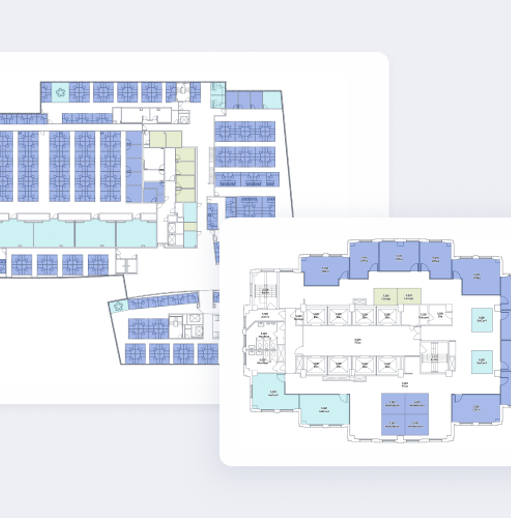
Space planning and optimization capabilities integrated with Building Information Modeling (BIM) allow you to visualize, plan, and manage workspaces dynamically. You can analyze utilization data across your portfolio for evidence-based consolidation decisions, supporting the congressional mandate for a footprint that fully supports the mission without wasting the budget.
Real-time occupancy tracking also provides you with the actual usage data needed to demonstrate compliance with the 60% threshold. Instead of estimates and assumptions, you’re finally working with verified occupancy and utilization data from across your portfolio.

Modern workplace experience platforms support federal employees by streamlining the process for booking rooms and desks, locating colleagues, and managing services all from the same platform, all while generating utilization data you can use to prove your compliance with congressional mandates.
Address the $50 billion maintenance backlog strategically
With approximately $50 billion in deferred maintenance and repair liabilities across the GSA portfolio, you need proactive and predictive approaches to asset management rather than reactive emergency repairs.
BIM-powered asset management enables you to track every asset’s life cycle, location, and condition in detail. When you combine comprehensive visibility with automated scheduling and real-time inventory tracking through mobile field service applications, your field technicians can review parts, update tasks, and log work from any device, even when their mobile devices are offline.
The move from reactive to proactive maintenance directly addresses Acting Commissioner Heller’s warning that maintenance costs “are likely underestimated and will only grow if left unaddressed.” With the right software solution, you can implement predictive strategies based on actual asset conditions and usage patterns to catch problems before they escalate into budget-draining emergencies.
Capital project management capabilities also play a key role, allowing you to plan, budget, and manage infrastructure projects from start to finish, while monitoring milestones, controlling costs, and keeping stakeholders aligned. When you back your capital requests with detailed asset condition data, utilization metrics, and predictive failure analysis, you create compelling evidence-based proposals rather than wish lists.
Drive consolidation and realize cost savings
The hearing proved the potential for significant savings by highlighting recent successes. Chairman Perry noted the Public Buildings Reform Board’s work under the Federal Assets Sale and Transfer Act (FASTA) “with an anticipated $5.4 billion in savings from its second-round recommendations.”
Acting Commissioner Heller detailed GSA’s progress: “Last year, we executed 90 building dispositions, reducing the government’s footprint by more than 3 million square feet. Those building sales generated $182 million in proceeds, avoided $415 million in repairs and operating costs.”
The potential for future savings is even larger.
With continued congressional support, Acting Commissioner Heller testified, “… those dispositions will further reduce the inventory by 15 million square feet and avoid an additional $3 billion in future repairs and operating costs.” GSA has also focused on lease optimization, “generating $730 million in cost avoidance through lease negotiations and inventory reductions,” according to Heller.
These sorts of savings require evidence-based decisions about which buildings you should retain, renovate, or dispose of.
Lease and contract management capabilities help you centralize lease data, automate renewal alerts, and analyze costs across your portfolio for consolidation opportunities. Interactive mapping tools support the strategic lease decisions that generate the kind of cost avoidance that Heller described.
With comprehensive lease management for a federal portfolio, you can:
- Track lease obligations and critical dates across your entire portfolio to avoid costly renewals and missed deadlines
- Automate renewal notifications so you have time to negotiate better terms or plan strategic exits
- Analyze lease costs against market rates to identify opportunities for renegotiation or consolidation<
- Map lease locations and expiration dates to visualize portfolio-wide patterns and consolidation opportunities
- Generate compliance reports that demonstrate lease optimization to congressional oversight bodies
Interactive mapping tools support the strategic lease decisions that generate the kind of cost avoidance that Heler described. When you can see all lease obligations in one system, you can make the evidence-based decisions about space retention, consolidation, and disposal that congressional leaders demand.
Meet compliance, reporting, and federal security requirements
Meeting mandates means more than getting good data. What you need are systems that you can deploy and use within federal security requirements.
Archibus for Government provides a FedRAMP Authorized solution that meets strict federal security standards. It’s a designation that ensures your data protection and operational compliance with the highest government standards, which is essential when you’re managing sensitive facility information.
Automated reporting and compliance tracking capabilities provide you with system-wide centralized reporting for portfolio management. Rather than manually compiling data from multiple sources, you can generate the comprehensive reports that GSA, OMB, and Congress require—covering space occupancy methodology, utilization rates, and costs.
Cut costs. Add value. Get started with Archibus.
Ranking Member Stanton opened the December hearing with a simple but powerful standard: “This hearing is about two things. Cutting costs and adding value. That is the standard that the public expects from us, and it should be the standard that we expect from ourselves.”
That’s exactly what data-driven facility management delivers. When you replace fragmented systems with unified intelligence, you cut costs through better decisions. When you demonstrate compliance with hard data, you add value to taxpayers. When you transform maintenance from reactive to predictive, you do both.
Discover how Archibus for Government helps cut costs and add value.
Frequently asked questions

By Jonathan Davis
As a content creator at Eptura, Jonathan Davis covers asset management, maintenance software, and SaaS solutions, delivering thought leadership with actionable insights across industries such as fleet, manufacturing, healthcare, and hospitality. Jonathan’s writing focuses on topics to help enterprises optimize their operations, including building lifecycle management, digital twins, BIM for facility management, and preventive and predictive maintenance strategies. With a master's degree in journalism and a diverse background that includes writing textbooks, editing video game dialogue, and teaching English as a foreign language, Jonathan brings a versatile perspective to his content creation.