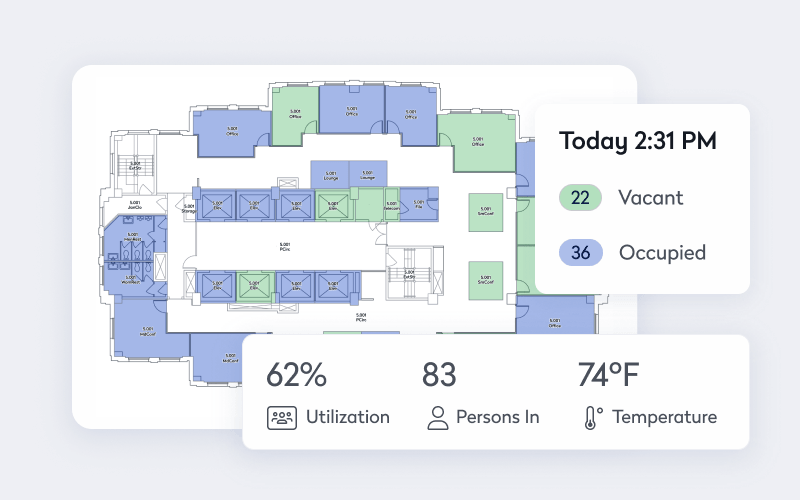
Facilities and estates teams use booking platforms to record reservations, occupancy tools to capture presence, and service systems to track operational demand. Yet greater visibility does not automatically create greater certainty. 79% of UK workplace leaders understand current occupancy, while only 28% feel highly confident forecasting their space needs six to 12 months ahead, according to our latest Workplace Index. The 51-point gap reveals a central challenge for the industry: teams can describe recent activity, but many still struggle to explain what produced it and whether the pattern will continue.
Phil Davitt, Eptura’s Senior Vice President of Global Professional Services, explored that challenge at Facilities & Estates Management Live in London. His presentation, “From workplace data to business value: What high-performing FM teams do differently,” gave facilities and estates leaders an early look at findings from our latest research, drawing on perspectives from 1,383 workplace leaders and office-based employees alongside more than 91 million anonymized desk and meeting room bookings.
Key takeaways
- Visibility does not guarantee predictability: Although 79% of UK workplace leaders understand current occupancy, only 28% feel highly confident forecasting their space needs six to 12 months ahead
- Demand patterns reveal what attendance averages conceal: Stable desk-booking frequency can coexist with growing pressure on meeting rooms, while same-day and reservations create different operational demands
- Connected evidence supports better workplace decisions: Facilities teams can build a clearer operating view by connecting attendance, space type, timing, actual use, and employee friction, then measuring whether an intervention improved the intended outcome
Stronger forecasting begins with a specific operational decision rather than another isolated metric. When facilities teams establish a baseline, connect the relevant signals, and measure the result consistently, workplace data becomes evidence they can use to guide space, service, and portfolio
Look beyond the occupancy figure
Occupancy gives facilities teams a useful record of recent activity, but it cannot explain future demand on its own. Occupancy and utilisation measure different aspects of workplace performance, and a daily or weekly average can hide significant differences in what employees need, when they need it, and whether the workplace supports the work they came to do.
Booking activity across London workplaces illustrates the problem. Employees booked desks an average of 2.04 days per week, and that frequency remained relatively consistent from 2024 to 2025. Desk bookings increased by just 0.7%, while room bookings grew by 4.3%. Stable desk attendance therefore coexisted with rising pressure on shared rooms.
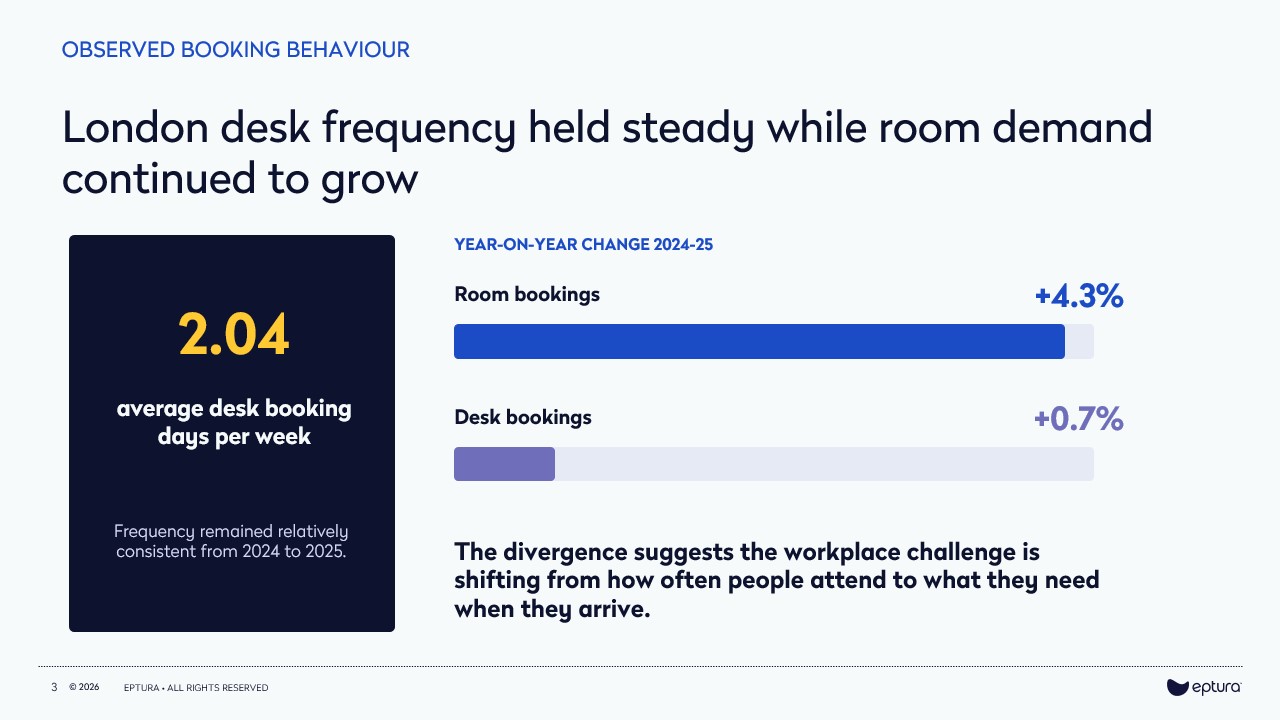
The change suggests that the planning question has shifted from how often people attend to what they need when they arrive.
Manage immediate and advance demand differently
Room booking lead times reveal another layer that monthly averages conceal. In London, employees created 38.8% of room bookings on the same day. They made 27% one to seven days ahead and 34.1% at least eight days in advance. Facilities teams therefore manage two distinct forms of pressure: immediate demand from people who need space now and advance demand that reserves capacity long before the day arrives.
Each pattern requires a different operational response. Same-day demand depends on accurate, real-time availability and a simple way to claim space. Advance demand requires active reservation management because plans often change between the booking date and the meeting. Check-in requirements can confirm that employees still need a room, while release rules help teams manage no-shows and return unused rooms to availability. Waitlists and reassignment can then connect that recovered space with people who are already searching.
Replace fragmented signals with connected evidence
The Workplace Index findings show why forecasting confidence falls so sharply. More than half of UK workplace leaders, 54%, say assumptions often influence workplace decisions instead of live data. Another 43% say inconsistent data frequently slows decisions. Teams may collect large volumes of information but still lack a connected view of demand.
A useful forecast needs to connect four signals:
- Attendance: Shows overall presence across the workplace
- Space type: Reveals what employees try to use when they arrive
- Timing: Identifies when pressure occurs and how demand develops
- Actual use: Confirms whether recorded demand became physical activity
When those signals sit in separate systems or reports, teams can describe each one and still reach the wrong conclusion about future requirements.
Test who the data represents
Booking data also has a coverage problem. Nearly one in four UK employees, 23.6%, often use workspace without booking it. Their activity occurs in the physical workplace but never enters the formal demand record. Teams that rely only on reservations may underestimate informal use, overlook pressure in specific areas, or build forecasts around employees who follow the booking process most consistently.
Management confidence and employee access make that risk more visible. While 69% of UK managers trust booking data to reflect actual usage, only 26% of employees report access to booking software. Another 25% report no technology for workplace interactions. The figures measure different issues, but together they raise an essential question: whose behavior can management actually see?
Treat workplace friction as operational evidence
Employee experience provides another test of the data. One in five UK employees often cannot find a space suited to the task, while 13% often find that a booked space is unavailable. Those failures occur after workplace systems have supposedly captured demand. A successful reservation therefore cannot serve as the final measure of success. The real outcome comes when an employee finds usable, appropriate space and starts work without unnecessary disruption.
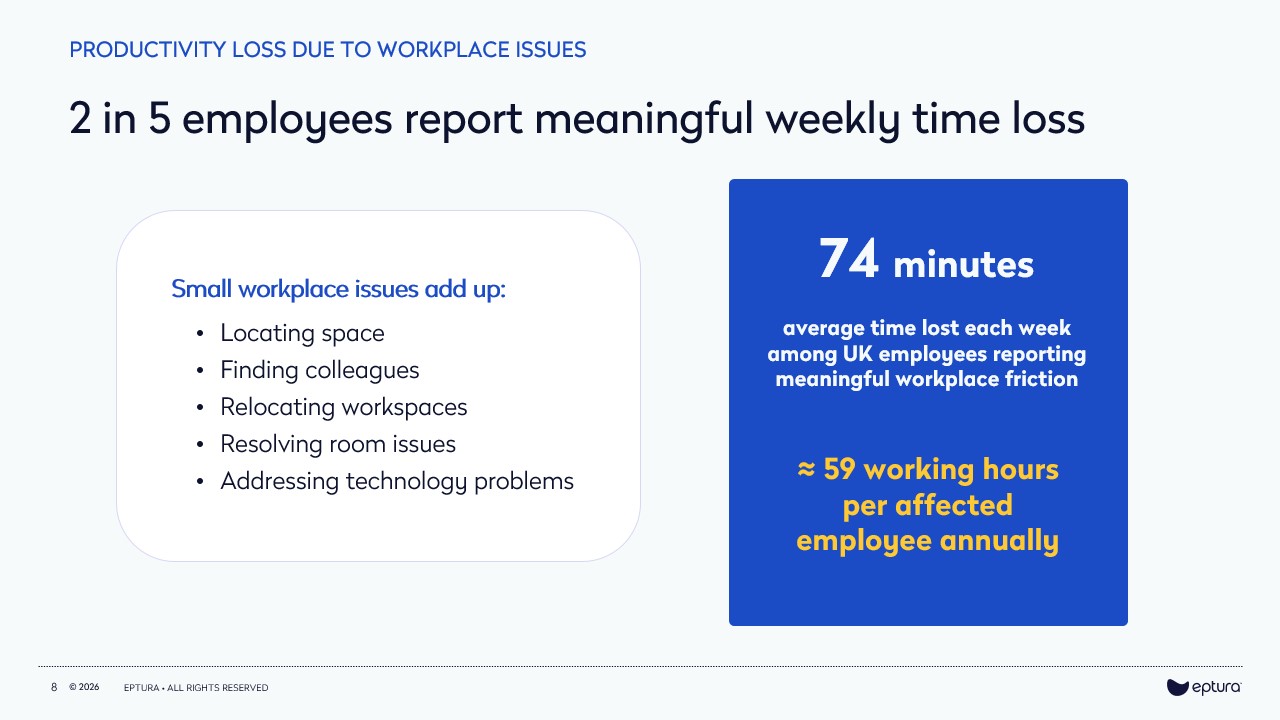
Small workplace problems also create measurable business costs. Among UK employees who report meaningful workplace friction, the average time loss reaches 74 minutes each week. That equals approximately 59 working hours per affected employee across a 48-week year. Employees lose time locating space and colleagues, relocating between work areas, resolving room issues, and addressing technology problems.
Facilities teams can use that friction as a performance measure. Establish a baseline before changing a booking process, service model, or workplace layout. Identify which groups experience the greatest disruption and where the problems concentrate. Measure the same population after the intervention. When you connect a specific source of friction to a specific change, time recovered becomes evidence of operational improvement rather than a broad productivity claim.
Match portfolio changes to measurable demand
UK workplace leaders expect their portfolios to change. The research finds that 57% expect workplace space to increase, with 43% anticipating more shared or flexible space, 40% expecting more collaboration space, and 39% planning greater use of space-sharing or hybrid models. The figures suggest that many organizations want a different mix of space, not simply more of the same.
Start by identifying the activities the current workplace fails to support, the employee groups most affected, and the amount of existing capacity you can recover. Teams can then use utilization data to guide space-planning decisions, determining whether the appropriate response involves expansion, reconfiguration, or better management of supply.
Measure the outcome, not the technology
Connected systems create the opportunity to understand workplace performance, but organizations still need measurement discipline to prove value. The UK findings show a gap between system integration and formal return on investment measurement. Teams can close that gap by starting with a specific operational decision and selecting an outcome that matches it.

If you adjust services and staffing by day, measure peak-day reliability. If you introduce check-ins and release rules, measure the capacity returned to supply. If you reconcile bookings with actual use, track failed searches and unavailable reservations. Establish the baseline and measurement method before implementing the change, then use the same definition and population afterward.
Build a more useful operating view
Phil proposed organizing workplace evidence around three measures: rhythm, friction, and adoption quality. Together, they help teams distinguish between capacity, configuration, process, and data coverage and participation, so they can choose the right intervention and prove what improved.
During the Facilities & Estates Management Live session, Phil argued that facilities teams often have more workplace data than they can effectively operationalize. The challenge is rarely data collection. The challenge is translating signals into measurable decisions about space, services, and portfolio strategy.
Ready to turn workplace data into clearer space and service decisions? Explore Eptura Workplace.
Frequently asked questions

By Erin Sevitz
As Vice President of Content and Customer Marketing at Eptura, Erin Sevitz oversees teams responsible for providing worktech insights and engaging 25 million Eptura users worldwide. With over 10 years in thought leadership on workplace management and the built environment, Erin brings deep industry knowledge to her role. Previously, she led communications for the International Facility Management Association, a global nonprofit dedicated to professional development for workplace strategists and building managers, and served as editor in chief for IFMA’s FMJ magazine.