


2025 marked an inflection point for facility and workplace management. Human-centric design moved from philosophy to practice, AI evolved from experimental tool to embedded intelligence, and connected ecosystems became the foundation for every other innovation.
You don’t have to take our word for it, either. The clearest sign that these were the biggest trends of 2025 came directly from the facility and workplace leader community, through what you voted for, what you clicked, and what resonated most as the industry navigated unprecedented change.
Key takeaways
- Integration won because it solves real problems: Organizations managing multiple disconnected workplace systems waste resources bridging data gaps instead of creating value. Unified platforms eliminate this friction and unlock strategic insights that fragmented tools simply can’t provide
- Three trends converged to reshape facility management: Human-centric design, AI as embedded intelligence, and connected ecosystems didn’t develop in isolation—they reinforced each other, creating compound value for organizations that embraced all three simultaneously
- Success in 2026 requires action today: Organizations positioning for competitive advantage are consolidating fragmented systems, investing in people-centric AI training, and fostering cross-functional collaboration between IT and facilities teams
What made 2025 transformative wasn’t just the individual trends. It was how they reinforced one another. Integration created the foundation for AI to deliver value, AI enabled the measurement that made human-centric design strategic rather than philosophical, and human-centric thinking guided how both technology and data should serve people.
What the facility and workplace community said about 2025
When we asked facility and workplace leaders on the Eptura LinkedIn account to choose one word that defined facility management in 2025, the results were clear: Integration took the lead at 48%, followed by Resiliency at 33% and Predictive at 14%.
There was a great write-in answer, too: Convergence.
Both the winner and the write-in capture something essential about 2025. Integration speaks to the technical reality of bringing disconnected systems together, enabling data to flow freely, and eliminating the operational chaos of fragmented tools. Convergence describes the bigger picture. Here it’s about the coming together of trends, technologies, and functions into unified approaches where AI, human experience, and connected ecosystems reinforce each other. Integration is how we got there; convergence is what we achieved.
That consensus makes perfect sense. In fact, many of our most successful blog posts in 2025 focused on how a unified platform eliminates the friction of fragmented systems and unlocks measurable value across facilities, people, and data.
The integrated workplace office: Why connection is the key to unlocking workplace value
When organizations consolidate workplace, facility, and asset management into a single system, they eliminate silos and enable data to flow freely across departments. In the post, we break down how integration creates a value chain, connecting occupancy data with cleaning schedules, linking asset work orders directly to employee experience apps, and transforming operational complexity into strategic advantage.
See how integration unlocks workplace value.
2025 Workplace Index report: How unified worktech supports AI implementation
AI promises transformative results, but fragmented systems create the biggest barrier to success. We explore the ways unified platforms overcome the top AI challenges, including eliminating data silos, ensuring consistency, and providing the scalability that makes AI adoption actually work. If you’re planning AI investments in 2026, this post is an important read.
Discover how unified worktech enables AI success.
Rethinking productivity: 2025 Workplace statistics
The key stats from the post: 50% of businesses are managing an average of 17 disconnected worktech solutions, while only 4% have achieved full integration. 37% of organizations now employ 11 or more full-time staff to collate and report on data across systems. There’s a solution, though, and we explain why productivity depends on an integrated, intelligent, and human-centered workplace ecosystem.
Learn how integration drives real productivity gains.
A singular solution to the problem of too many systems
Running too much single-point software creates operational chaos, and in the blog post we make the case for consolidation by showing how a unified approach reduces administrative burden, improves decision-making speed, and delivers the cross-platform analytics that modern facility management requires. If you’re drowning in disconnected tools, this roadmap shows the way forward.
Explore the business case for unified workplace platforms.
How intelligent worktech supports team goals across the organization
Different teams have different goals, for example employee experience leaders want unified vision, while asset managers need uptime, and facility teams seek operational excellence. We show you how intelligent, connected worktech supports all these objectives simultaneously through one unified solution, cross-platform data analytics, and embedded AI that works across functions.
See how unified platforms align team goals.
FM and workplace thought leaders explored 2025’s most impactful trends
Your poll responses and reading choices identified the forces reshaping facility management industry wide. Throughout 2025, we were tracking these transformations, documenting how human-centric design, AI implementation, and connected ecosystems evolved from emerging concepts into operational imperatives.
The human-centric design revolution and understanding the geography of work
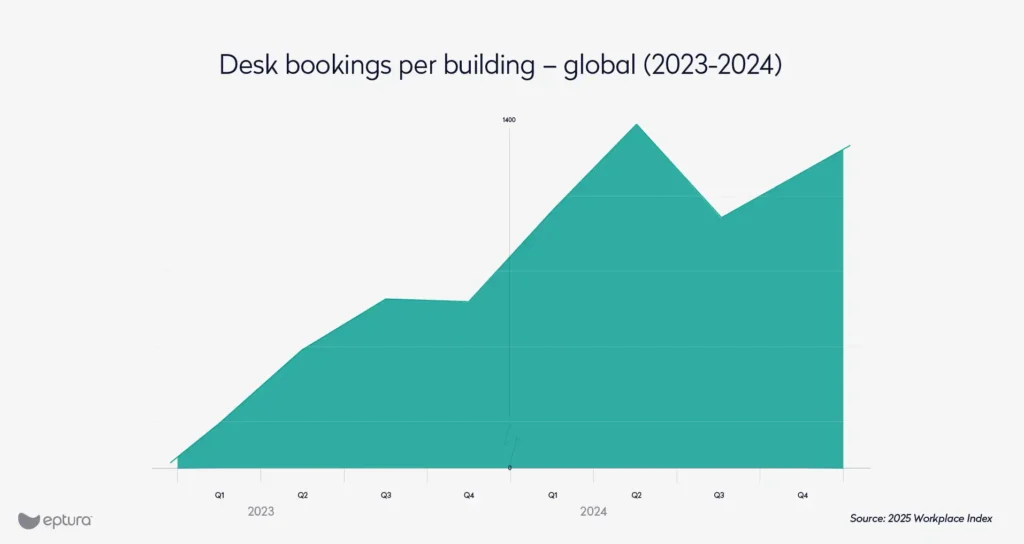
Office attendance surged in early 2025. The Eptura 2025 Workplace Index showed desk bookings up 33% globally while visitors per location nearly doubled. Facility leaders faced critical questions: What drives people to come to the office, and how do they experience it once they’re there?
Finding answers requires understanding the relationships between people and places.
Tica Masuka, Global Workplace Strategy Director at Spaceful, explained in the Workplace Innovator podcast episode “Support That Emotional Intelligence – Understanding Human Geography and the Power of Place”: “There is this interrelation happening between people and place where people influence place, but place also influences people, and we need to understand it both ways in order to create great workplace experiences.”
David Dewane, Chief Experience Officer for Physical Space at Genient, advocated for bringing social scientists into space planning in the Workplace Innovator podcast episode “Understand the Reality – Shaping Experiences in the Workplace across Space, People, and Technology”: “They can tell you what’s really going on, that’s the most important thing.” He encouraged facility managers to budget for researchers who can reveal how teams actually use workplaces.
Design itself was being recognized as a cultural tool. Pendrick Brown, Managing Director for EMEA at HLW, described this culture-first approach: “We really want to get under the skin of the company we’re working with to really understand their culture, really understand their ethos.”
There were also new ideas about what spaces should provide. FMs were thinking about applying hospitality principles to facility management, treating employees with the personalized attention typically reserved for hotel guests. Organizations fostered belonging through well-equipped spaces, enjoyable amenities, and elevated service, where receptionists were reimagined as concierges who personally escort guests and manage technology setup.
We also saw a shift to designing for every employee and the whole employee experience
Employee experience evolved from basic workplace conditions to a holistic view encompassing physical workspace design, company culture, work-life balance, and growth opportunities.
Interested in neuroinclusive design also grew, creating workplaces that support neurodivergent individuals. Kay Sargent emphasized intentional decision-making as a part of the process: “Every decision we make—height, scale, color, texture, material—every single decision we make should be intentional, and far too often they’re not.”
AI goes from tool to teammate, but people always come first
According to the 2025 Workplace Index, 77% of facility managers planned to implement AI in employee experience workflows within 12 months, while 68% focused on visitor management and 59% on space optimization.
So, facility and maintenance leaders were asking themselves a fundamental question: How do we implement AI in ways that support our teams?
There was an overall move from automation to strategic intelligence.
At the Eptura Flex event in New York, industry leaders emphasized a critical distinction: AI implementation should focus on creating real business value, not simply adopting technology for its own sake. The perspective aligned with what leaders were seeing. AI wasn’t a shortcut. Instead, it was an amplifier. Organizations that laid proper foundations in data structure and strategy would see transformative results.
Facility managers were discovering AI’s power in pattern recognition: analyzing energy consumption, monitoring HVAC systems, predicting equipment failures, and automatically generating work orders. These applications reduced downtime, extended equipment lifecycles, and enabled proactive management.
Later in the year, at the Eptura Flex event in London, discussions centered on concrete use cases for AI—location strategy, portfolio optimization, capital project management, building operations, and employee experience enhancement. The big takeaway: Technology should follow your goals, not the other way around.
There was also a new role for AI as “connective intelligence.”
AI’s greatest value emerged in its ability to connect disparate data sources and reveal insights invisible in siloed systems. Organizations sitting on valuable data trapped across standalone systems could now use AI to analyze patterns across visitor management, space utilization, energy consumption, maintenance records, and employee feedback simultaneously.
The shift was profound. AI wasn’t replacing facility managers’ expertise. Instead, it was augmenting their capacity to see patterns, anticipate needs, and make data-informed decisions at scale. With 34% of organizations planning to increase in-office days, AI is the enabler that makes personalized, responsive, human-centered workplaces possible at enterprise scale.
The rise of the connected workplace ecosystem
Organizations began the year drowning in disconnected workplace technology. Our 2025 Workplace Index revealed the scale, with 50% of businesses managing an average of 17 standalone worktech systems, while 37% employed 11 or more full-time staff just to collate, analyze, and report on fragmented data.
Organizations were spending enormous resources managing technology instead of deriving value from it. The “integration tax” was real. Companies were paying substantial costs in both dollars and productivity just to bridge the gaps between systems that should have been talking to each other all along.
Ryan Linthicum, Managing Principal at Langan Engineering, offered practical guidance in the Asset Champion podcast on implementing asset management technology: “Pick outcomes, not features. Invest in people and technology and standardize data early. Data is king.”
His advice captured a fundamental truth. The path forward wasn’t about acquiring more tools. Instead, it was about building connected ecosystems where data could flow freely, inform decisions across departments, and support strategic objectives rather than create administrative overhead.
Here again, the keyword was integration.
Integration enables alignment by making FM data visible and actionable across departments, transforming facilities from a support function into a strategic partner.
When HR can see how space design correlates with employee retention rates, they make different decisions about workplace investments. When finance has clear visibility into the ROI of workplace experience improvements like tracking how amenities, design choices, and technology investments impact productivity, collaboration, and talent attraction they can justify smart expenditures that disconnected systems make invisible.
When IT coordinates with facilities on technology deployment, understanding occupancy patterns, utilization data, and employee needs, infrastructure investments align with actual workplace usage rather than assumptions. Cross-functional visibility only becomes possible when systems connect.
The shift from siloed to strategic creates measurable business impact. Facility managers who can demonstrate how their decisions affect recruitment costs, real estate efficiency, and employee satisfaction gain influence in organizational planning. They move from reactive service providers to proactive strategic advisors.
Looking ahead: What to expect and how to prepare for 2026
The three transformations we tracked throughout 2025, human-centric design, AI as teammate, and connected ecosystems, are accelerating and converging in ways that will fundamentally reshape how organizations approach workplace management.
2026 marks the end of the “tools era” and the beginning of the “ecosystem era.” Success will no longer be measured by how many workplace technologies you’ve deployed, but by how seamlessly those technologies work together to serve strategic goals.

The “integration tax” — employing 11 or more people to manage data across 17 disconnected systems — will become unacceptable as organizations consolidate to unified platforms that unlock insights fragmented systems simply can’t provide.
Companies that invested in building connected workplace ecosystems in 2025 will operate with fundamentally different capabilities than their competitors, while facility and workplace leaders who developed strategic skills and cross-functional partnerships will emerge as true business partners demonstrating direct impact on recruitment, retention, productivity, and innovation.
Organizations preparing for 2026 success should focus on three interconnected areas.
Build unified digital infrastructure
Consolidate fragmented workplace systems into integrated platforms that eliminate data silos. Audit your current tech stack, prioritize integration, establish clean data standards early, and ensure your platform can support AI capabilities across all workplace functions.
Digital transformation delivers immediate returns by shifting maintenance from reactive to predictive. Organizations that consolidate their operations, including accessing sensor data, historical service records, and automated scheduling tools, can anticipate issues before they escalate while AI-backed analytics detect patterns and trigger maintenance workflows, reducing labor costs and avoiding costly disruptions.
Start by learning how digital transformation modernizes your operations.
Invest in people-centric AI training and change management
Develop comprehensive training programs that help FM teams understand AI capabilities and build confidence in working alongside intelligent tools. Focus on outcomes, not features.
For many, the biggest barrier to AI success in 2025 wasn’t technology. It was workforce readiness. Organizations that invested in change management, employee training, and people-first implementation approaches saw adoption and value.
Your first step is finding out why successful AI implementation starts with people.
Foster cross-functional collaboration between IT and FM
Break down traditional silos between IT and facilities management teams. Create shared ownership of workplace data, establish joint goals around employee experience, and align technology investments with both operational efficiency and human-centric outcomes.
When HR understands how space affects retention, when finance sees the ROI of workplace experience investments, and when IT coordinates with facilities on technology deployment, stronger outcomes emerge. Connected work across facilities, people, and data requires cross-functional alignment, and organizations that built these partnerships position themselves for strategic advantage.
Bring the teams together by better understanding how connected work drives cross-functional success.
Make the right 2026 resolutions for FM and workplace success
The gap between leaders and the left-behind will widen significantly in 2026. The opportunity to prepare exists right now. The question isn’t whether these trends will reshape workplace management. We all know they will. The question is whether your organization is taking concrete, measurable steps today that will determine success in the year ahead.
Frequently asked questions

By Mike Petrusky
As Director of Podcasts at Eptura, Mike Petrusky hosts both the Workplace Innovator Podcast and the Asset Champion Podcast, sharing thought leadership with CRE, FM, and IT leaders in the digital and hybrid workplace. Mike has produced more than 500 podcast episodes listened to in over 111 countries. As an in-demand public speaker, Mike engages audiences at numerous industry events each year, including International Facility Management Association and CoreNet conferences, focusing on the human element of workplace and facility management.