Maintenance contracts can define the work, price, and legal terms but without giving teams enough direction to manage day-to-day service. Gaps become visible when a critical asset fails, a provider requests additional approval, closeout records arrive incomplete, or IT needs to coordinate contractor access across physical and digital systems.
You can close those gaps by connecting the agreement to the way your teams assign work, document service, measure results, and review the relationship. Clear responsibilities reduce delays, reliable records make problems easier to prove, and regular reviews give you time to fix service issues before renewal.
Key takeaways
- Clear scope turns contract terms into workable processes: Define covered assets, responsibilities, approvals, access requirements, documentation, and closeout standards so every team understands what happens from request through completion
- Service levels should reflect asset risk and business impact: Set separate targets for response, arrival, temporary restoration, and permanent repair, then measure results using consistent definitions
- Reliable records support better vendor decisions: Connect contracts with work orders, asset histories, costs, and performance measures so you can correct problems earlier and approach renewals with stronger evidence
Specific contract language and legal requirements vary by organization, industry, and jurisdiction, so legal counsel should review the final terms. Facilities and maintenance leaders should drive the agreement, however, because they understand how the work happens, what assets and risks matter most, and how the provider must fit into existing maintenance strategies, work-order processes, safety procedures, and service expectations.
Turn contract scope into an executable workflow
The agreement should explain what the provider covers and how work moves from request to completion. Identify the locations, assets, systems, and components in scope. List included and excluded services, maintenance schedules, emergency coverage, parts responsibilities, required qualifications, and authority to approve repairs or replacements.
The agreement should explain what the provider covers and how work moves through the broader maintenance workflow, from request to completion
Broad language creates avoidable disputes. “Maintain the HVAC system” does not explain who supplies filters, covers controls, responds after hours, performs inspections, or replaces failed components. Attach asset identifiers, locations, operating conditions, and specific task requirements where the detail helps teams assign and verify work.
Define the handoffs between maintenance, procurement, finance, IT, site operations, and the provider., including:
- Work approval: Who creates requests, sets priority, approves estimates, and authorizes additional scope
- Access and safety: Who supplies site instructions, escorts, permits, isolation requirements, and safety information
- Parts and tools: Which party supplies materials, specialist equipment, software, transportation, and disposal
- Closeout: Who reviews the completed work, accepts documentation, and authorizes invoice processing
- Follow-up: Who owns repeat failures, warranty work, incomplete repairs, and unresolved recommendations
IT teams need a visible role when contractors require digital or physical access. Track contractor roles and required access approvals, schedule access reviews and deprovisioning workflows, and support integrations with identity and access-management systems where available. The maintenance platform should provide work context, not become the authority that grants or removes enterprise access.
Include any compliance and audit evidence the provider must return, such as inspection results, certifications, test readings, photographs, technician qualifications, and corrective-work records. Define the required format, retention period, review owner, and submission deadline so maintenance, IT, and compliance teams can trace the evidence to the relevant asset and work order.
With a modern maintenance platform, maintenance teams can use natural-language questions to access insights from live work orders, asset history, and maintenance schedules. Supervisors and planners can quickly identify patterns, answer operational questions, and determine next steps without building custom reports or switching tools.
Set performance expectations around the risk
The contract sets the overall terms, while service levels explain what the provider must deliver day to day. Match those expectations to business impact instead of using the same response target for every asset and location.
Take your time, because the process requires making deliberate choices about what matters most. As Maurice (Moe) Morrow, senior facilities and vendor specialist at United Therapeutics Corporation, explained in an episode of the Asset Champion podcast.
“You’ve got to prioritize things. HVAC is one of the top things here. I’m going to paint that wall myself, and I’m going to use those funds to keep my HVAC up and running.”
A critical asset or life-safety system may require immediate escalation, rapid onsite response, status updates, and a restoration target. A lower-risk asset may allow a longer service window. Separate the time to acknowledge a request, arrive onsite, restore service temporarily, and complete the permanent repair so a fast email response does not hide days of downtime.
Useful performance measures can include:
- Response, arrival, restoration, and completion times
- Preventive maintenance completion and schedule compliance
- First-time resolution, repeat work, and rework
- Documentation completeness and closeout time
- Safety, access, and compliance-procedure adherence
- Estimate, invoice, and parts accuracy
- Communication during delays or scope changes
Define how you calculate each measure, when the clock starts and stops, which priorities use different targets, and which delays do not count against the provider. If your platform includes AI-assisted analysis, you can use asset criticality and past service patterns to explore possible targets. Maintenance, procurement, and operations teams still need to review the suggestions and agree on realistic commitments.
Connect the agreement with daily execution
Contract terms create value when teams use them in everyday work. Connect covered assets and services with the records, priorities, instructions, approvals, and documentation requirements used to manage work orders. Facility and asset teams should know whether the provider covers a task, what the agreement requires, and what evidence they need before closeout.
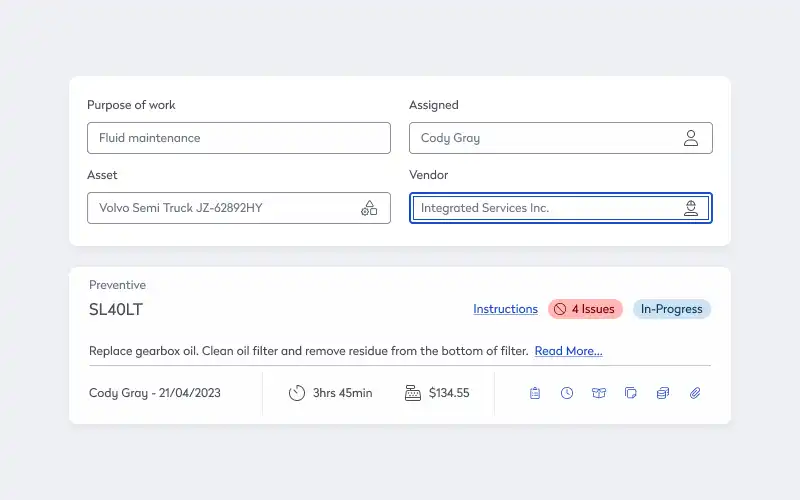
You can use vendor-management and work-order workflows to track covered work, document labor and parts, verify completion, and support invoice reviews with documented service records. When providers can update job status and submit agreed evidence, your team gains better visibility without relying on calls, emails, and separate spreadsheets.
Service agreements are only as effective as the data behind them.
By connecting contract terms, vendor records, work orders, asset history, and performance measures, you gain a clearer view of service quality, costs, and accountability.
IT teams can define who owns the data, how systems exchange it, what contractors can see, how long records must remain available, and how vendor and asset records match across systems. That structure helps everyone trace the work from approval through completion.
Review performance before disputes escalate
Do not wait until renewal to assess service quality. Schedule reviews at intervals that match the contract value, asset risk, and volume of work. A high-risk agreement may need monthly service reviews and quarterly cost reviews, while limited specialist work may need less oversight.
Review service-level results, overdue work, repeat failures, preventive maintenance completion, documentation quality, extra charges, invoice disputes, safety issues, access exceptions, and feedback from site teams. Use consistent definitions across providers and locations so differences in closeout practices do not distort performance.
Compare providers using repeat failures, preventive maintenance completion, response and restoration performance, documentation quality, rework, backlog trends, and total maintenance cost. You can use reporting and analytics to compare service activity across vendors, sites, and asset classes, then investigate the patterns before making corrective-action or renewal decisions.
The review should also test whether the agreement still fits the operation. Asset populations change, sites open or close, operating hours shift, and internal teams gain or lose capability. A provider may miss a target because of poor execution, but the cause may also involve incomplete asset data, delayed approvals, parts constraints, unclear scope, or an unrealistic service level.
You can use AI-assisted analysis to summarize service activity and find patterns such as recurring delays, rework, repeated failures, or incomplete documentation. Use the insights to focus the review, not as proof of poor performance or billing error.
Correct performance problems with evidence
When performance slips, document what the provider missed, which asset or service it affected, what happened as a result, and which records support the finding. Check whether the provider, your organization, or both contributed to the problem before deciding how to fix it.

Set an owner, due date, and review point for each correction. Increase monitoring where necessary, then assess whether the change resolved the issue. Repeated or serious failures may require formal notice, remedies, renegotiation, or termination, but not every missed target justifies ending the relationship.
The agreement should explain how teams report a failure, how long the provider has to correct it, when the issue escalates, and what happens after repeated or serious problems. Natural-language search and AI summaries can help you find the relevant service records faster. Maintenance, procurement, legal, IT, and operations teams still review the evidence and decide what happens next.
Renew, renegotiate, or exit with control
Before renewal, compare provider performance with total cost and what the operation needs now. Review additional charges, service capacity, geographic coverage, certifications, insurance, access requirements, asset changes, and whether another sourcing model now offers better value. Update outdated terms rather than automatically extending them.
If the relationship ends, manage the handover carefully. Account for open work orders, asset histories, inspection records, parts, warranties, outstanding claims, keys, badges, credentials, and system access. Assign responsibility for knowledge transfer and unfinished work, and review access removal with IT instead of assuming the contract end date completes the process.
The difference between a useful service agreement and one that creates friction is not the amount of legal language. It is whether teams can translate expectations into consistent work, measure performance with reliable evidence, and correct problems before they affect reliability, safety, cost, or compliance.
You need contract, vendor, asset, work order, and service information that teams can review together. A shared record helps maintenance, IT, procurement, and finance coordinate the work, understand what the provider delivered, and negotiate a better agreement next time.
Turn service agreements into better service outcomes
When you connect contract terms with vendor records, asset histories, work orders, costs, and performance measures, you can catch service problems earlier, support reviews with reliable evidence, and negotiate future agreements with greater confidence.
Learn how Eptura vendor management software helps you coordinate third-party maintenance work and keep service information in one place.
Frequently Asked Questions

By Jonathan Davis
As a content creator at Eptura, Jonathan Davis covers asset management, maintenance software, and SaaS solutions, delivering thought leadership with actionable insights across industries such as fleet, manufacturing, healthcare, and hospitality. Jonathan’s writing focuses on topics to help enterprises optimize their operations, including building lifecycle management, digital twins, BIM for facility management, and preventive and predictive maintenance strategies. With a master's degree in journalism and a diverse background that includes writing textbooks, editing video game dialogue, and teaching English as a foreign language, Jonathan brings a versatile perspective to his content creation.