


How mobile maintenance apps connect field work to enterprise asset strategy
Maintenance teams are responsible for far more than keeping equipment running. They help protect business continuity, support employee experience, reduce operational risk, ensure compliance, and maximize the return organizations receive from their physical assets.
Those responsibilities are becoming more complex. Eptura’s 2025 Workplace Index found that 34% of organizations plan to increase office attendance while many continue struggling with fragmented workplace technologies and disconnected data. As occupancy rises and asset portfolios become more complex, maintenance leaders must improve service delivery, increase efficiency, and support strategic business goals without proportionally increasing budgets or headcount.
Key takeaways
- Mobile maintenance apps turn field work into operational intelligence, creating a single source of truth for asset performance, maintenance activities, and decision-making.
- Connected maintenance data helps organizations shift from reactive repairs to proactive asset management, improving reliability, uptime, and asset lifespan.
- Giving technicians real-time access to asset history, documentation, and inventory information improves efficiency, reduces delays, and increases first-time fix rates.
- Maintenance leaders gain better visibility into workforce, inventory, and asset performance, enabling smarter resource allocation and capital planning.
- High-quality maintenance data creates the foundation for AI and advanced analytics, helping organizations make more informed operational and investment decisions.
For many organizations, the challenge isn’t a lack of technology. It’s a lack of connection between systems. When work orders, asset records, inventory data, space information, and labor management operate in separate applications, technicians spend more time searching for information, managers struggle to measure performance, and executives lack the visibility needed for informed decision-making.
Modern mobile maintenance apps solve much more than technician productivity. When integrated with enterprise asset management and workplace operations platforms, they create a continuous stream of operational intelligence. Every inspection, repair, inventory transaction, and preventive maintenance task contributes to a single source of truth that supports reliability, asset lifecycle management, workforce optimization, capital planning, and future AI initiatives.
Every completed work order becomes operational intelligence
Many organizations still view mobile maintenance apps as tools for receiving assignments and updating work orders in the field. The greater value lies in the data technicians create during every interaction with an asset.
Each repair, condition assessment, inspection, and preventive maintenance activity captures information that helps organizations understand asset performance over time. Labor hours, parts consumption, failure codes, meter readings, inspection results, photographs, and technician observations all become part of a centralized asset history.
When this information is standardized and captured consistently, maintenance leaders gain visibility into the metrics that drive operational performance, including:
- Mean time to repair (MTTR)
- Mean time between failures (MTBF)
- Asset availability
- Preventive maintenance completion rates
- Schedule compliance
- Labor utilization
- Maintenance backlog trends
Rather than reconciling multiple spreadsheets or manually consolidating reports, organizations gain real-time visibility into maintenance performance and asset reliability.
This aligns closely with Workplace Index findings showing that many organizations continue to struggle with disconnected workplace technologies and fragmented operational data. Connected maintenance systems help eliminate silos by transforming individual work orders into trusted organizational intelligence.
As discussed on the Asset Champion podcast, long-term success depends on breaking down organizational silos and building stronger operational alignment. Mobile maintenance platforms contribute directly to that goal by ensuring maintenance information moves across teams rather than remaining trapped within departments.
Give technicians the context to solve problems faster
Every maintenance call begins before a technician arrives on-site.
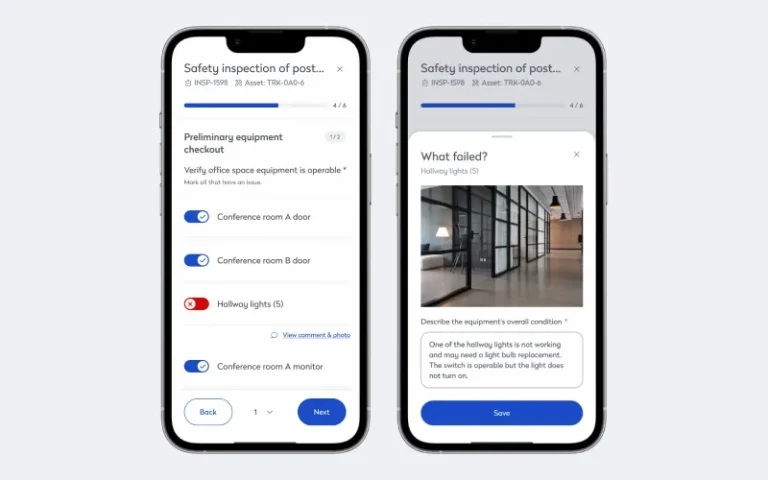
Technicians equipped with complete asset information can diagnose issues faster, improve first-time fix rates, and reduce downtime.
Arrive prepared
Connected maintenance platforms provide immediate access to:
- Asset location and equipment information
- Complete maintenance history
- Previous technician notes
- Open work orders
- OEM manuals and warranty documentation
- Safety procedures and compliance requirements
- Required replacement parts and materials
- Preventive maintenance schedules
Technicians can arrive prepared with the right tools, parts, and information, reducing unnecessary trips and shortening repair cycles.
Troubleshoot with the full asset story
Equipment failures rarely occur as isolated events.
Consider an HVAC system repeatedly generating occupant comfort complaints. Replacing the same component every few months may address symptoms without solving the underlying problem. Historical maintenance records may reveal recurring failures tied to seasonal demand, increasing occupancy levels, or systemic mechanical issues.
By reviewing prior inspections, maintenance history, and performance trends, technicians are better positioned to identify root causes instead of repeatedly addressing symptoms.
The result is improved reliability, fewer repeat failures, and greater asset availability.
Connect maintenance to workplace operations
Asset performance directly affects workplace performance.
An HVAC issue in a heavily occupied collaboration area creates a different business impact than the same issue in an unused storage room. Elevator disruptions affect employee movement. Lighting failures affect safety and occupant experience. Equipment outages can interrupt business operations altogether.
As organizations continue integrating facilities, workplace, and asset data, maintenance decisions can be informed by both equipment condition and business impact. Workplace occupancy, visitor activity, room reservations, and operational priorities can all influence how work is scheduled and prioritized.
This represents a major shift in how maintenance organizations operate.
Instead of focusing solely on fixing assets, maintenance teams can align work with broader business objectives, helping support employee productivity, workplace experience, and operational continuity.
Connected maintenance becomes a core component of a connected workplace strategy.
Move from reactive repairs to proactive maintenance
Unexpected failures will never disappear entirely, but they should become less common as maintenance programs mature.
One of the most significant advantages of mobile maintenance technology is its ability to improve preventive maintenance execution and support more proactive maintenance strategies.
Mobile apps make it easier for technicians to document inspection findings, condition assessments, photographs, meter readings, and recommendations while work is occurring rather than hours later.
Over time, maintenance leaders develop richer asset histories that make it easier to identify:
- Emerging reliability issues
- Repeating failure patterns
- High-maintenance assets
- Preventive maintenance effectiveness
- Equipment health trends
Organizations benefit through:
- Reduced emergency repairs
- Longer asset lifecycles
- Higher asset availability
- Improved reliability
- Better schedule compliance
- Lower total maintenance costs
- Increased uptime
For many organizations, uptime matters more than work-order volume. The true cost of asset failure extends beyond repair expenses and includes lost productivity, occupant disruption, compliance risks, and operational downtime.
Eptura’s Workplace Index identifies increasing asset lifecycle as a major opportunity for organizations looking to optimize operational performance. Connected maintenance data provides the visibility needed to achieve that goal.
A recurring theme throughout Asset Champion is that prevention remains one of the most effective long-term asset strategies. Identifying issues before equipment fails allows organizations to reduce downtime while maximizing the value of capital investments.
Manage maintenance through asset criticality and risk
Not all assets carry the same operational importance.
A failed pump supporting critical building systems presents a significantly different risk profile than a malfunctioning asset serving a noncritical area.
Mobile maintenance platforms help organizations incorporate asset criticality into maintenance planning by combining asset history, inspection findings, downtime records, and operational impact data.
This enables more risk-based decision-making, including:
- Prioritizing critical assets
- Adjusting maintenance intervals
- Allocating resources based on business risk
- Identifying assets approaching failure
- Improving reliability strategies
Maintenance leaders can move beyond simply reacting to work requests and instead focus on protecting the assets that create the greatest business value.

Keep maintenance moving, even without connectivity
Maintenance work rarely occurs under ideal conditions.
Mechanical rooms, industrial facilities, utility infrastructure, remote campuses, and mission-critical environments often face connectivity challenges. During emergencies, network access may not be available at all.
Offline mobile capabilities allow technicians to continue completing inspections, updating work orders, documenting repairs, capturing photos, and recording labor without disruption. Once connectivity returns, all information synchronizes automatically. Eptura’s technician solutions support access to maintenance information even when field teams are operating in isolated or remote environments.
The result is improved business continuity, faster response during critical events, and more complete maintenance documentation.
Improve workforce planning with real-time visibility
For many organizations, labor constraints have become a larger challenge than maintenance demand.
As a result, maintenance leaders increasingly focus on workforce performance indicators such as labor utilization, schedule compliance, backlog age, wrench time, and technician productivity.
Mobile maintenance apps provide the visibility needed to manage these metrics effectively.
Managers can monitor:
- Work order status
- Workforce capacity
- Backlog growth
- Preventive maintenance completion
- Contractor performance
- Response times
- Labor allocation
Assignments can be routed according to certifications, expertise, location, and availability.
For example, a manufacturing campus can automatically assign electrical tasks to licensed electricians, HVAC work to HVAC specialists, and compliance inspections to appropriately trained personnel while balancing workloads across the team.
This improves labor utilization, reduces overtime costs, and helps ensure the right resources are focused on the highest-priority work.
Inventory visibility reduces delays and failure risk
Maintenance delays are often caused by unavailable parts rather than repair complexity.
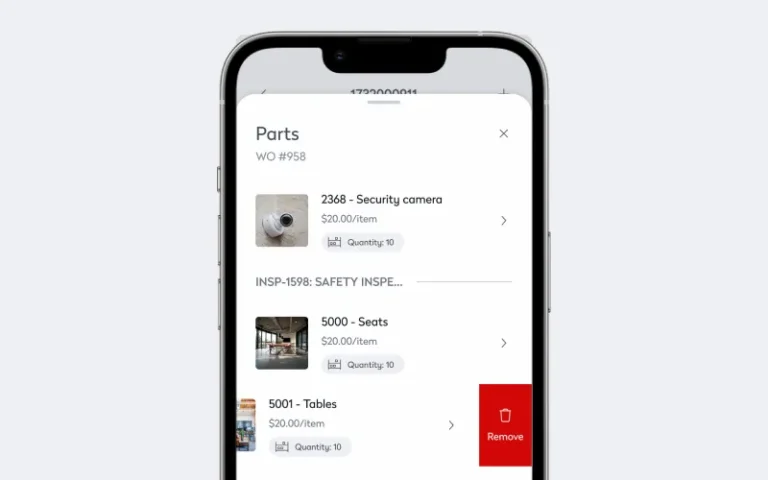
Real-time inventory visibility allows technicians to confirm part availability before arriving on-site, reducing repeat visits and improving repair efficiency.
Connected inventory systems help organizations:
- Track stock levels
- Reserve parts
- Monitor usage patterns
- Trigger replenishment workflows
- Reduce stockouts
- Minimize emergency purchasing
Real-time parts visibility is a key capability highlighted within Eptura’s maintenance and technician solutions because it helps keep work moving while reducing unnecessary downtime.
Over time, inventory data also provides insight into reliability trends, recurring failures, and long-term maintenance planning requirements.
Automation reduces administrative burden
Maintenance organizations generate enormous amounts of documentation.
Without automation, technicians and supervisors spend valuable time updating records, tracking inventory, documenting compliance activities, and communicating status updates.
Connected maintenance workflows automate many of these processes by:
- Routing work orders
- Recording labor
- Updating maintenance histories
- Adjusting inventory levels
- Triggering inspections
- Notifying stakeholders
- Generating compliance documentation
Reducing manual administrative work improves consistency while allowing maintenance teams to focus on higher-value activities that improve asset performance and operational outcomes.
Better maintenance data creates a stronger foundation for AI
Artificial intelligence is rapidly becoming part of maintenance strategy, but AI is not a maintenance strategy in itself.
Instead, AI acts as an amplifier of operational maturity.
Organizations with incomplete asset histories, disconnected systems, inconsistent work-order practices, and poor data quality often struggle to generate meaningful insights because AI depends on reliable operational information.
The Workplace Index identified integration challenges and fragmented technology environments as key obstacles to realizing the full value of AI. Organizations that successfully connect maintenance, workplace, and asset data are better positioned to leverage AI for planning, analysis, and decision support.
Structured maintenance data provides the foundation for:
- Predictive maintenance initiatives
- Resource planning
- Reliability analysis
- Asset performance forecasting
- Maintenance prioritization
As emphasized throughout Asset Champion, AI is most valuable when paired with accurate data, strong processes, and experienced human judgment. Asset management leaders continue to stress that technology delivers value only when supported by trusted operational information.
From maintenance data to executive decision-making
Executive teams rarely need more work-order reports.
What they need is visibility into business risk, operational performance, maintenance spending, and capital investment priorities.
Connected maintenance data helps leadership answer critical questions:
- Which assets create the greatest operational risk?
- Where is maintenance spending increasing?
- Which assets should be repaired versus replaced?
- What capital investments will have the greatest impact?
- How can asset life be extended while controlling costs?
When maintenance leaders combine asset history, labor costs, downtime events, parts consumption, and reliability trends, they gain a clearer understanding of total cost of ownership (TCO) across the portfolio.
This shifts maintenance from a cost center conversation to a strategic business discussion.
Instead of reacting to failures, organizations can forecast capital requirements, prioritize investments, reduce lifecycle costs, and maximize return on asset investments.
Eptura Asset positions centralized asset history, performance information, and lifecycle visibility as essential capabilities for making smarter repair-versus-replace and long-term planning decisions.
Mobile maintenance apps connect field work to enterprise strategy
The most effective mobile maintenance apps do far more than help technicians complete work orders.
They connect field activity with enterprise asset management, workplace operations, workforce planning, inventory management, compliance programs, capital planning, reliability initiatives, and executive decision-making through a shared operational data foundation.
Technicians gain the information needed to work efficiently. Maintenance leaders gain visibility into reliability, utilization, backlog performance, and asset health. Executives gain strategic insight into risk, investment planning, operational continuity, and long-term portfolio performance.
The 2025 Workplace Index describes a path toward becoming more connected, more informed, and more intelligent through integrated technology, data analytics, and AI. Mobile maintenance solutions play a vital role in that evolution by transforming everyday field work into organization-wide business intelligence.
When maintenance information flows across connected systems instead of remaining trapped in isolated applications, organizations are better positioned to extend asset lifecycles, improve uptime, reduce downtime, optimize maintenance spending, increase workforce productivity, strengthen workplace operations, and build the trusted data foundation required for future AI-powered decision-making.
Learn more about the Eptura technician app.
Frequently Asked Questions

By Jonathan Davis
As a content creator at Eptura, Jonathan Davis covers asset management, maintenance software, and SaaS solutions, delivering thought leadership with actionable insights across industries such as fleet, manufacturing, healthcare, and hospitality. Jonathan’s writing focuses on topics to help enterprises optimize their operations, including building lifecycle management, digital twins, BIM for facility management, and preventive and predictive maintenance strategies. With a master's degree in journalism and a diverse background that includes writing textbooks, editing video game dialogue, and teaching English as a foreign language, Jonathan brings a versatile perspective to his content creation.