



Legal organizations are navigating one of the most complex real estate environments in decades. Hybrid work, rising operational costs, and rapid digital transformation are reshaping how legal teams use space. What once felt like a stable, predictable footprint now feels increasingly out of sync with the realities of modern legal work.
Across the industry, firms are asking the same question: Is our current office footprint still the right fit?
For many, the answer is becoming clearer. Consolidation isn’t just a cost‑cutting tactic anymore — it’s a strategic response to shifting work patterns, client expectations, and operational pressures. And the firms making progress are the ones grounding their decisions in real data rather than assumptions.
Key takeaways
- Legal office footprints are drifting out of alignment with hybrid schedules and cyclical litigation demands
- Fragmented systems make it difficult to see the full picture, obscuring opportunities to consolidate or reallocate space
- Cost and compliance pressures are intensifying, pushing firms to right‑size their portfolios
- Data‑driven consolidation delivers measurable ROI, from reduced square footage to improved reporting and operational efficiency
Signal #1 — Volatile workspace utilization
Legal work is inherently cyclical. Trial preparation, confidential witness meetings, and intense collaboration periods create sudden spikes in space demand. Between these peaks, large portions of the office often sit idle.
We explore this challenge in Workspace Allocation for Litigation Teams: Cutting Costs Without Cutting Corners, which shows how litigation teams experience dramatic swings in space needs and why flexible, data‑driven workspace strategies are essential. The article highlights how traditional static allocations often leave firms paying for space they don’t consistently use.
This volatility creates two major risks:
- Idle space that drains budgets
- Inflexible layouts that can’t adapt to shifting case loads
Legal teams using Eptura Workplace are uncovering these patterns with precision. Occupancy analytics reveal when space is actually needed, while scenario planning tools help firms test consolidation options without disrupting critical work. Instead of guessing, leaders can see exactly how much space litigation teams require during peak periods — and how much sits unused the rest of the time.
Signal #2 — Fragmented systems and lack of data transparency
Many legal organizations still rely on disconnected spreadsheets, legacy systems, and manual processes to track occupancy, leases, and cost allocation. This fragmentation obscures the real story of how space is used — and what it costs.
Our article Stack Planning Under Constraints: Turning Complexity into Strategic Advantage illustrates how siloed systems make it nearly impossible to understand portfolio performance. When data lives in multiple places, leaders struggle to answer essential questions:
- Which locations are underperforming
- Where the firm is over‑allocated
- How lease obligations align with actual usage
This lack of transparency makes consolidation risky. Without a unified view, leaders can’t confidently model scenarios or quantify the impact of change.
Legal teams adopting a unified platform are replacing this fragmentation with a single source of truth. Space planning, occupancy data, lease details, and cost insights live in one ecosystem, giving real estate and operations leaders the clarity they need to make strategic decisions. This shift mirrors broader legal‑tech trends toward platform consolidation and integrated workflows.
This aligns with broader industry trends highlighted in Legal Tech in 2026: Consolidation, Platforms, and Trust, which describes how legal organizations are moving toward unified platforms to improve efficiency and transparency.

Signal #3 — Escalating cost and compliance pressures
While these pressures are especially acute in the legal sector, they’re not unique to it. Organizations across highly regulated industries are confronting the same combination of rising costs, tighter compliance expectations, and underutilized real estate. Looking at how peer industries have responded offers useful parallels for legal leaders evaluating their own portfolios.
Operational costs continue to rise, and legal organizations face increasing scrutiny from clients and regulators. Maintaining oversized or inefficient office footprints only amplifies these pressures.
Real‑world examples of organizations that have used data‑driven consolidation to reduce costs and improve compliance. Highlights include:
- A major financial institution saving $11 million by shedding underutilized space
- Bank of Montreal consolidating 1.3 million sq. ft. while improving operational efficiency
Legal teams are applying the same principles. With occupancy analytics and compliance‑ready reporting, they can right‑size their portfolios while maintaining the confidentiality, security, and operational rigor their work demands.
How Eptura supports legal office consolidation
Legal organizations are turning to Eptura because it provides the full ecosystem needed to evaluate, plan, and execute consolidation with confidence.
Eptura Workplace: Operational Space Management & Move Coordination
Space planning & management:
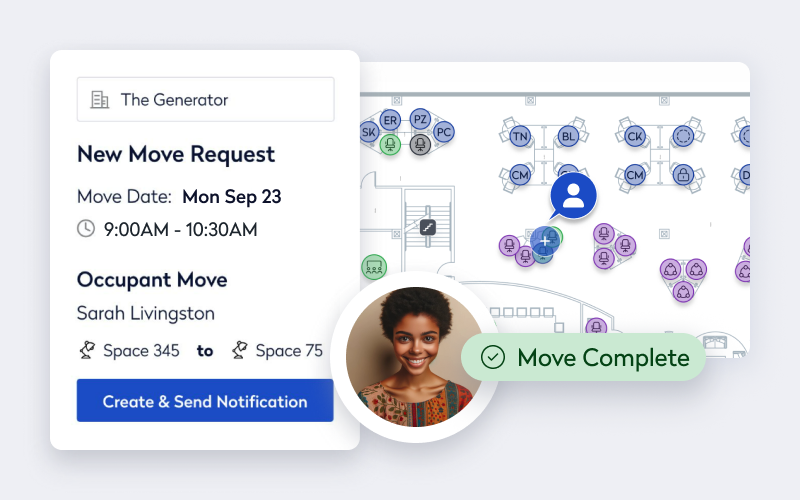
Eptura Workplace enables legal operations teams to visualize, update, and optimize floor plans and seating arrangements. The platform supports digital twins of office space, making it easy to map resources, assign employees, and instantly view layouts for each building.
Move coordination:
Streamline office moves and relocations with automated workflows. Legal organizations can create move plans, assign tickets, and coordinate the relocation of people and equipment, reducing manual effort and minimizing disruption.
Day-to-day occupancy insights:
Real-time occupancy data, integrated with third-party sensors, provides visibility into how spaces are used. Legal teams can track trends, adjust cleaning schedules, and ensure compliance with space utilization targets.
Eptura Engage: Employee Experience & Resource Booking
Intuitive booking tools:
Eptura Engage delivers a seamless experience for booking rooms, desks, and resources. Legal professionals can reserve confidential meeting spaces, coordinate team days, and access amenities with just a few clicks.
Efficiency in consolidated spaces:
Advanced features like AI-powered booking, automated check-in via badge swipe, and shift-based reservations ensure that every square foot is used efficiently. Employees can locate colleagues, view interactive floorplans, and receive workspace recommendations based on preferences and history.
Collaboration & reporting:
Eptura Engage integrates with Microsoft 365, enabling legal teams to plan workweeks, coordinate meetings, and analyze space utilization trends. Detailed dashboards and Power BI templates provide actionable insights for ongoing optimization.
A smarter path forward for legal real estate
The evidence is impossible to ignore. Volatile utilization, fragmented systems, and rising cost pressures are signaling that traditional legal office footprints no longer match the realities of modern work. Firms that act now—using data rather than intuition—will be the ones best positioned to support hybrid teams, meet client expectations, and control long‑term real estate spend.
We give legal leaders the clarity and confidence to move decisively. With unified analytics, scenario planning, and integrated workplace tools, you can evaluate your footprint, model the impact of consolidation, and execute change without disrupting critical work.
If your organization is ready to turn signals into strategy, explore Eptura’s resources or request a tailored demo to begin your consolidation journey.
Frequently asked questions

By Amanda Meade
Amanda Meade is a content creator at Eptura, specializing in workplace experience, meeting productivity, and emerging trends in workspace planning and visitor management. With a background in content marketing and SEO, she crafts clear, actionable content that helps teams work smarter through in-office collaboration. Throughout her career, Amanda has worked across industries, including home services, healthcare, real estate, and SaaS, developing a unique ability to distill complex topics into practical insights.